Grief and Mystery: The Unsolved Murder of Ann Harmeier, Part One
LP contributor Diane Walker, like many people who grew up in Cambridge City, Indiana, in the 1970s, still wonders at the unsolved murder of Ann Harmeier. So, she started searching. Walker’s years-long attempt to unearth answers includes scouring court records, newspapers, and other documents. She wr

Editor's note: This story contains descriptions of graphic violence and sexual assault. Reader discretion is advised.
My clearest memory of Ann Harmeier is of her singing at the Milton Elementary School, maybe 1974 or 1975, in an auditorium that would be named for her after her murder. The big kids of Lincoln High School in Cambridge City, where all of us little kids would go eventually, were performing — some pop tunes, a little Broadway.

Ann sang “Happiness” from the musical You’re a Good Man, Charlie Brown. She had a pixie haircut, but there was nothing pixie about her voice: resonant, controlled, powerful. Ann threw herself into her song, thrusting out her hand, holding an imaginary key as she sang: Happiness is … finding your skate key!
I thought this was a little corny, but even at 10 years old, I knew Ann Harmeier was going to be somebody. Already was somebody. As she sang the final words of the song — Happiness is … anything at all, that’s loved by you! — Ann whirled around euphorically, injecting real joy into her performance.
Ann’s mother, Marjorie Harmeier, had taught music in Cambridge City and the surrounding schools for 26 years, so everyone in the school district knew Ann and her mother. Mrs. Harmeier was exacting with her students, but warmth crept through her instruction. She was wonderful to me, working what must have been hours of unpaid overtime to help prepare my solo for an Easter performance. I wasn’t as gifted as Ann, but that solo gave me much-needed confidence, as Mrs. Harmeier must have known.
Ann and Mrs. Harmeier had lost their father and husband, Robert, to a brain tumor when Ann was four, so Ann was the town’s daughter. It wasn’t just sympathy for her. It was pride in Ann herself. She was charismatic and well-liked and always doing things: winning honors at state music competitions, in a trio with two friends she’d sung with since childhood. Making National Honor Society. Being voted queen at Cambridge City’s fall festival. Starring as a confident and compelling Nellie Forbush in the high school musical South Pacific.
As her parents did before her, Ann went to Indiana University–Bloomington, where she majored in theater. By fall 1977, her biggest role had been in a small student production — and that was okay. IU was the big time compared with Cambridge City, a town of 2,400 people about 60 miles east of Indianapolis, and we knew she’d have to work hard to rise, but she’d get it done. We hoped she’d become famous someday, because we wanted to say we knew her when. We could also picture her following in her mother’s footsteps, teaching music to kids during a lengthy career and having people love her for doing so. It would be a good life either way.

Ann and her mother were close, the be-all and end-all for each other. Ann would leave notes under her mom’s pillow, thanking her for a good weekend at home, saying how much she loved her. She did it the morning of Monday, September 12, 1977, before beginning the two-hour drive from Cambridge City to Bloomington.
Ann had promised to call to check on the results of medical tests for Rev. Rose Taul, the young Presbyterian minister who was a close friend of the Harmeiers. When Ann didn’t call, both Mrs. Harmeier and Rev. Taul knew something was wrong. At around 11 p.m., the two women set out to retrace Ann’s route and made a chilling discovery: Ann’s 1971 Pontiac LeMans, battery dead, on the side of State Road 37, two miles north of Martinsville. Officials at the Morgan County Sheriff’s Office would later tell them that Ann had placed her hazard lights on, locked her doors, and taken her purse. Nobody had seen her leave the car. This was the first of 35 days of looking for Ann.
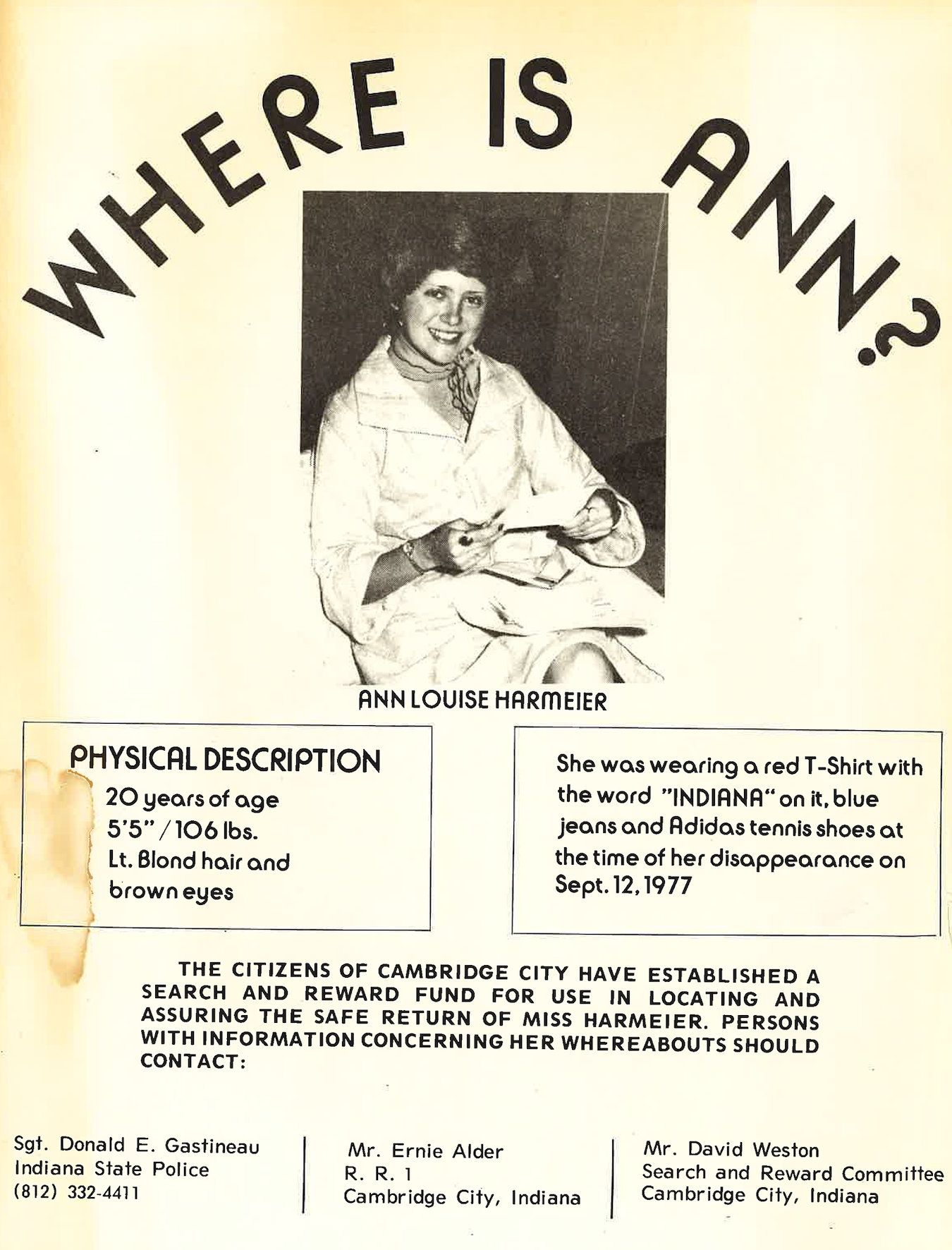
The town loved the Harmeiers so much that it was impossible for people to do nothing while Ann was missing. According to our hometown newspaper, The National Road Traveler, $14,000 (about $70,000 today) was donated to a reward fund for information. A search committee of Mrs. Harmeier’s friends and colleagues distributed 20,000 posters, to Indiana college campuses, highway rest stops, and any other place that allowed them. Long-haul truckers carried and posted flyers across the country.
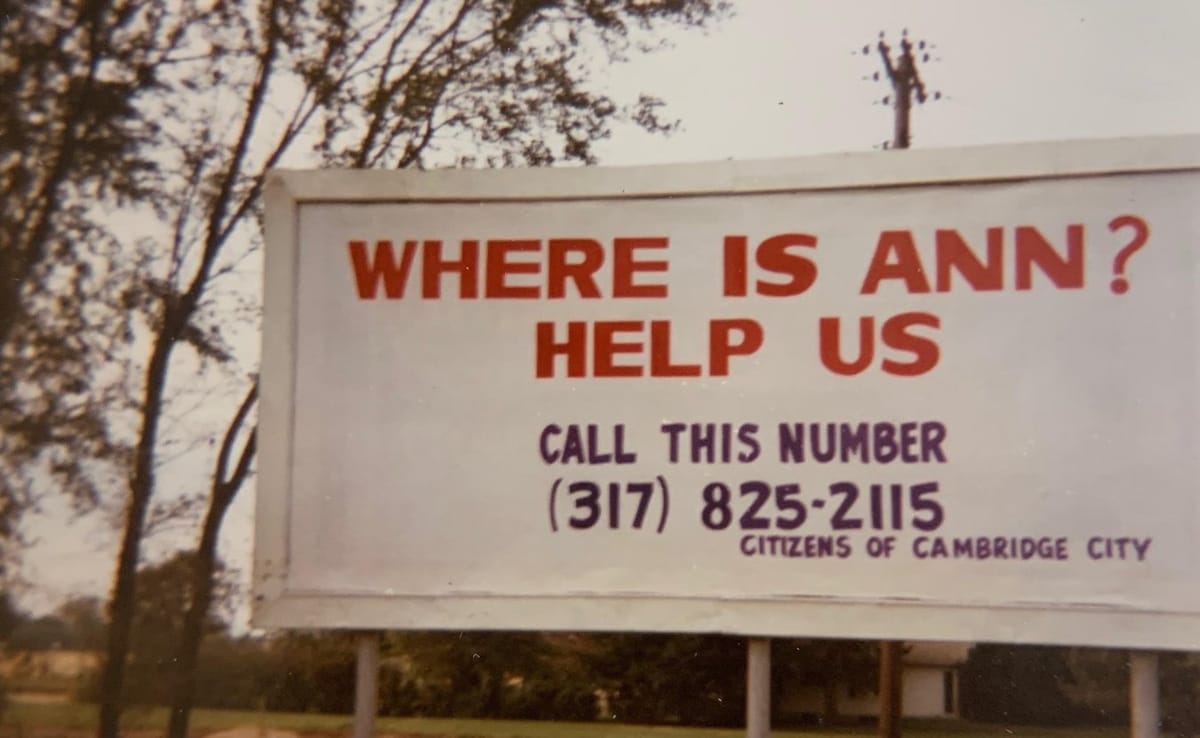
Five thousand bumper stickers with the search committee’s phone number were given away, each asking “Where is Ann?” Churches took up collections and held prayer days. A Cub Scout troop released balloons with messages inside, hoping whoever found one would call with information about Ann’s whereabouts. Hundreds of volunteers searched the Morgan-Monroe State Forest. When a psychic in Kentucky predicted Ann’s body would be found in McCormick’s Creek State Park, searchers combed that park and pursued a tip about wooded areas in Orange County.
The town’s efforts went a pre-internet version of viral. The Associated Press wrote a story about Ann’s disappearance that was published in newspapers throughout the Midwest, Maine, Oregon, and Florida and in Canada. The search for Ann was featured in People magazine and on the NBC Nightly News.
A gas station owner said he saw a woman with a group of other young people — she had short, light hair and a red IU T-shirt and jeans like Ann had been wearing. Someone floated an unfounded theory that Ann had been kidnapped by the Unification Church or was being held by a cult. No one thought she disappeared intentionally. She wouldn’t do that to her mother.
In early October, Mrs. Harmeier went to clear out Ann’s apartment in Bloomington. A photo in the The National Road Traveler showed her in profile, with Rev. Taul behind her, wearily surveying the empty living space. It seemed cruel to photograph her then, but I suppose she thought it might help. On that same day, IU campus police were supervising a group of Sierra Club volunteers who were searching for Ann’s body in the densely wooded area near where her car was found.
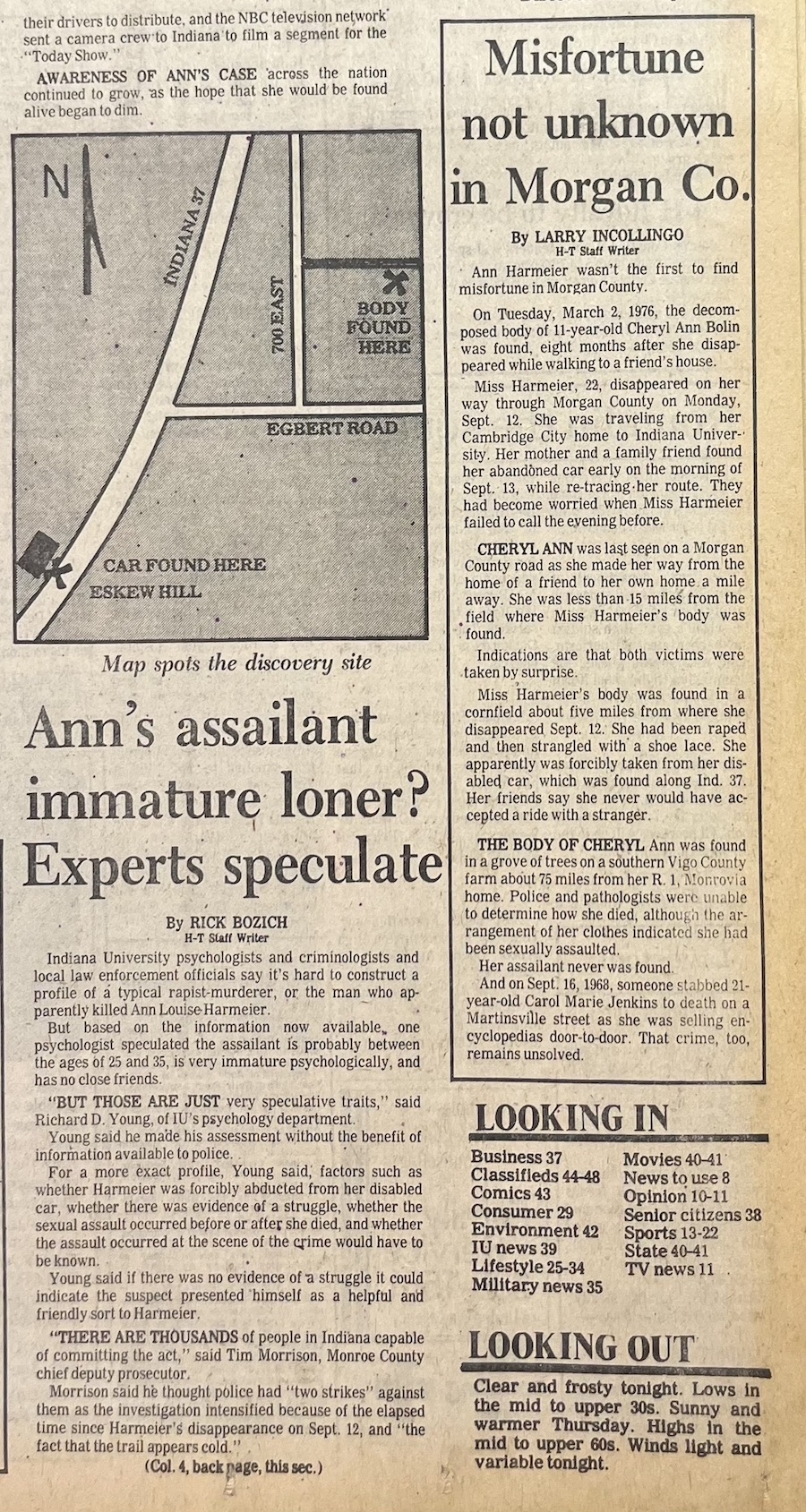
On October 18, not far from Egbert Road in Morgan County, a farmer harvesting corn saw some blue and red rags in his field. He discovered Ann’s body. The coroner determined she’d been killed the same day she’d gone missing, her body identifiable only through dental records. Horrible details from the coroner’s report were published in the October 20 Bloomington Herald-Telephone. Ann had been gagged, her hands tied behind her back with a shoelace from her sneakers. The other shoelace was around her neck, tightened in tourniquet fashion with her hairbrush. Police presumed she’d been raped because her jeans and underwear were around her ankles, her torn bra and T-shirt bunched around her neck.
I remember where I was when I heard the news. An 8th-grade football game was scheduled that night, so band music could be heard from outside and the hallway was full of students and cheerleaders with pompoms. I was at my locker and overheard one kid tell the cheerleaders that a report on the radio said a body had been found; Ann’s childhood dentist had provided her records, and they matched. “Oh,” said one of the cheerleaders softly. “Poor Mrs. Harmeier.”

As someone else said Mrs. Harmeier was under sedation, I looked at the books in my locker and thought: “It can’t be her. How can looking at teeth tell anybody anything?” But I knew as well as anybody. We all had known from the beginning. Young girls weren’t safe if they were alone. I knew I wasn’t safe at 13, and that I wouldn’t be as I grew older. Adults talked of women going missing all the time, and their bodies found like this. In a ditch. In a forest. In a cornfield.
My mother had almost died that spring in a car accident, and we were mourning her mother’s death a month before Ann’s disappearance. It seemed viciously unfair that Mrs. Harmeier, someone I loved and respected, could lose her own daughter in such a horrible way. That her happy, talented child could be yanked from life by some evil man who took and used her just because he could.
I’ve since wondered what Mrs. Harmeier thought about after she came out of sedation, or when she lay down to sleep during the few years that followed. I wondered if, when she woke in the morning, perhaps after dreaming of Ann in life, her first thought was: Ann is gone.
Ann’s murder has never been solved. I don’t think any of us who knew Ann or Mrs. Harmeier has ever found a way to dispel the shock or grief of it. Ann had turned 20 years old a couple of weeks before she died. Her murder, and her mother’s subsequent early death from cancer, left abiding wounds in those who loved Ann.
Closure isn’t possible for something like this. But finding who did this to Ann would honor her existence, a short but wonderful life filled with love and purpose. If the killer is still breathing, he has to answer why Ann isn’t.
No one saw her disappear
At her mother’s suggestion that it would be safer, Ann opted not to leave home on Sunday night, when it would have gotten dark before she reached Bloomington. She had a used car, purchased from one of her mother’s colleagues, and it began overheating halfway to Bloomington. Witnesses later said Ann had stopped in Indianapolis and bought a radiator cap at a gas station. She stopped again in Waverly, a small town not far from Indianapolis, that at that time was just off S.R. 37. A bystander filled her radiator with water. A mechanic offered to fix her car, but Ann wanted to make her 10:30 a.m. class, so she chanced it and continued driving to Bloomington.
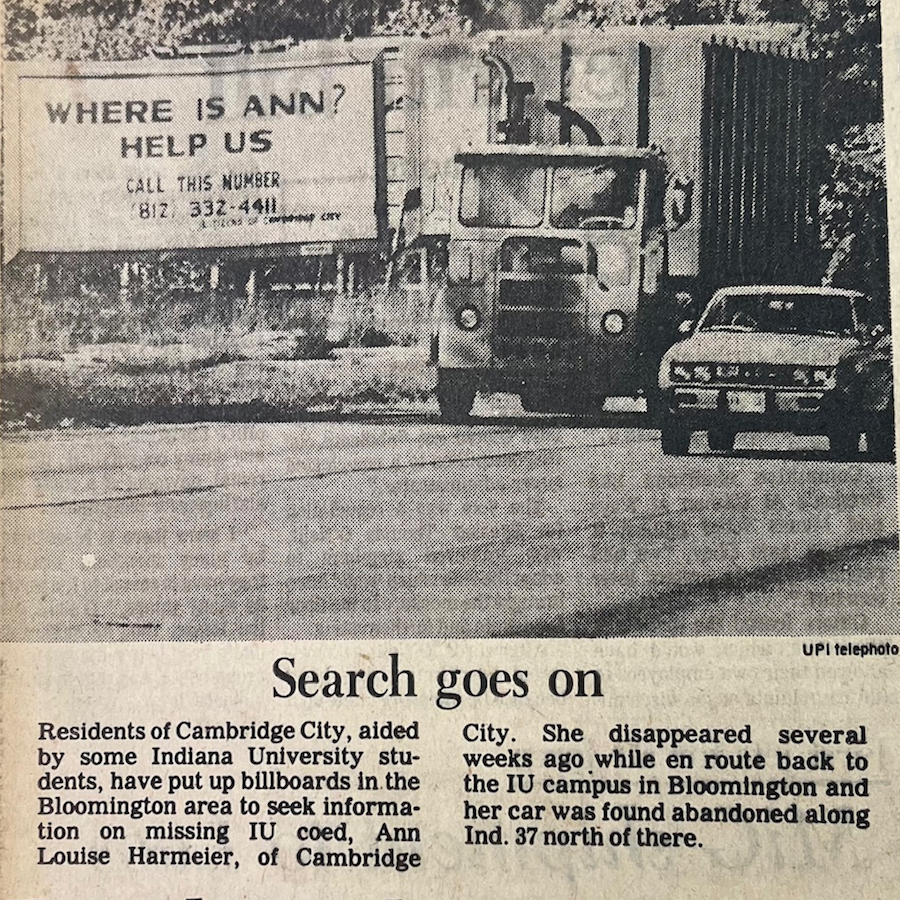
About ten miles south of Waverly, the car may have overheated again — it’s not clear whether it was the radiator or the thermostat — so Ann pulled over on the west shoulder of S.R. 37. According to the Richmond Palladium Item, in a story published three days after her disappearance, a Greyhound bus driver had seen Ann in front of the car with its hood up at around 10:30 a.m.
In a time before cell phones, Ann was on her own. She wasn’t far from Martinsville, but she likely had little idea of the distance or whether she could walk there. In 1977, there were fewer buildings alongside S.R. 37, and no mile markers.
After her disappearance, Indiana State Police (ISP) officers used her car to recreate the scene twice, stopping and questioning almost 1,000 motorists. Six people said they’d seen her and the car, according to the Traveler. Three said they’d stopped and offered to help.
IU psychology professor James Allison had a daughter who was a year younger than Ann, and Ann’s murder hit him hard. After his retirement in the 1990s, Allison conducted an extensive investigation for a book he was writing about Ann’s murder. One of the questions he sought to answer was why police didn’t see Ann or her car in the 15 hours between 10:30 a.m. Monday and 3:30 a.m. Tuesday, when her mother and Rev. Taul found it.
The likely reason? Shortage of personnel. Allison wrote that ISP was stretched thin in 1977 and didn’t have defined routes, so state troopers patrolled roads at their discretion. Allison talked to a trooper who was monitoring traffic at S.R. 37 and Egbert Road with his partner that morning, not far from where Ann’s body would be found.
The troopers’ shift ended at 10 a.m., and they drove north home, not seeing Ann or her car, which was south of where they traveled. According to a UPI story published October 19, 1977, whoever killed Ann left her body four-and-a-half miles northeast of her car, 200 yards from a county road accessible only by Egbert Road. Since no one saw her walking, her abductor must have used a car. Whoever carried Ann to her death might have missed, by minutes, the state troopers watching that intersection of Egbert Road and S.R. 37.
‘A position of opportunity’
ISP had seven to nine troopers searching for Ann while she was missing, but leads were scant. They and the Morgan County Sheriff’s Office were investigating and clearing scores of men who had sex-related convictions or records of violence. According to Senior Judge Thomas Gray, who was then Morgan County Prosecutor and one of the first called to the scene of the crime, checking past offenders is the first step. But by November 25, the Bloomington Herald-Telephone was quoting ISP Lieutenant Merle McKinney that there was “nothing good right now” in the way of leads.
In March 1978, law enforcement thought they had a break. They found a witness who’d seen a “compact” foreign car on Egbert Road near where Ann was killed. The witness described the driver of the car as a man in his twenties, medium height and weight, and clean-shaven. Newspapers quoted Gray describing the driver as “blond” or with “sandy light brown hair falling to the collar and back.”
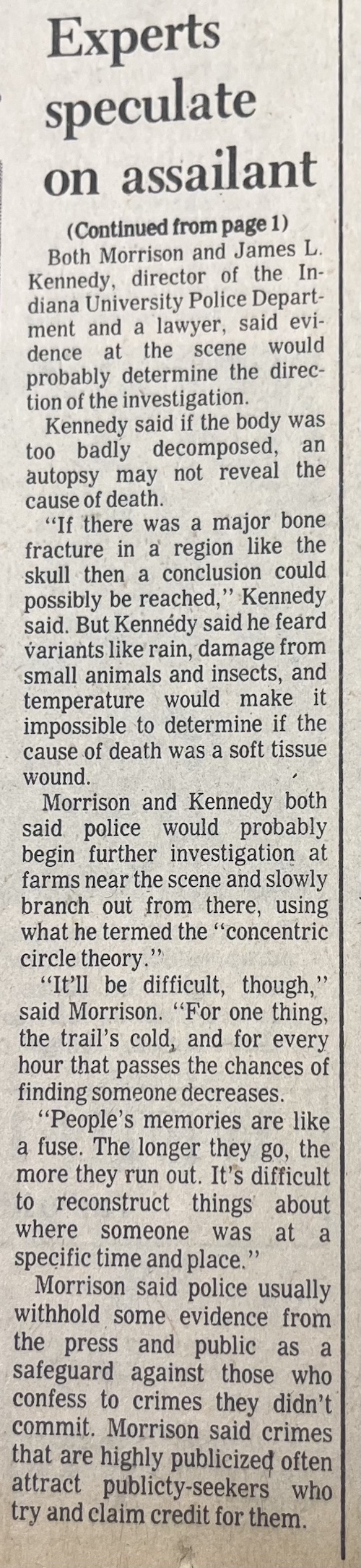
The witness helped police develop a sketch of the man, which was released to police departments throughout the state. For reasons no one remembers now, police never released the sketch to the public as planned. Law enforcement back then told the media that the man in the sketch wasn’t a suspect. But by the 1990s, when Detective Maurice “Bud” Allcron was investigating the case and spoke with Allison for his book, the blond or sandy-haired man in the sketch was considered a suspect.
One of the enduring mysteries of Ann’s case is why she got in a car with the man or men who murdered her. Lynne Foster Shifriss, who knew Ann from acting projects at IU, said Ann was the “last person who would ever just get in somebody’s car.” During theater projects, Shifriss and Ann would go out for food. “I remember noticing how careful Ann was, locking her car before running up the steps to get the pizza,” wrote Shifriss in an email to me. “That was a time when many people, including me, didn’t even lock the doors at home.”
Because the location where Ann’s body was found was so remote, many wondered whether Ann’s killer was local. Gray, however, doesn’t believe the killer needed to know the area.
Gray told me that when he and his investigator were called to the scene after Ann’s body was found, they had a very difficult time finding it. He said the cornfield could’ve been chosen randomly by the killer.
“It would have been a position of opportunity,” Gray said. “You just go down a country road. You see a blank road that has no houses on it. You turn down it.”
A baby-faced man
The witness who saw the blond man driving a compact car on Egbert Road was the only lead, and state police made the most of it. Hypnosis for enhancing memories had gained traction by the 1970s, and “we had nothing better to do,” according to Gray.
Under hypnosis by a state police expert, the witness said the foreign car was a dark blue Volkswagen Beetle, or “Bug,” as they were commonly called. According to a Martinsville Reporter-Times article on September 17, 2007, the hypnotized witness saw a blond man with bangs beating a woman inside a car. It’s not clear in the article whether the car was the same VW Bug also described by the witness.
The hypnosis took place at the house of then-Morgan County Sheriff Paul Mason, with both Mason and Gray, who was the Morgan County Prosecutor, watching. But neither remembers which details about the man and the car were given by the witness in his original interview and which were produced under hypnosis.
When Detective Allcron showed Allison the never-released sketch done with the help of the witness, Allison described the blond man as “baby-faced.”
Old newspaper articles and Allison’s manuscript, which includes interviews from 1993 and 1994 with the detectives closest to the case, were my best sources for details. Most officials who investigated Ann’s death, such as Lieutenant Merle McKinney and ISP Officer Jim Bradley, are dead. Bud Allcron was still alive when I started writing, but when I called him, the woman answering said he had dementia and wouldn’t remember what I was asking about. He has since died.
Ann’s second cousin, Scott Burnham, has been leading the way in keeping the case in the public’s mind: writing an editorial in the Chicago Tribune, starting a social media campaign, and working with reporters on new articles. But even as the closest surviving family member, he hasn’t been able to access the records on Ann’s case.
In 2018, Burnham filed a public records request with the Indiana State Police for the investigative file on Ann’s murder. ISP denied the request, saying that Ann’s case was still open. Burnham filed a complaint with the Indiana Office of Public Access that ISP’s denial violated the state’s Access to Public Records Act. The public access counselor ruled against Burnham in 2019.
Burnham has kept up his fight, interviewing people from Martinsville and Cambridge City in the hope that someone remembers something. But, as Gray, Sheriff Mason, and surviving ISP detectives Gene Gastineau and Jerry Conner have all pointed out, memories blur in 45 years, and even the most dogged surviving investigators can’t remember some details of the case. Without records and with imperfect memories, Allison’s book contains the best-available description of whom detectives like Allcron and McKinney considered suspects.
For example, as reported in the Herald-Times in 2019, Allcron said Jeffrey Hand was “always in the mix, but at the same time, there wasn’t anything specific to tie him to the crime. I’d say we probably had 10 or 12 people that were maybe suspects that we had to eliminate or decide they might have been involved.”
I talked to Jeffrey Hand’s former attorney, Nile Stanton. Hand had been found not guilty of the murder of a hitchhiker by reason of insanity. Hand was then committed to a psychiatric facility. But the prosecution filed the paperwork incorrectly, so Stanton got Hand freed from the facility on this technicality in 1976.
Hand didn’t have an alibi for September 1977. According to Stanton, Hand wasn’t doing anything much after his release from the mental facility.
As with Allcron, I couldn’t find anything to connect Hand with Ann’s murder, either. And I focused on more likely suspects.
In October 2022, I spoke with Mason, who died three months later. He didn’t remember or couldn’t say who the witness was who’d helped police create a sketch of the Egbert Road driver in 1977. But he thought there was a good chance the witness is still alive, having been a young man back then.
Police had to use hypnosis at the time to jog this witness’s memory. Would the witness, if still alive, recognize a photo of the man he saw so long ago? It seems unlikely after all this time, but it’s a tantalizing possibility.
A natural suspect
Ann’s cousin Scott Burnham said that Mrs. Harmeier died believing that Steven Judy had killed her daughter. Judy was executed by electric chair in 1981 for four Morgan County murders that had striking similarities to Ann’s murder. In 1979, he had raped and strangled Terry Lee Chasteen using a tourniquet, after persuading her to accept a ride from him as a Good Samaritan. Chasteen’s children were with her at the time, so Judy killed five-year-old Misty, four-year-old Stephen, and two-year-old Mark to cover his tracks.
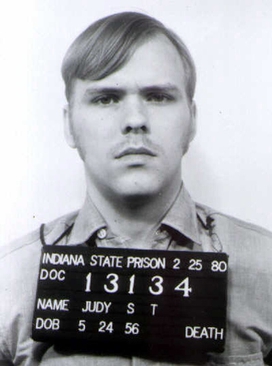
Judy had blond hair with side-swept bangs — a clean-cut look by 1970s standards, as the witness in Ann’s case had described the man on Egbert Road in 1977. “He looked like Jay North,” says Gray, who prosecuted Judy for kidnapping and capital murder. “That kid from Dennis the Menace, the old TV show.”
Judy may have looked innocent, but he’d been convicted of rape and attempted murder when he was only 13. The survivor of a horrific childhood, Judy pleaded the insanity defense at his trial. Because the issue was not whether he’d murdered the Chasteen family but whether he was insane when he did it, Judy testified in detail about what he’d done to Terry and her children.
According to Bette Nunn of the Martinsville Reporter, who attended the trial and later wrote a book titled Burn, Judy, Burn, Judy had gone out driving aimlessly on the morning of the murders. At Interstate 465 and Interstate 70 in Indianapolis, he spotted Terry driving and gestured that her car had problems. After she pulled over, and under the pretext of fixing her tire, Judy disabled her car. He offered Terry and her kids a ride, then took them to White Lick Creek in Morgan County, where he raped and strangled Terry.
When the children heard their mother scream, they ran toward her and witnessed Judy raping her. Judy said he drowned all three kids in the creek.
Several people saw Judy leave the scene in his foster father’s white truck, and he was arrested the next day. During his sentencing, according to Nunn’s book, he addressed the jury:
“I’m telling each one of you now, you’d better vote for the death penalty for me, because I will get out, one way or another, and it may be one of you next, or one of your family.” Judy then looked at the presiding official in the courtroom. “That goes for you too, Judge.”
At his trial, Judy estimated he’d raped between twelve and fifteen women. He later confessed to his foster mother that he had killed several women in Louisiana, Oklahoma, and Texas, as well as a woman in Indianapolis.
Judy was therefore a natural suspect in Ann’s case, and Mrs. Harmeier might have been told or concluded on her own that Judy killed her. Mrs. Harmeier was diagnosed with breast cancer less than a year after Ann’s death. She underwent treatment, but her cancer came out of remission in late 1982. She died on March 15, 1983. Her death certificate says she died of “inanition” — malnourishment from not eating during the last week of her life.
An alibi, and a cruel game
Judy had an alibi for Ann’s murder: He was in the Marion County jail that day for the kidnapping and armed robbery of a young woman in Indianapolis. His alibi has since been questioned by ISP detective Gastineau, among others, who said that a jail employee told him that Judy was on work release in September 1977 but was sick the day Ann disappeared, so he stayed in his cell. Gastineau, who has been both a state trooper and a county sheriff, says inmates want out of jail for any reason. He believes that even if Judy were sick, he’d have gone to his job that day.
Jail records no longer exist for that period. Gray noted that this isn’t unusual. Paper records are cumbersome and may not be needed as time passes, so there’s little point in keeping them.
The court records, however, were kept, and they show Judy was in jail during the time that Ann was killed.
According to the Indianapolis Star, Judy was arrested on April 21, 1977, for kidnapping the Indianapolis woman at knifepoint, and bail was set at $80,000 — about $433,000 in 2025 dollars. This amount indicates that Judy was considered extremely dangerous by the judge and a flight risk, not the type of criminal who’d be allowed to participate in a work-release program, had one existed.
Hugh Baker, an attorney who served as Judy’s public defender in the Indianapolis kidnapping trial, said, “That [Judy] was always in jail is my recollection. There wasn’t any work-release pretrial at the time, to my knowledge.” Gray agreed that there was no such program at the time, and said that Merle McKinney, who by then was working as an investigator for the Morgan County Prosecutor’s Office, checked jail records personally after the Chasteen case to ensure Judy was locked up when Ann was killed.
Judy’s trial for the Indianapolis kidnapping and armed robbery resulted in a mistrial. The prosecutor offered a deal in which Judy pleaded guilty to a minor charge of theft. Steven Harris, Judy’s attorney for the Chasteen case, shared with me the court documents for Judy’s Indianapolis case.
The sentencing order from March 1978 gave Judy credit for the 336 days he’d been incarcerated since his arrest in April of the previous year. The records also show that he was to be turned over to Illinois authorities after completing his Indiana sentence, because he’d violated parole there by committing an offense less than a month after being released from the state penitentiary. (Judy served 20 months for the aggravated assault and battery of a 17-year-old girl he accosted in a parking lot.) But instead of serving time for the parole violation, he murdered Terry Chasteen and her children.
Steven Judy’s uncontrollable violence and the timing of his relatively light sentences make him worthy of scrutiny in the Ann Harmeier case. But even though his victims were terribly unfortunate to cross his path, Ann was likely not one of them — he was in jail when she vanished.
As his execution for the Chasteen murders neared, Judy told Harris that he would leave written details about other murders he’d committed. “He did give me an envelope, and I waited until after the execution, and I opened it,” said Harris. “It said, ‘Sorry, Steve, I can’t do this. I think too much of my foster parents. Thanks for everything you’ve done.’”
Why would Judy do this when he’d confessed to his foster mother about other murders and it probably upset her? “[Judy] liked to play games. He liked to be witty and be in charge of things,” said Harris. “Maybe it was his way of not cooperating with the police one last time.
“But I think they’re barking up the wrong tree if they think he did it,” Harris said of the possibility Judy was Ann’s killer. Editor's note: In Part Two, Diane Walker talks about visiting another suspect who is serving life in a Kentucky prison for other crimes.