Monroe County Civic Theater Serves As a Space for Exploring Work, Play, and Autonomy
Monroe County Civic Theater’s next production is Lewis Carroll’s Alice in Wonderland, premiering in September. MCCT board member Zilia Balkansky-Sellés, Ph.D., reflects on how theater fits into, and informs, many community members’ lives. From school to therapy to social circles, theater is a vessel
by Zilia Balkansky-Sellés, Ph.D.
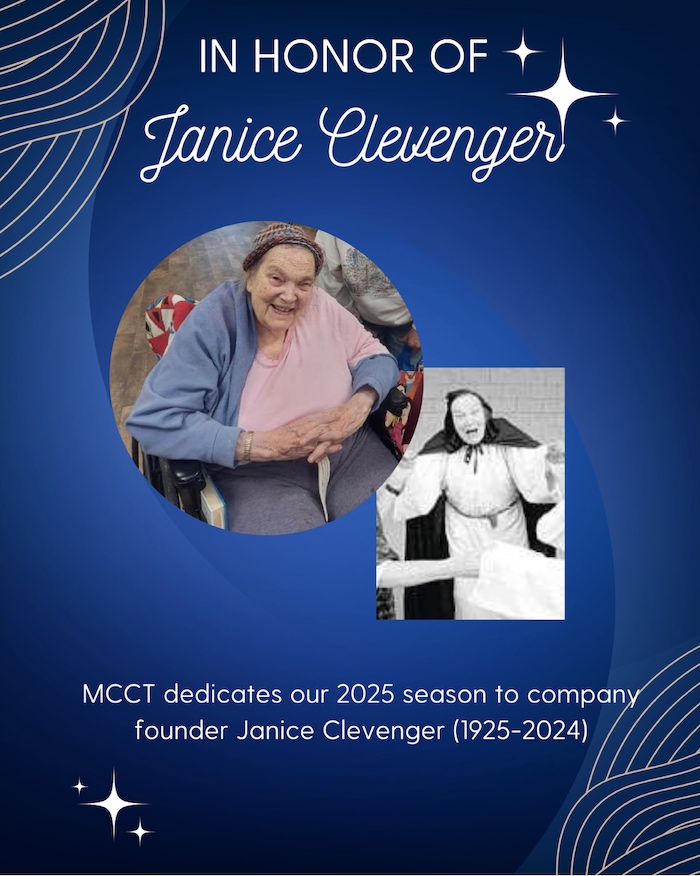
Monroe County Civic Theater (MCCT) is an “all volunteer” nonprofit community theater group based in Bloomington, Indiana, that was founded in 1986 by Janice Clevenger, among others. Since its founding, MCCT has committed to an inclusive theater-making experience for anyone who wants to participate. Auditions do take place for full-length shows, including an annual Shakespeare in the Park offering in late spring/early summer each year, but anyone who wants to take part often gets a chance to be included in some capacity. I’ve been participating for about seventeen years, since 2008, including during the time I was finishing a doctoral program in folklore studies at Indiana University. I have been on the MCCT Board of Directors for the past year and am continuing into my second year on the Board. MCCT collectively strives to create viable, entertaining, meaningful art through this collaborative art form that requires an often high degree of commitment and focus from its participants.
The “amateur” designation of MCCT belies the extensive training and experience that many of the regular participants have. As a play-making community (using the word play in two senses), the frame of the theater experience, within a community and amateur framework, provides opportunities for people of all ages to play together in ways that provide structure, but also provide scope to break out of routine and daily expressions of self, including stratifications and separations common in society at large. Embodying a Shakespearean character provides a space to break out of routine expressions and how people may think of themselves. To what extent any participant in MCCT productions takes advantage of the many opportunities inherent in theater-making depends entirely on the individual and a layered set of frameworks or intertwining and nested relationships, which I sometimes think of as a set of Russian dolls.
Since MCCT actors are not paid for their work and time, and since all of the work is voluntary, and since ticket prices for most shows are either low or non-existent, with modest fundraising and membership dues providing needed materials and the rental price of performance spaces, we afford a certain flexibility and freedom in the kinds of plays and revues that it produces and supports. This freedom from commercial imperatives also provides a freedom in casting choices and provides the opportunity for individuals to experiment, fail, and try again. Spaces for this kind of exploration are increasingly rare in academic, sports, and commercial enterprises.
Still, productions require some investment in time, money, materials, and adequate spaces in which to perform. The MCCT Board guides the behind-the-scenes fundraising and provides another opportunity for people to play together outside of their personal and professional lives, and beyond the performance and rehearsal spaces of the plays. Every Board member and participant has a day job, and/or is a student, and/or is retired or semi-retired. That being said, the current Board of nine individuals is nicely diversified with five of the Board members being in their mid-thirties or younger, and the others above fifty. Four of the current younger members hold the four officer positions (president, vice president, secretary, and treasurer). All have some background and training in theater, including one (Devin), currently the Board secretary, with a Bachelor’s degree in theater who is making theater the center of his life. The current treasurer (Hannah) has a Ph.D. in Biochemistry, along with an undergraduate minor in technical theater, and works locally for an international pharmaceutical company, while engaging in local theater productions, both with MCCT and other organizations. Past members of the Board, including one who had trained with the Royal Shakespeare Company in England, continue to support and participate in productions to different degrees and in different ways.
The financial freedoms or restrictions, depending on what is under discussion, also, to some extent, constrain the choice to works that are in the public domain — not a problem for a group strongly focused on performing and celebrating the works of Shakespeare. Even so, over the past few years, MCCT has taken on at least one production each year for which royalties and licensing have to be paid and which are under some kind of commercial restriction. Such considerations primarily play into the experiences of participants in the kinds of shows they have the opportunity to engage with. While many productions are offered without a ticket price, for some shows an entry fee is charged. For those who cannot afford the modest entry fee, there are volunteer opportunities by which one can work for the chance to see the show. For some shows, most notably the annual Shakespeare in the Park offering, collections are taken up during intermission and after the conclusion of the performance. In June 2024, the annual Shakespeare in the Park production, The Comedy of Errors, brought in the most revenue for the year of any show, entirely made up of donations tossed into collection bags carried by volunteers into the audience.
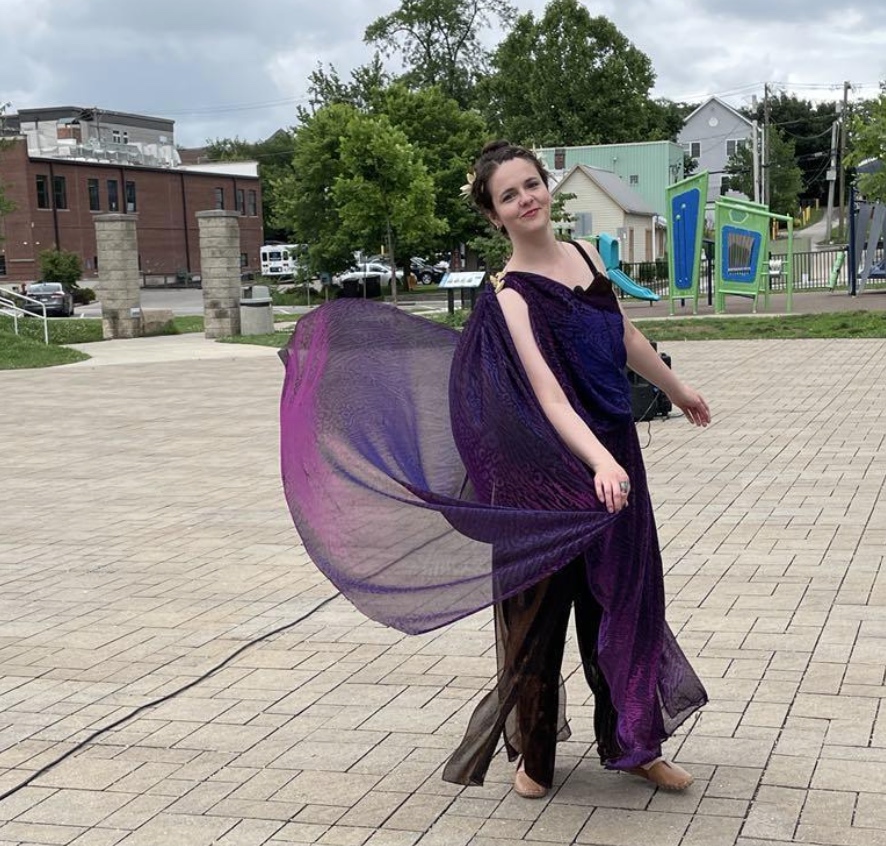
As I have participated over the past seventeen years, primarily as an actor, but occasionally as a musician, singer, and songwriter, I have been impressed by the way that this porous, free-flowing, volunteer theater group manages to persist, over decades, in the midst of increasing fundraising competition among small non-profit groups, not only theater groups, in the small, midwestern college town of Bloomington, Indiana. Bloomington, the site of the flagship campus of Indiana University, includes a top-tier music school, the Jacobs School of Music, as well as a prominent musical theater program in the Department of Theatre, Drama, and Contemporary Dance. With a plethora of performance opportunities both at the university and beyond the university campus, including a number of small theater companies, as well as the two main high schools, both of which have a strong tradition of musical and theatrical productions, MCCT continues to hold a unique space in a theatrically competitive ecosystem, as well as within a financially competitive environment.
A good example of the long-term ripples from the flexible casting and open opportunities for participation is Devin, currently serving as Secretary of the MCCT Board. I first acted with Devin in a summer production of Shakespeare’s A Midsummer Night’s Dream, when he, in his early teens, played Puck. Now in his late twenties, he has completed a Bachelor’s degree in theater from Indiana University, has taken professional theater jobs in other states, as an actor, director, and theater educator, and, during the times he is based in Bloomington, Indiana, continues to audition for professional roles, in which he is regularly cast. He has also started a youth theater group this year (2025) along with another former participant in MCCT, Callie, who is now completing her doctorate in education. What has impressed me during my time working with these two artists, both Devin and Callie, is that they keep coming back to MCCT to take part in shows, whether as actors, directors, or choreographers, while they continue to develop a professional identity, body of work, and presence in the theater (writ small and large), and while they develop new projects to nurture oncoming generations into the vitality and potentialities of a life of theater-making or a casual season of theater-making.
These first encounters and engagement with theater-making do not just take place for children and young adults. In the case of another participant, Denise, she discovered community theater, and theater in general, when as a young mother approaching thirty she took her son to an audition in another Indiana town (not Bloomington). Her son got a part in the play, and she, almost thirty at the time, was recruited to play a teenage role. She told me that, up until that time, she would experience tremendous anxiety in front of others, to the extent of not being able to speak even in intimate social situations. That first theater experience changed her life. Playing in the context of local theater continued to provide opportunities for her to grow and develop her own expectations, education, and talents. Before that first local theater encounter, she had not gone to college nor even considered going to college. This particular door opened the way for her to apply and go to university. It took her almost twenty years to complete that undergraduate degree, but she did it. She completed an undergraduate degree, but missed the theater degree by one class, although she fulfilled all of the other requirements, all while working a full-time job, raising her family, and taking care of ill relatives. She told me all of this over brunch in a Bloomington restaurant as she praised how community theater and MCCT had changed the course of her life for the better. Even now, working for Indiana University in human resources, she told me that her job engages much of her theatrical training and experience.
Denise was my first real contact with MCCT. During the time I was working on a doctorate in folklore studies at Indiana University, I took several acting and voice classes and auditioned for and was cast in shows being directed by MFA directing students. At the time, someone mentioned to me that there were more acting opportunities through MCCT. Denise was the first director for whom I auditioned for an MCCT production, in this case for Shakespeare’s The Life of Henry VIII, or Henry VIII. She cast me as Henry VIII’s first wife, Katherine of Aragon. That first experience and all that surrounded it led to my ongoing engagement with MCCT for the past several years. As life challenges and upheavals took place, I continued to be involved with theater, primarily through MCCT. I kept returning to the solace of theater, the comfort of MCCT, and the reliability of Shakespeare as a haven of beauty, structure, and dependability. Denise was my welcome person to all of that.
The framing of the idea of community theater as a space for play, whether or not the participants are aware of it as such, allows a freedom that is not as easily experienced in professional productions and in the hyper-competitive scene of, for example, the nationally ranked music school at Indiana University and the range of theater groups in Bloomington, Indiana. There is a lot of talent and a strong cohort of hopeful theater creatives in Bloomington. A number of the participants in MCCT productions have aspirations for a life of theater-making or have embarked on a life of theater-making or are returning to a long-time love of theater making. Dan, who recently served as the Treasurer for the MCCT Board and continues now as a Board member at large, told me the following before the start of a Board meeting on May 10, 2025:
I got a second life in the theater. I was involved heavily in theater in Chicago, with acting, producing, stage combat, but [a] back injury prevented me from committing to any shows. … Fifteen years [later], in Bloomington, with the injury newly healed, MCCT gave me a gateway back into a thriving scene.
Beyond his own gateway back into a theater scene, Dan has opened the door for his daughter, Adeline, who was involved with her first MCCT production during the first COVID years. At the age of eleven, she took on a major role in one of the Shakespeare plays that MCCT performed online. She has continued regular participation and now, at the age of sixteen, has become an increasingly seasoned performer with a strong sense of connection to theater-making.
Among the college-age participants, some are currently undergraduate students (of various majors, including theater), while others have graduated from the university, including from Indiana University’s Department of Theatre, Drama, and Contemporary Dance. Among the younger participants, usually middle school and high-school aged students, auditioning for parts in an MCCT show, in which the Board works to provide opportunities for all, roles are not only cross cast (that is cast without regard to gender), but also cast without concerns, mostly, about the age of the actor. The space of MCCT allows for an inter-generational blending of individuals in the shared act of theater-making, both on the stage and off. Such opportunities are not readily found in society at large, or, especially, within school communities with their segregation of age groups by grades and schools.
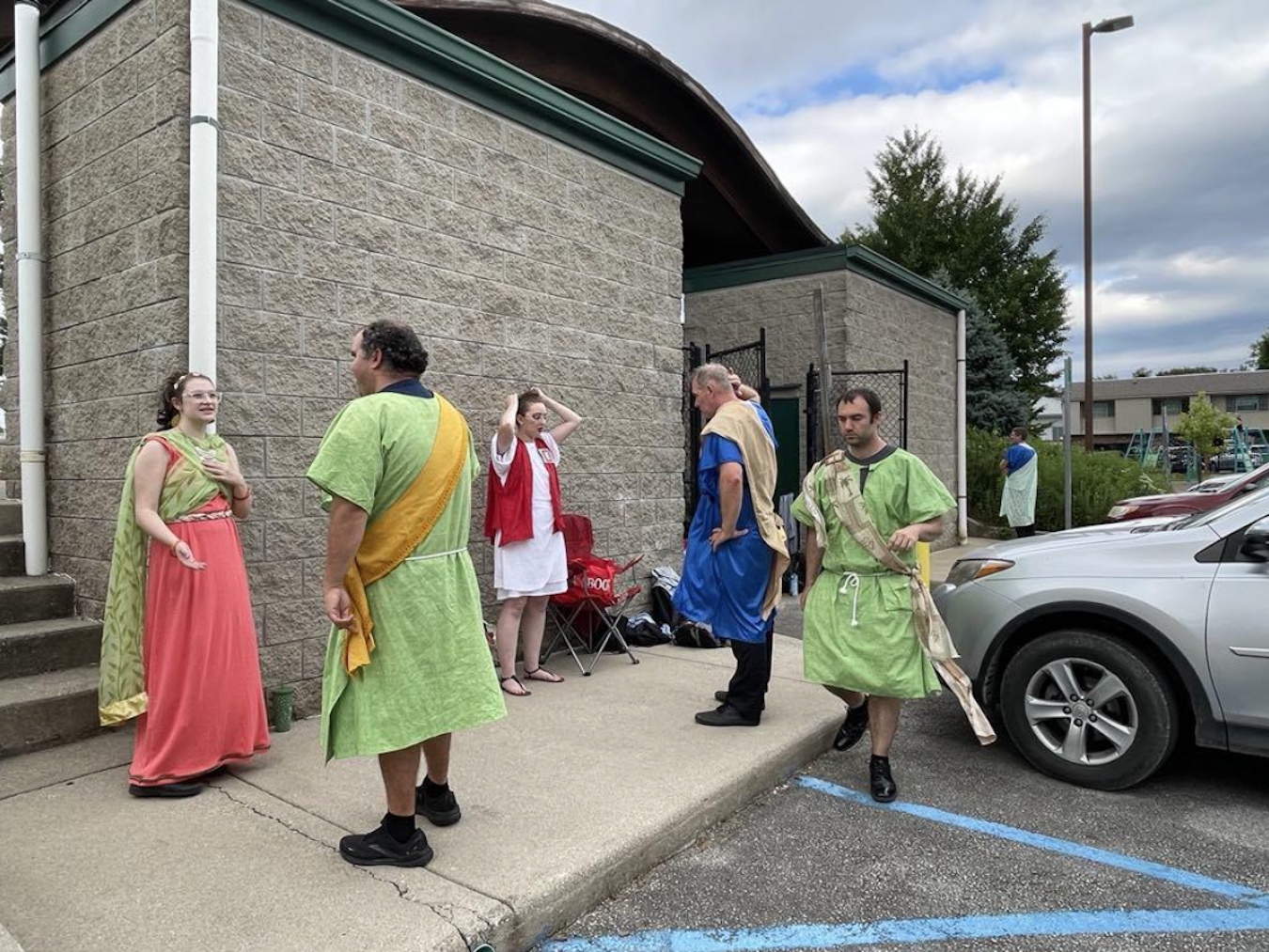
Other participants
Every participant has their own story of how they came to audition for MCCT or to engage with MCCT in some fashion. Kenny, the current president of the MCCT Board, arrived in Bloomington a few years ago for a job at Indiana University, working in the office of student conduct. He had already been immersed in local theater in North Carolina. He already believed in the potentiality and power of community theater as a framework for engaging people in ways that brought forth their creativity and provided an opportunity for this collaborative art form. As he auditioned, and got cast, for role after role, as he became more involved in different levels of MCCT, he also continued his theatrical training. He auditioned for and was accepted into a two-year, once-a-week, Meisner Technique program in Indianapolis, to which he drives after work once a week for the evening class. He also participates in online readings of new plays with a group of theater writers and directors. This level of engagement crops up among those who participate in MCCT as a kind of home base, but continue to work on their acting, writing, directing, or technical theater skills in other venues.
Location and other contexts
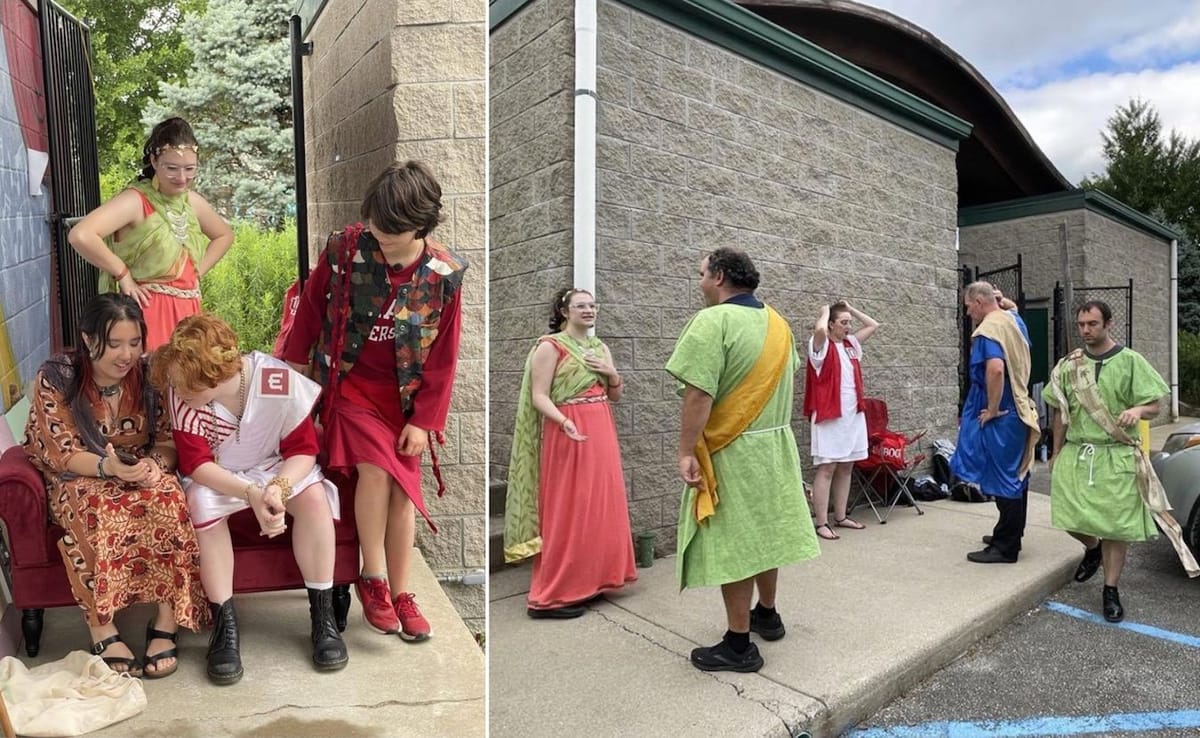
In other contexts, MCCT exists in a college town that is the site of the flagship campus of Indiana University, situated in a somewhat liberal (better to say politically hybrid) town which is located in a very conservative state. In these challenging political and social times, MCCT exists in the, somewhat, innocuous (maybe) safe space of community theater, allowing a certain freedom of expression in the moment. The 2024 MCCT Shakespeare in the Park offering of Shakespeare’s The Comedy of Errors, set the rival towns of Syracuse and Ephesus as the competing university campuses of Purdue and Indiana University. The director, Devin, adapted college football songs to the locales of The Comedy of Errors. The production was choreographed by Callie, who has a dance background and is a doctoral student in education, to emulate cheerleaders and a marching band. The Abbess, whom I played, was depicted as university faculty, in scholarly regalia, under which regalia I wore a slinky red dress. Costuming, as has often been the case over the past several years, was done by Beckie, a professional theater person and seamstress.
In the park
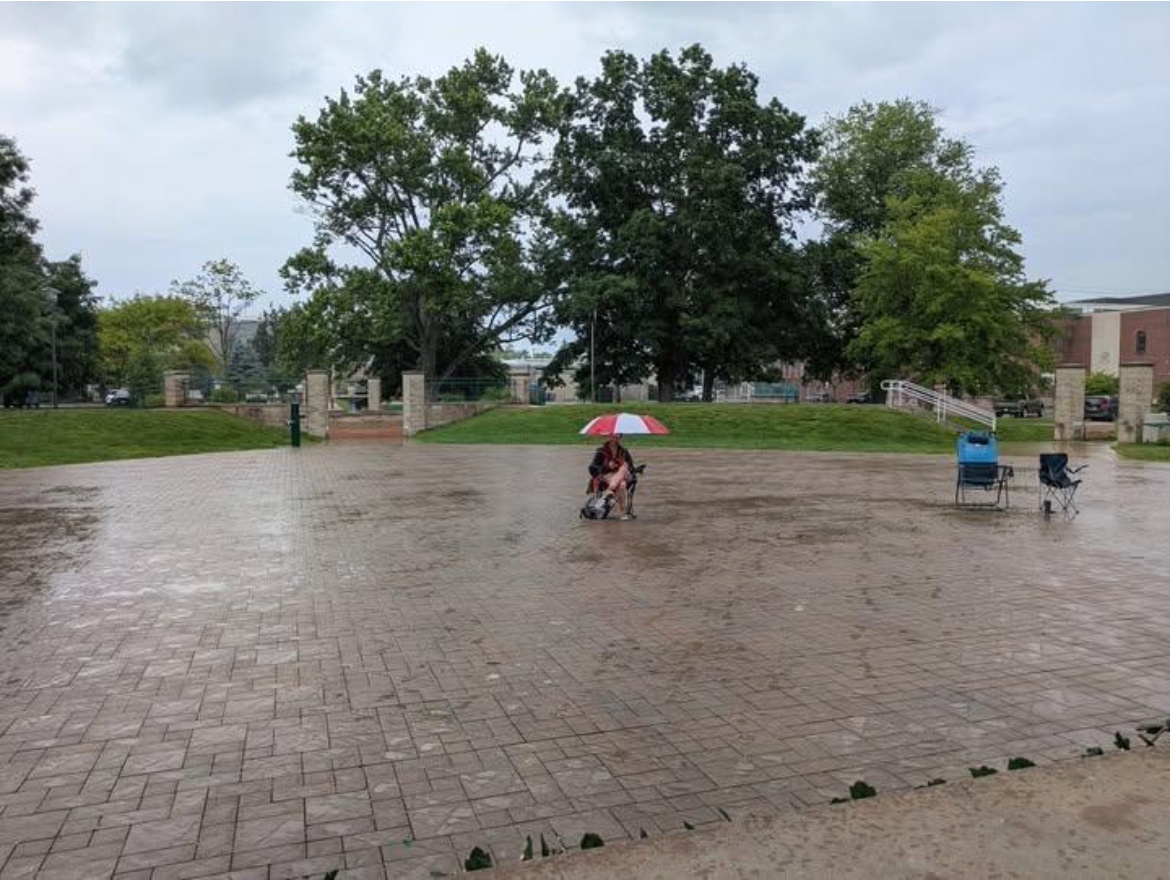
In the last week of May 2024, up through the first two weekends of June 2024, Third Street Park (formally known as Waldron, Hill, and Buskirk Park) in Bloomington, Indiana, was the site for Monroe County Civic Theater’s production of Shakespeare’s The Comedy of Errors. As the spring weather warmed, the actors, director, sound person, and costume designer would gather in the early evening in the open space. The leads were all adults with a half dozen younger performers, mostly high school students, along with a few middle-school aged students.
During the breaks from rehearsal, and as actors waited for their cues, I observed the clustering together of different configurations of actors: the more youthful crew, the men, the solo actors sitting quietly during a break, the ones hanging out near the costume designer, looking in the mirror, checking their adornments and makeup. The configuration of groups would change from time to time, depending on where we were in the play, and whether or not some prop or set piece had to be adjusted, moved, or fixed. Costume changes were minimal, and, still, pieces could get tangled up, torn, dirty, or left behind. Interactions around some particular need of the moment would usually evoke a quick response. Inattention to a particular direction, whether about a costume piece, a prop, or a piece of the set, would, as expected, lead to delays, and, in some instances, a discussion or direct address from the director. With all of that, the atmosphere was congenial, even familial, not to say that it was without bumps in the road.
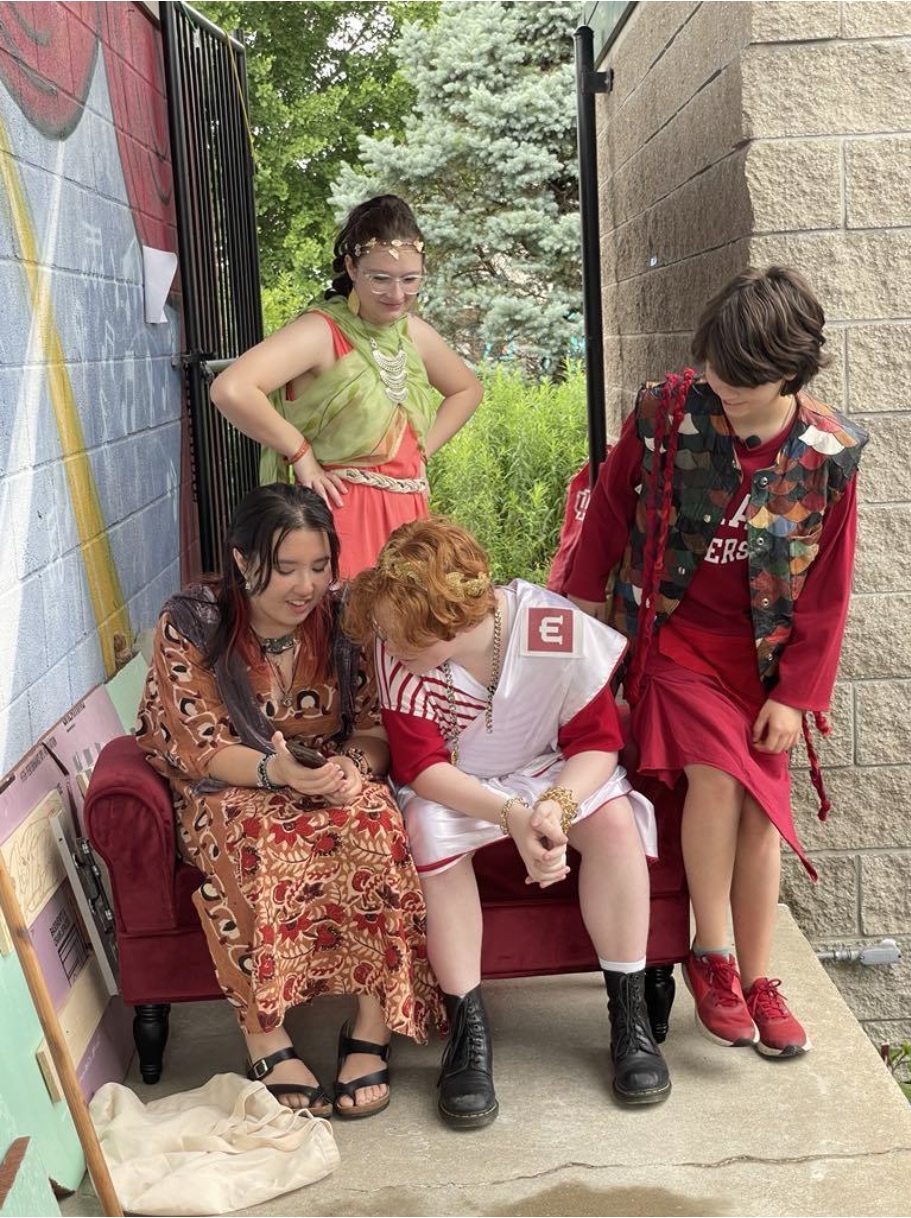
The costume designer, Beckie, told me, well into rehearsals, when we were all trying out costumes that she was frustrated because actors were not following her directive to not eat or drink anything while in costume. She told me this might be her last show with MCCT in the park. (It wasn’t.) She said she wanted the Board to do something about this, not realizing I had recently been elected to the Board. I ended up talking with the director, Devin, and he talked with the actors about being more careful with the costumes. It was a start. Since then, new guidelines have been set concerning etiquette and protocol during rehearsals, including creating rehearsal reports and maintaining better communication among everyone on set and off set. The effectiveness and directness of the communications, to some extent, depends on the individuals involved. And still, and yet, we carry on.
Continuity, maintenance, diversifying, adapting, growing
One model I have imagined of the collective maintenance of MCCT is that of a loosely linked set of individuals who are connected through their interest, love, engagement with theater-making on some level, and I see this loosely linked conglomerate as a hoop that can grow and contract. Through the hoop of MCCT, at different times, there are streams of people and engagement flowing through at different rates. Some people come and play one time, take part in a show, volunteer to support a production, do one thing, and then move on. Others linger longer, for a season or a few years, and others, who provide the stability and continuity of the organization, linger for years, contributing and participating in one or several ways. There are many reasons that the survival of MCCT since its casual creation in 1986 through the present year (2025) is surprising and unlikely. And yet, in a happy confluence of individuals, location, opportunities of the place and times, MCCT has persisted and shifted, over time, according to who is in the space of engagement. Now, at the end of my first year of ever serving on the Board of Directors, I’ve witnessed the streams of individuals who come and go, or come and stay for a time. During this past year of Board meetings, we have been talking, with serious intent, of what it would take to begin to build a small endowment for MCCT. This idea has been mentioned in years past, I’ve been told, but this time, the Board is seriously considering what it would take to create an endowment. The notion of some kind of, even small, financial security to support theater-making and play, and perhaps expand the activities of MCCT is enticing. At the same time, I have wondered at the ingenuity and scrappiness that have been fostered by putting together shows on the proverbial shoestring, where the focus was on the people playing together as the heart of the enterprise, beyond the money and materials needed for any particular production.
Reflections and continuing thoughts about the nature of MCCT
Emily, who served recently as the President of the MCCT Board and who has been involved with MCCT for most of her adult life, sent me the following reflection:
MCCT was my in-road to the theater community in Bloomington. For the last 27 years it has been a constant source of community, inspiration, family, and friends. No matter the ups and downs of my life, MCCT has been a place where I have found myself enriched, challenged, and lifted up. MCCT has given me my dearest friends and my found family.
Bill, who served as Vice President of the MCCT Board during the most recent Board configuration before the current one, wrote the following to me:
Theater in general, and specifically the MCCT, has allowed me to explore my creative side. MCCT has been a welcoming community for me. I find the inclusive culture to be a refreshing change from issues at large in our society at the moment. I’ve encountered some life challenges since I’ve been involved in theater, the community has rallied around me, without exception during these times. I am diagnosed with OCD; as a collaborative art form, theater is therapeutic for me since I am forced to experience the chaos of many artists’ visions and trust my fellow artists so that we can emerge at the end with a single piece of art.
Eric has been involved with MCCT for several years. He wrote the following:
Having joined in 2008, when I was in college, it was a nice way to do shows and build up my acting credits. While acting is still my primary focus, I have since had a chance to try my hand at directing, and the group gave me much-needed help and confidence to do so. Over the years, we’ve had several names who have stayed in long-term roles, onstage and off, and have ended up with many fun and humorous stories to tell. It’s nice to be able to perform outside for some shows, and it’s especially nice to have theater as a part of my life for almost twenty-five years.
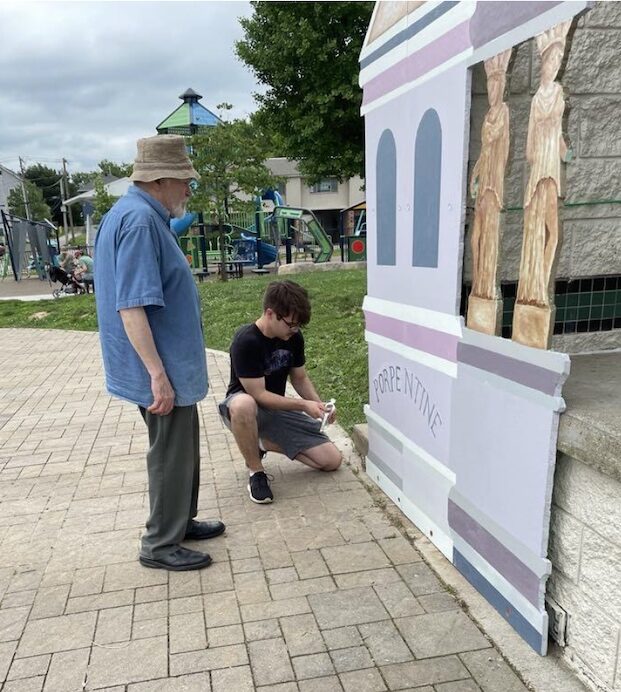
Devin, who currently is on the MCCT Board and was first in an MCCT production when he was in high school, reflected on his experience:
I started with MCCT when I was in high school. I had done musicals before and one of my music directors (Eric Anderson Jr.) was directing Shakespeare in the Park. He convinced me to audition and cast me as Puck. Having the opportunity to play such a big part, having so much fun doing it, and receiving such positive feedback, got me hooked on Shakespeare. When I went to IU for theater, I got involved in as much Shakespeare there as I could, and I continued to perform in MCCT Shakespeare in the Park throughout college. I went on to do a Shakespeare acting apprenticeship with Commonwealth Shakespeare Company in Boston. After graduating, I moved to Chicago and did a Shakespeare adaptation called Richard World III, which landed on a couple of Best Plays in Chicago lists, next to titles like Hamilton and Six. After that, I moved to Louisville to work with the Kentucky Shakespeare Festival as a teaching artist. I attribute my successful career trajectory with Shakespeare to my humble beginnings with the MCCT community instilling in me a love for the Bard’s ability to speak through the ages and bring people together. When the pandemic hit, I ultimately decided to move back to Bloomington in large part because of the MCCT community. I knew, despite moving away for a couple years, that I would find community and an artistic outlet here when everything else was being uprooted. As I continue to build a theater career in Bloomington, I’ve become even more involved with MCCT, participating in four of the last five Shakespeare in the Park shows, and becoming a board member this year. One thing that I really value about this community is its intergenerational nature. Shakespeare in the Park draws in participants of all ages. As I’ve grown from a high schooler to a nearly 30-year-old with this community theater, I’ve performed with many of the same folks for over a decade. I’ve made a lot of valuable relationships with older community members. And as I continue to teach drama around town, I make an effort to get my high school students out to auditions. It’s important to me to pay it forward to the community that raised me, by helping to get younger people interested in Shakespeare and MCCT.
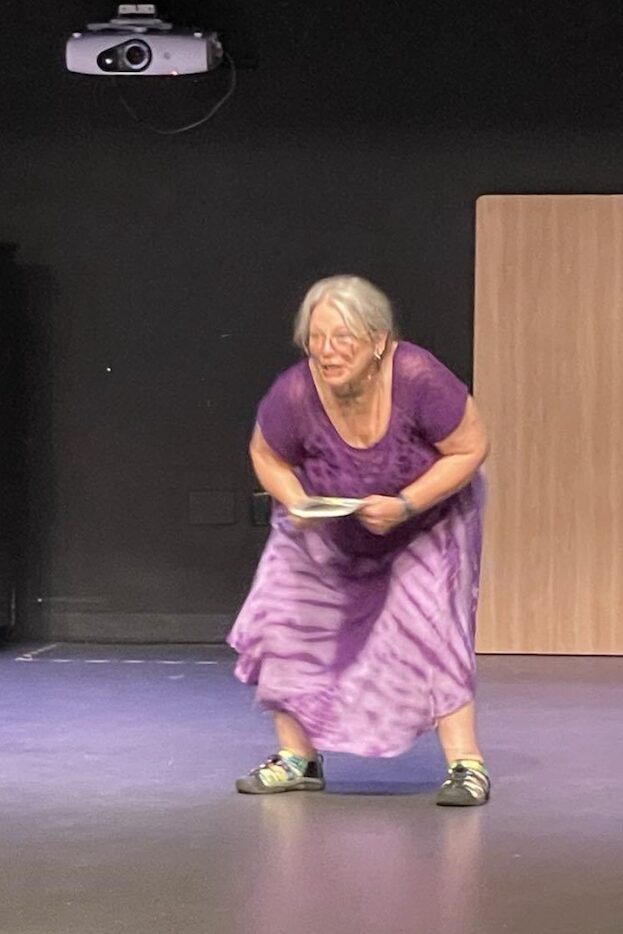
Roy, who currently is on the MCCT Board, has often designed and painted the sets for shows during the last several years. In spring 2025, Roy, for the first time, took on directing a play, Shakespeare’s Love’s Labour’s Lost. Roy wrote the following reflection about his engagement with MCCT:
For most of my life I had been a very introverted, almost reclusive scholar, artist. Sometime in my 50s I was pushed to an audition for Julius Caesar which I had taught several years before. I never expected it would lead to such a life-changing experience. Community theater allowed me to publicly use my unshared talents as a painter, writer, and actor in a way I could never have imagined. The people I encountered were without exception friendly and supportive. Their devotion to the organization and its productions was inspiring. Community theater, in my experience, fosters a special kind of interdependence in which personal success is bound to that of everyone else involved. A play is a lot of work and all must do their part to make it work. This involves a degree of sharing and caring, of vision and compromise, self and selflessness required by few activities that yields social awareness and personal discovery. For the community, amateur theater has a unique place somewhere between high-school play and professional theater. Besides seeing friends and family perform, the audience can feel closer to the experience of the actors. There is a kind of intimacy lacking in the business of professional theater. It’s closer to theater’s origins when citizens produced their own plays as civic events that celebrated their cities. It has certainly raised my consciousness of my community.
Ongoing thoughts about this community theater and the opportunities afforded within this context
To be a part of creating something beautiful is part of what enhances the engagement with theater-making beyond the scope of daily awareness and consciousness. This experience is something that engages the individual on all levels, intellectually, creatively, physically, emotionally, even, let’s call it, spiritually. This engagement and creating cannot be carried out alone. Whether as part of an ensemble or in a solo show, theater is profoundly collaborative. MCCT, when it does what it does best, creates a space in which individuals can come together to discover who they are and might be, or become, while working with others in ways rarely afforded in most jobs, academia, and many contemporary living configurations. In the case, too, of MCCT’s regular return to and production of Shakespeare’s plays, the engagement with elevated language, relationships, and story-telling, story-making, beyond the realm of daily encounters, enriches the experience of all participants and, hopefully, the audience, who with all its members is yet another participant and factor, when we get it right, and, even, when we don’t.
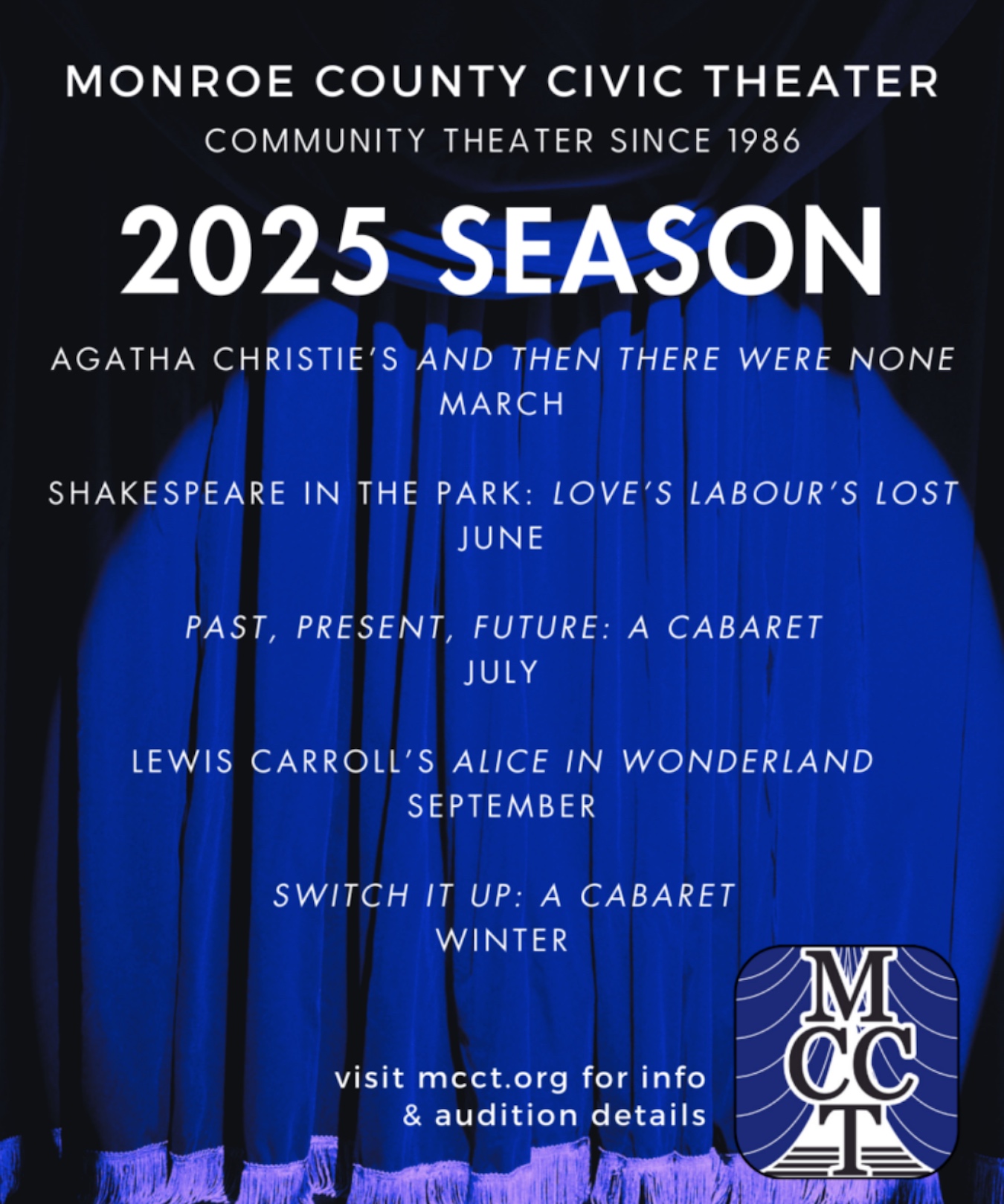
Our 2025 Season
MCCT’s 2025 Season started strong with Agatha Christie’s And Then There Were None, directed by Becky Stapf. This classic period piece was performed in the Firebay Theater of the Waldron Center. The annual Shakespeare in the park brought Love’s Labour’s Lost, under long-time MCCT actor and set designer Roy Sillings, taking the helm for the first time as director. July brought a musical offering, Past, Present, Future: A Cabaret, under the direction of Laura DeBrunner, a music teacher and singer. Classical selections of music and dance from the past half century were performed at the community space in Bell Trace, Senior Living community. Rehearsals for Lewis Carroll’s Alice in Wonderland started in July, under the direction of Kelsey Hertling, a first time director with a long history of technical theater background. Opportunities for learning and expansion, as in the first time directing ventures of Roy Sillings and Kelsey Beal, are among the offerings that are possible through Monroe County Civic Theater and community theater in general. For Alice in Wonderland, Mrs. Hertling has double cast every role. All actors have a primary role, as well as understudy roles. Rehearsal sessions often consist of reworking scenes with alternate cast members. This kind of experience provides more opportunities for everyone involved to flex their theatrical muscles, gain a greater range of experience, and see the possibilities inherent in a character and story through multiple interpretations. The last MCCT offering for 2025 will be Switch It Up: A Cabaret, framed with the enticing invitation for singers and performers to choose material for which they would not be cast. New horizons and possibilities engaging participants and viewers with fresh perspectives. And the show goes on!