Soul Tonk: Bloomington’s Modern-Day Juke Joint
Live-music night at a downtown bar has become a community bridge in Bloomington.
Live-music night at a downtown bar has become a community bridge in Bloomington.
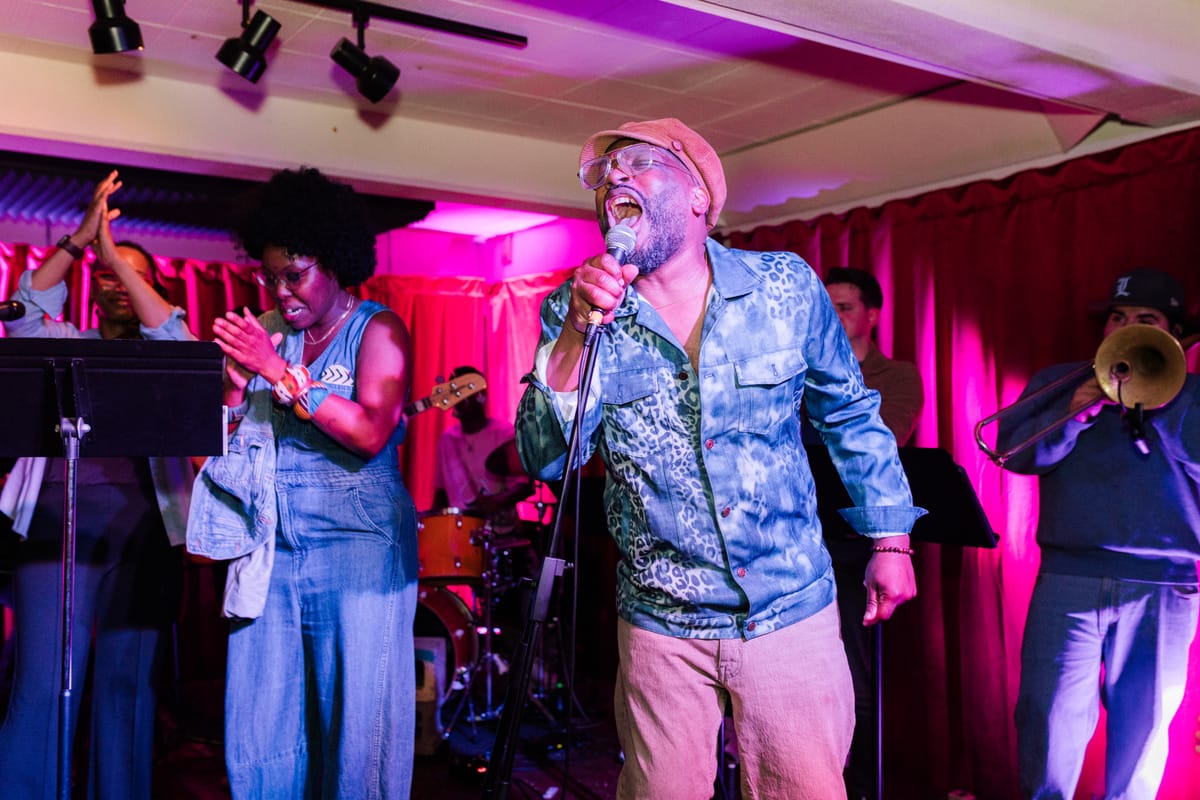
Once a week, local music lovers and those traveling through town can put down the baggage of their everyday lives and converge to enjoy live country and classic rock and roll at The Blockhouse Bar’s “Honky-Tonk Tuesdays.” Occasionally, visitors will find a “takeover” of sorts, with a different theme than the usual honky-tonk. The Blockhouse has hosted Queer Tonk several times over the last couple of years, an event that intentionally showcases queer artists performing honky-tonk tunes. More recently, it’s offered soul music takeovers known as “Soul Tonk.”
These Tuesday nights honor the roots of soul and honky-tonk as genres representing the lives of their musicians and primary audiences. Soul Tonk takes people back to the juke joints and origins of “hard country” — places where individuals can convene and be enwrapped in the music of life. The pains of love lost, the heartbreak of chasing the American dream — or in the juke joint blues/R&B setting, the recognition that Black Americans were never originally a part of that dream to begin with. Juke joints and honky-tonks were secular spaces that acted as sacred sanctuaries for working-class folks who needed a reprieve from their everyday lives before they got back to “living for the city.” Soul Tonk honors the spirit of the juke joint while also acting as a brilliant bridge shining a light on Black experience and cultural production; inviting all — regardless of personal or institutional affiliations — to engage, dance, and learn alongside one another.
Origins of Soul Tonk
The Blockhouse Bar has been home to Honky-Tonk Tuesdays since 2018, providing a showcase space for local musicians and a spot for Bloomingtonians to come together and unwind. David James, musician and owner of The Blockhouse, has always considered the venue as a “third space” for adults in town — a place to meet new people and enjoy live music, poetry, comedy shows, film screenings, and more. His mission has been to diversify the space to ensure it is representative of the Bloomington community. “The shared possibility in public spaces offers up circumstances that you’re not going to find at home, not going to find on the phone. […] People need physical places to engage with the people who live near them,” he says.
It was natural, then, that The Blockhouse became the venue for Soul Tonk, which brings together communities who do not often intersect to coalesce and bask in the secular salvation of the soul. Soul Tonk is primarily organized by Gloria Howell, the director of Indiana University’s Neal-Marshall Black Culture Center (NMBCC). Howell moved to Bloomington from her home state of Mississippi to pursue her doctorate. She found community in Bloomington in ways that were “intentional, but also very serendipitous at times.” She recognized that many Black students and faculty often found themselves feeling isolated. “Not because they wanted to be,” she says, “but because they didn’t have community.” Howell has made it a personal mission to help create connections for Black Bloomingtonians across the “town and gown” divide.
Harkening back to Howell’s reflection of how her own finding of community was at times serendipitous, the origins of Soul Tonk were just that. In fall 2024, Alice Randall — often cited as the “mother of Black Country” — was set to come to Bloomington. Howell was approached by IU’s Gayle Karch Cook Center for Public Arts and Humanities, a partner of the IU Arts & Humanities Council, about potentially hosting an event in celebration of Randall’s visit. However, Howell was already stretched thin — Randall’s visit coincided with IU’s homecoming as well as the NMBCC’s 55th anniversary. Howell recalls that “so much was happening, so when the organizers [initially approached] I was like ‘there is no way we can make this happen.’” But then Natalia Almanza, internal programs and operations coordinator with the Arts & Humanities Council, as well as Andrea “De” de la Rosa, the City of Bloomington’s assistant director of small business development, had the idea to utilize an already established night — Honky-Tonk Tuesdays at The Blockhouse Bar. This was the origin of the first Black Tonk — a night honoring Alice Randall and other Black musicians in country music.
The night was a success, and everyone involved was inspired to do it again in February 2025 for Black History Month. It was then that James proposed doing the event regularly, and not just as a token event for Black History Month. His suggestion paved the way for the evolution of Black Tonk into Soul Tonk.
The first Soul Tonk was part of the Arts & Humanities’ Granfalloon celebration in April 2025, a way to pay homage to Granfalloon headliner, and foundational foremother of soul, Mavis Staples. With this evolution, Howell considered ways she could use her own personal networks as well as showcase other members of the Black Bloomington community. She reached out to local music scholars Olivia Ekeh and Nia I’man Smith as possible MCs for the event.
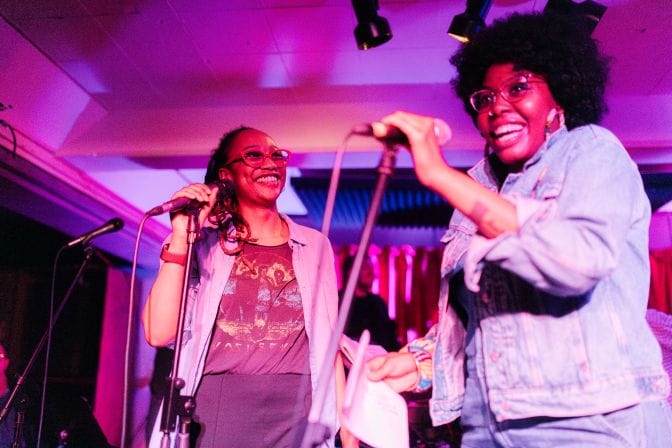
Ekeh is an assistant professor in the Department of African-American and African Diaspora Studies at IU. Smith is an interdisciplinary Black music scholar and doctoral candidate in the Department of Folklore and Ethnomusicology, and, under the alias “DJ Ann Charles,” host of SONIC BLACKNUSS RADIO, a biweekly curation of Black music across time and space on Bloomington’s local radio station WFHB. Howell, Ekeh, and Smith all work together to curate set lists for Soul Tonk while finding local — primarily Black — musicians and singers to perform covers of classic soul songs. Performers cross the campus/town line, with musicians ranging from beloved Bloomington band The Dynamics to local regulars of Bloomington’s many karaoke events and artists connected to the African-American Arts Institute at IU.
Soul Tonk, in its own way, followed the same evolution of soul as a genre. Moving from the roots of blues and Black country, soul was the result of a Black cultural alchemical process. Elements of gospel — such as testifying and call-and-response — combined with the raw vulnerability, ache, and resilience that characterized blues, all fueled and fused together by narrativizing Black American experiences to produce a powerful force of a genre.
In Wrong’s What I do Best: Hard Country Music and Contemporary Country, Barbara Ching, associate professor of English at Iowa State University, writes that honky-tonk music is about “the pains and pleasures of losing the American dream[…]. It complains in a punning, wailing, whining, twanging, thumping, grandiosely emotive style.” Ching’s description of honky-tonk speaks to its often hidden roots in juke joints and blues music. Juke, from the Gullah “jook” meaning rowdy or disorderly, was a staple in working-class Black American communities. Juke joints were spaces where Black Americans could find solace after a long day’s labor in the cotton fields, in domestic service as maids and nannies, or after the seemingly hopeless search for employment. Later, honky-tonks served a similar purpose for their White blue-collar counterparts. Both juke joints and honky-tonks became secular sanctuaries where attendees could sing, dance, and drink their woes away even if just for a few hours.
While honky-tonk laments the loss of the American dream for blue-collar White Americans, soul speaks to the pain of the illegibility of Black Americans within the American dream, as well as the pleasures of creating dreams of one’s own or the “make a way out of no way” spirit. With this history in mind, the Soul Tonk and the regular Honky-Tonk Tuesdays at the Blockhouse aren’t as strange bedfellows as they may seem.
The Heart of Soul Tonk: A Community Bridge in Public Space
With Gloria Howell as the director of the Neal-Marshall, it might have been easier to hold the events on campus. But that would have gone against the heart of the mission for Soul Tonk. The goal is to be connected to the community: to bridge the gap between the campus and city residents who may often find themselves at odds with Indiana University as an institution. Having the event downtown is an active effort to ensure those not affiliated with IU still feel welcome and included.
The hosts also provide learning opportunities for their audiences. There is the osmotic learning process that occurs by interacting with diverse and underrepresented sonic-scapes and people. But there is also very intentional space made for teaching. When reflecting on how she performs her role as an MC of the event, Olivia Ekeh mentions her upbringing as a pastor’s child and how that influences her stage practice.
“Growing up in that space and seeing not just my mom but our main pastor consistently, every Sunday, giving a sermon and … it’s essentially a lecture! There’s a lesson. There’s something that he’s ultimately trying to convey.” It was in the church space that Ekeh recognized the power of “edutainment.” She learned that “you have to make this somehow excitable, something that draws people in.”
“To approach MCing in that way,” she says, “thinking about the ‘logos’ part of the rhetoric […] it’s more than just being able to recite facts about artists and musicians. It’s about making it seem like you’re engaged with the history in and of itself.” This lends itself to how Ekeh delivers her “banter” portion between songs. She does not just occupy the stage as a talking head — she leans in, encouraging the audience to engage in the call-and-response element that is an integral component of soul, gospel, and African diasporic cultural production. The act of doing this is not just to inform, but also to set the stage and invite the audience in as more than just spectators. “Historians? We love a good anecdote,” Ekeh says. She uses her anecdotes and vast knowledge of soul, popular music, and gospel practice to warm the audience up and guide them through the setting and emotional space of the ensuing songs. Setting the scene helps the audience feel like they, too, are a part of the performance.
This goal is in line with her co-host Nia I’man Smith’s practice of MCing. Both MC’s have distinct styles when they are behind the mic, but their purpose is the same. Smith says her mission as a co-host is to bring “the high energy and good vibes.” She says, “My goal is for the audience to be equally entertained and engaged, and if that means I gotta get out in the crowd and get some people in the audience on the mic or improvise a song on the spot, I’mma do it.”
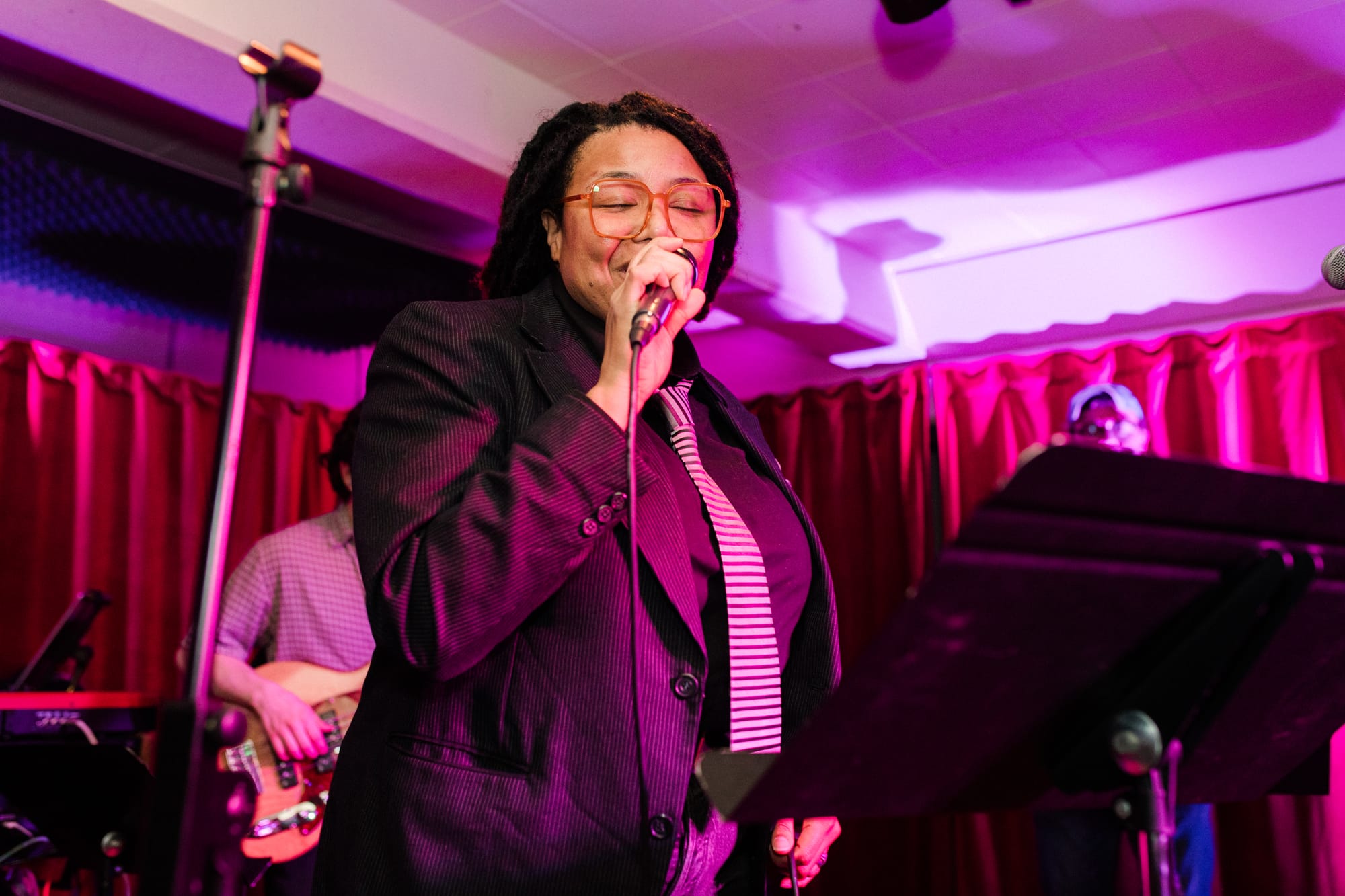
One key mission with Soul Tonk has a dual purpose: to provide space, freedom, and reprieve for those who understand what soul represents more intimately, and to provide a window or access point for those who may live more homogenous lives with little direct interaction or participation with communities outside of their own. “Soul Tonk gives people the opportunity to see something different,” says Howell. “For my [White] brothers and sisters, I think it gives people — in terms of community — it [dismantles] some ideas and biases and things they thought about Black folks.” And it “gives them an opportunity to see who we are, not in a spectacle way, but in a true genuine appreciation for this art form and for the people who are bringing it to us in this particular setting.”
Howell’s mission is heavily based on the desire to connect to the larger community. “I do honestly believe that so many times we spend a lot of energy on how to change the world,” she says. “And if we take time to think of our little sphere of influence right here in Bloomington […] I think Tonk is one of the examples [where] we can move and shake in a way that doesn’t have to be a loud platform, all these big-name people, it’s just the local folks showing how to bring people together and have a really good time. Even if it’s just these three hours at the Blockhouse we can forget about all this crazy in the world. If that’s all it is, or someone meets a new person they’ve never met before, I am totally satisfied.”
Soul’s Invitation to Transcend
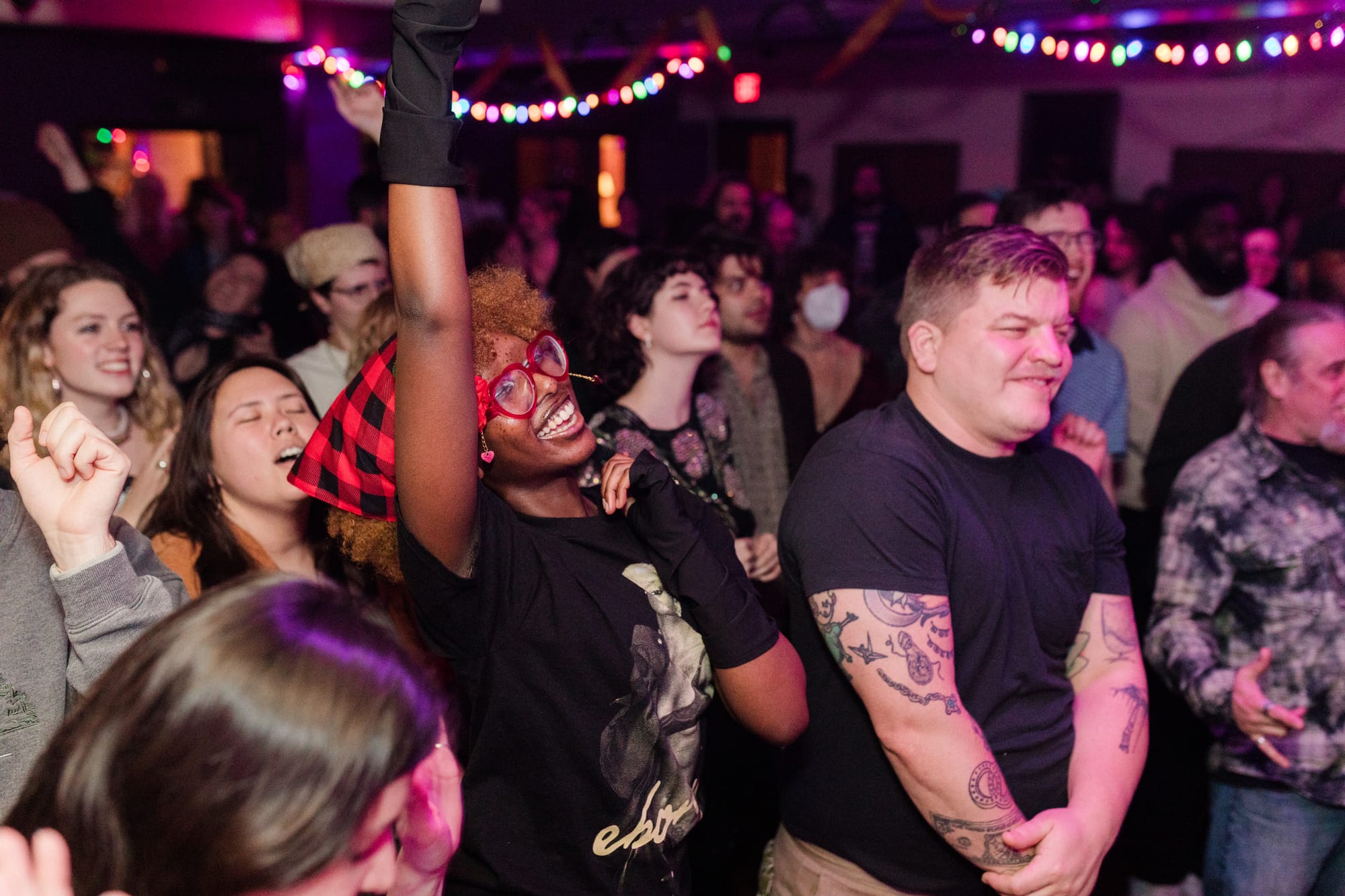
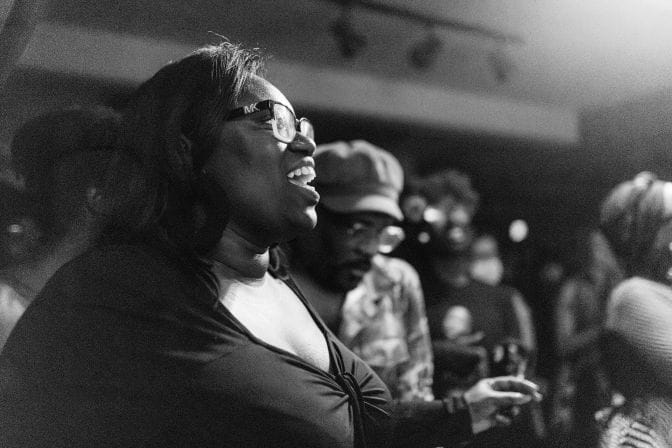
When attending Soul Tonk, there’s no concern for who may be up in the sky or down below. Soul Tonk urges its visitors to find glory in the present. The transcendent experience of being with others — dancing, sweating, whooping, and hollering together. A space where individuality is not lost or subsumed but quilted together into a moving rainbow fabric of collective community experience.
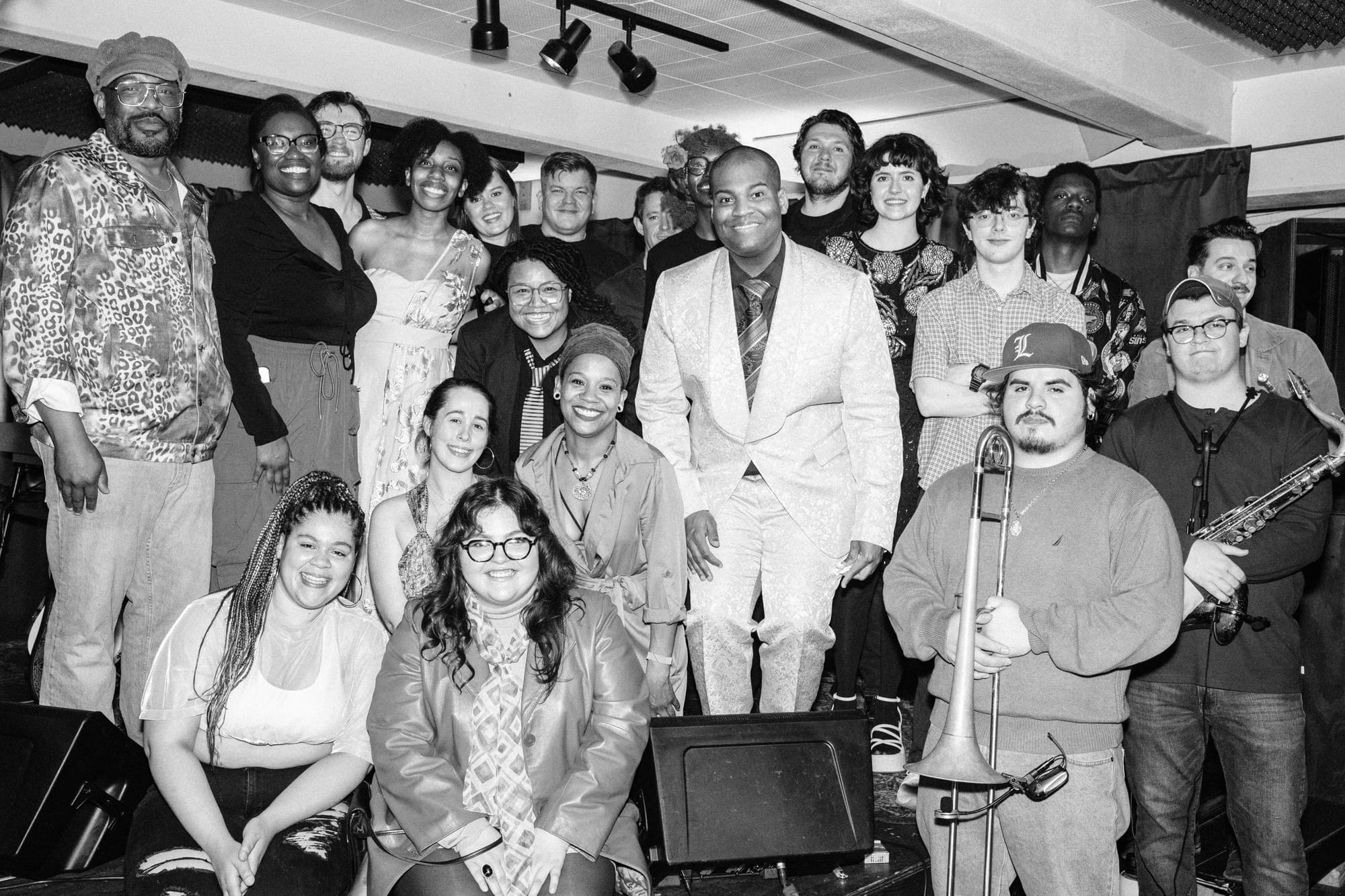
When asked how Soul Tonk speaks to the collective human experience, Nia I’Man Smith was quick to reorient back to the specifics of soul music:
“More so than the collective human experience, I see soul music as an expression and practice of the Black experience — particularly here in the US. However, it is important to understand soul music as a sonic manifestation of our African ways of being in and sounding in the world. Everything from the marriage of sacred and secular to the vocal and performative dynamism that soul music calls for roots us in an African way of expression. I see soul music as one of the musical ways that we call forth this knowing of who we are and who we be.”
The heart of soul speaks to the specific Black-American and African diasporic experience. If others connect and find themselves reflected in aspects of this context, that is a gift, but the core intention of the music is to provide a microphone to amplify the Black experience in America. In this way, the heart and legacy of soul connects back to the necessity of Soul Tonk occurring in a public space like The Blockhouse. The underground nature of the space calls back to the grittier roots of soul, connects to blues and jukes, and eschews the need to provide a cleaner or tamed down sound for a mainstream audience. And, of course, allows for soul’s return to the people and where they reside — in the heart of the city.
Referencing Faith Ringgold’s Black Women Artists collective, Olivia Ekeh says Soul Tonk is “where we at!” And for those who do not feel that quite yet, they needn’t worry, because as in the words of the mighty soul band The Staples Singers, if you’re not all in already, Soul Tonk will certainly “take you there.”