Stories from a Perfect Season: The 1976 Hoosiers Fifty Years Later
Nick Bauer speaks with 1976 IU basketball players and fans about the undefeated season and championship win.

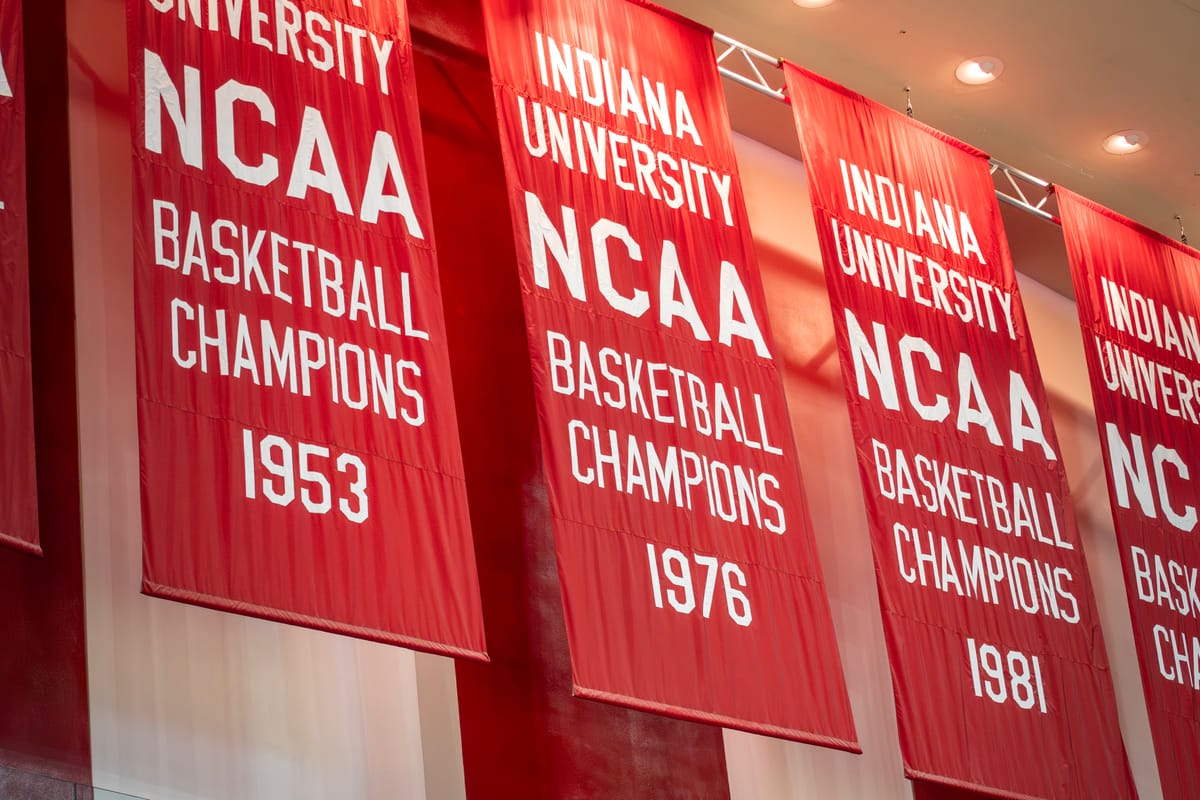
Assembly Hall in Bloomington, Indiana, is one of the most storied venues in college basketball. It earned that reputation in part during the season the greatest men’s team of all time graced its home court. That year, 1975-76, the team went undefeated, winning a national title in the NCAA tournament at 32-0 on the season. The history of the season is widely documented, but the stories of those who witnessed it are less well known. This article takes a look at the 1976 season through the memories of those who were players, fans, sports journalists, and staff members.
Preparing for the 1975-76 season
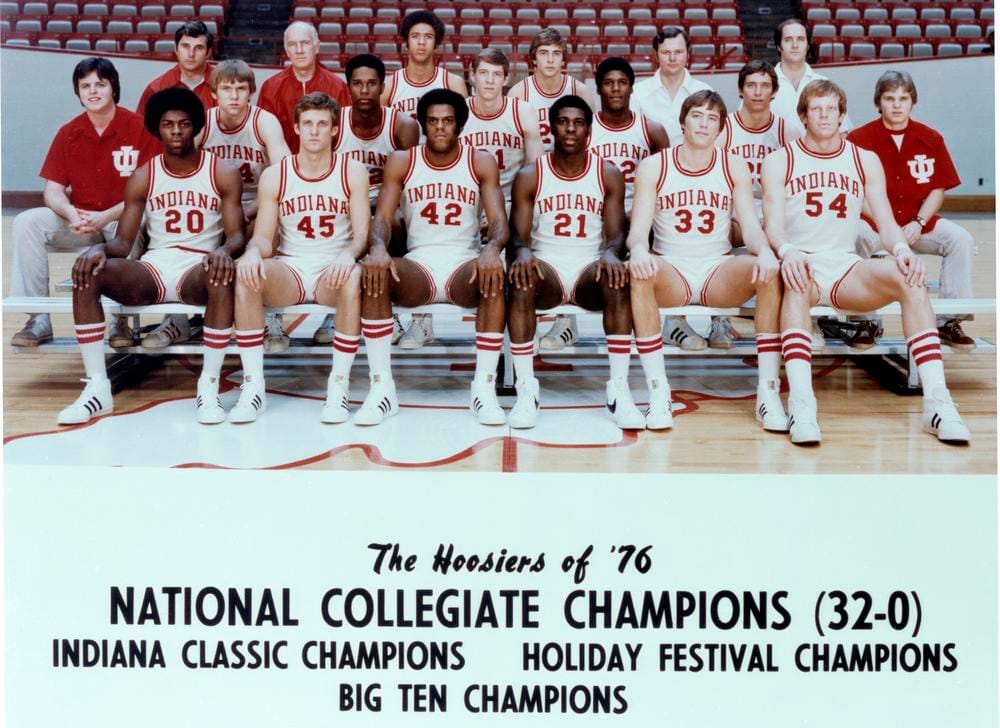
Many Hoosier fans and sports journalists believed the 1974-75 Indiana men’s basketball team was better than the team that followed it. The 1975 Hoosiers won 31 games in a row by an average of just under 23 points per game. Three of those wins had a margin of more than 50 points, and only four games were decided by single digits. The Hoosiers won the Big Ten conference, going 18-0, with the runner up, Michigan, reaching a mark of 12-6. That is, without a doubt, an impressive stretch of games. In a late-season rivalry game on February 22, 1975, in West Lafayette, Scott May broke his left arm. It was the 26th win of the season for IU by a single point. The Hoosiers won three more regular season games and two NCAA tournament games before falling to Kentucky in the Elite Eight with a two-point loss.
Mark Deal currently serves as the assistant athletic director for alumni relations at Indiana University. He played football at IU from 1975 to 1978. “They had the best team in the country,” Deal said, describing the end of the 1974-75 season. “Scott May broke his arm with three games to go in the season. May was basically not healthy enough to be a factor in the NCAA tournament. IU got beaten in the Elite Eight by Kentucky by two points. If Scott May doesn’t get hurt, they’d have been back-to-back undefeated national champions in 1975 and 1976. But the injury happened, unfortunately.”
Scott Dolson, the current IU vice president and director of IU collegiate athletics, was a young boy in northern Indiana during the 1975 and 1976 seasons. “My grandfather started talking to me about IU basketball and Coach Knight from the time I can remember,” he said. “And so, in 1975, I remember watching that team and it was undefeated and got beat by Kentucky in the Elite Eight. And it was just so sad and just a tough, tough loss. Then the ’76 season, with all those returning players, and I remember as a nine-year-old just going, ‘Wow, I can’t wait for that season.’ So, every game, even though all of them weren’t on TV, I was trying to follow the Hoosiers.”
Tom Abernethy, senior forward on the 1976 team, remarked of the players heading into that 1975-76 season, “We felt the year before we had just about everything to win it all. So, I think we were hungry. That’s probably the best mindset. I think we were hungry, determined, and excited for the season to begin.”
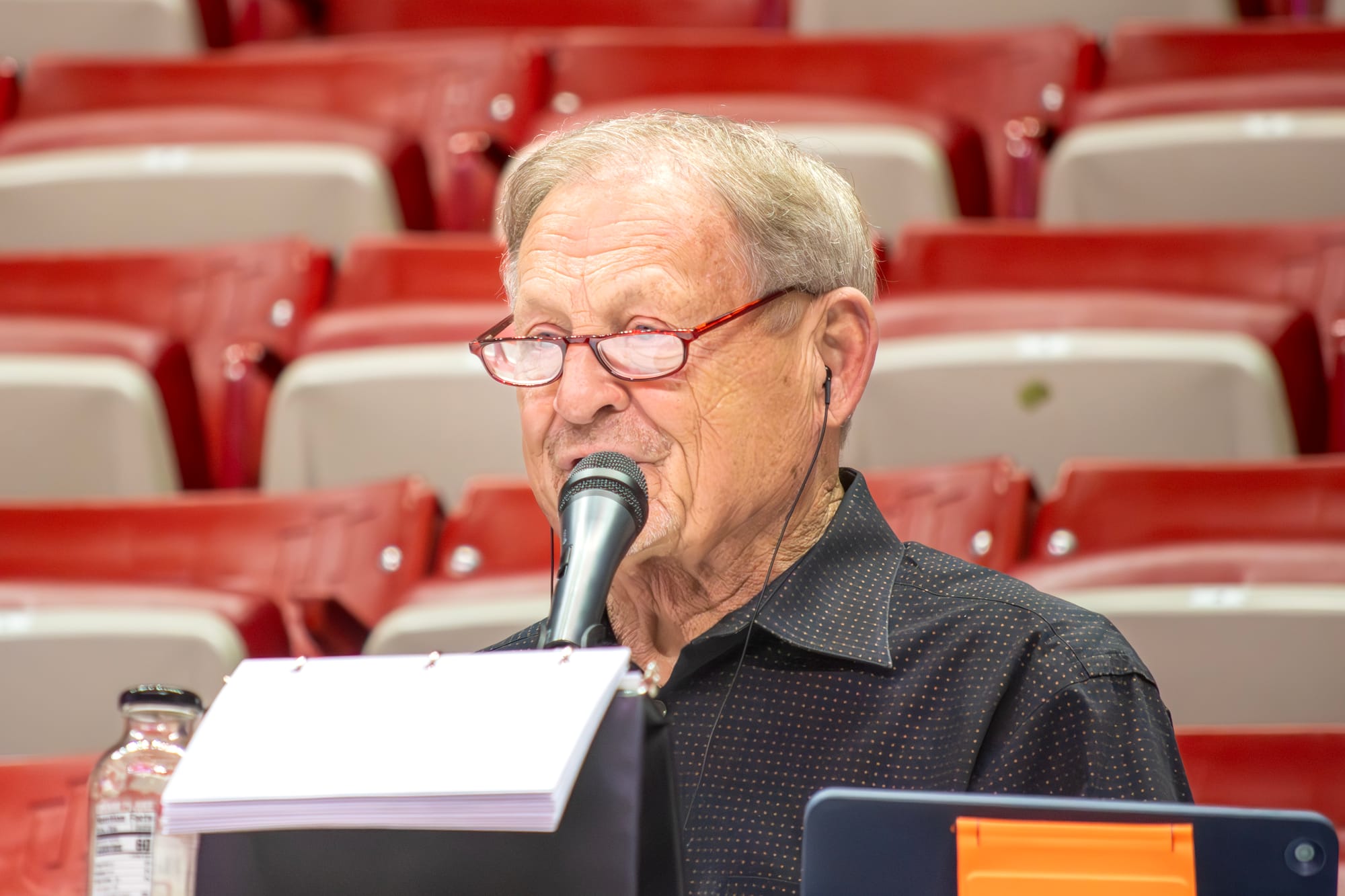
Don Fischer, the Voice of the Indiana Hoosiers, who has called the games with radio play-by-play since 1973, saw that same hunger. “The next year, in 1976, you just knew that that team went in there with this determination that they were going to try and win the national championship,” he said. “And they were going to try to be the best team in college basketball and they certainly proved that they were.”
Quinn Buckner, senior guard for the Hoosiers, talked about Coach Knight preparing the team for the 1975-76 campaign. “We were willing to do as a team what Coach Knight had set up as what it is we could be. Now, some guys remember him saying we could go undefeated. I don’t recall that, but I do know he said if you do what I’ve told you to do and what we have practiced to do, it’s going to be very difficult to beat you.”
Jim Crews, senior guard for the Hoosiers, remembered the goal to go undefeated. “I think our mindset was number one, which was to go undefeated. Obviously, if one had to falter, we'd rather lose in the regular season and win the national championship. But that was our goal. We didn’t think it was really acceptable to lose. We expected to win and we prepared to win. We worked hard to get to that point. And so, we took advantage of that.”
Abernethy summed up the expectations simply, saying, “I remember Coach Knight always stressing ‘play to your potential,’ and holding us to being as good as we can be.” The Hoosiers were the pre-season number one-ranked team in the AP Poll nationally. Expectations in Bloomington and across the country were high for a team that had the potential to live up to its reputation.
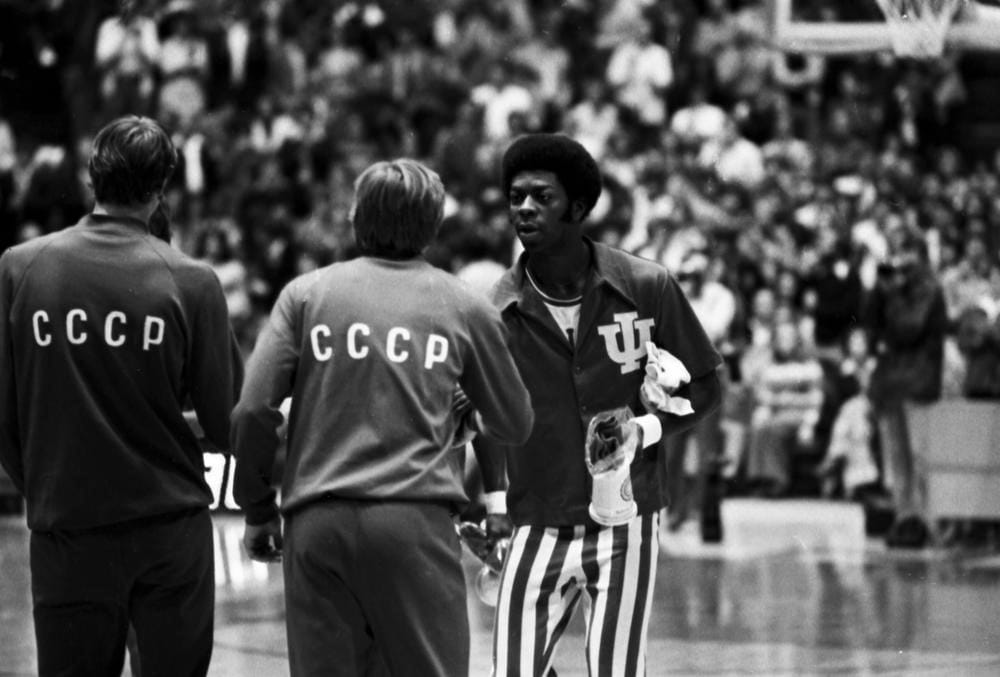
During pre-season play, the Hoosiers beat the USSR team, which had won Olympic gold in 1972, on its tour around the U.S. playing top college teams. As IU team member Bobby Wilkerson put it, “For me, the greatest game that we had to fight against was the Russians because we was playing the world champions. They big grown ass and we took it to them, and that set the tone for everybody else.” The Hoosiers defeated the Russians on November 3, 1975, by a score of 94-78 at Market Square Arena in Indianapolis behind 34 points from Scott May in his first start since breaking his arm the prior season.
The regular season
If beating the USSR didn’t put the college basketball world on notice, opening the regular season with a 20-point win over defending national champions UCLA and a 24-point win over Florida State had to help. From there, the season was off and running. Crews, a senior on the team, talked about the schedule of a college season, saying, “In college basketball, you play about every three days, and what you have to do is be your best physically, mentally, and emotionally to compete against the other team.” To play at a high level, game after game, requires a drive to be the best and play hard every time you take the court. Crews continued, “I think anytime you have good teams, really good teams, the coach instills it, but it has to be player driven. Coach Knight was obviously a tremendous leader.”
Crews followed his playing career at IU with an outstanding coaching career that started as an assistant under Knight from 1977 to 1985. After IU, he had 430 wins as a head coach at Evansville, Army, and Saint Louis, leading teams to seven regular season conference championships and three conference tournament championships. Crews also had eight coach of the year honors in his career, so he has a deep understanding of what it takes to succeed in college basketball.
The players from the 1976 team often refer to Knight’s training methods. “Coach Knight was incredibly good at motivating and encouraging us and keeping us focused,” said Abernethy. “But I think we had a team full of guys who were determined and ready to do what they needed to do. I don’t think we all knew what we really needed to do, but we were mature enough to know we had to lace them up and go at it.”
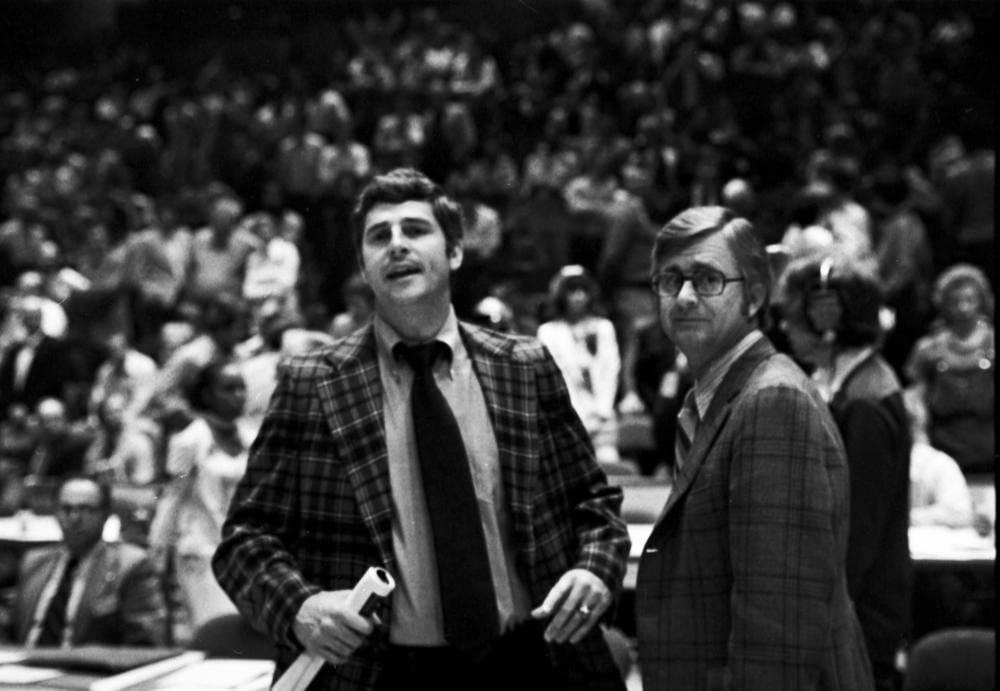
Buckner attributed the team’s success throughout the season to how they practiced. “The one thing I remember about all of this is I was never nervous going into a game and primarily because we were so well prepared. We practiced at a game speed all the time. So, when you got in the game, it wasn’t thinking of what you’re doing. You’re just reacting based on what you’ve been practicing. And it makes the game a lot simpler. What happens to people when they get in these kinds of environments, all of a sudden, they’ve got to think about it. By the time they thought about it, that action is now gone. We were so well drilled that the games were easy, quite frankly. You played at a high level from an intensity standpoint, but they weren’t something you had to think about. You just did what you’d been doing in practice. And if you didn’t, you knew about it, by the way.”
The players heard about their mistakes from a demanding coach who expected the best out of his guys. “You had to be good every day. Coach Knight demanded that you give your best effort mentally, physically, and emotionally every day,” Crews said. “So, we really probably had some, I don't know what the word would be, like almost callouses. You have a callous about your toughness and your emotional being and your mental being. It’s just kind of who we were, as you become your habits. When tough things happen, you just rely on your habits and how Coach Knight set up practice.”
Knight’s style of practice drilled the team intensively for the games. As Crews described it, “Coach Knight had a philosophy that practice execution equals game reality. If you practice a certain way, that’s what’s going to show up in the game.”
“The toughest team that we ever had to play against was our second team because they practiced with us. They practiced so hard and made it so difficult on us. They beat us up,” said Kent Benson, junior center for the Indiana Hoosiers. “To the point that practices were so hard that we couldn't wait to play again. We were tired of playing our second team because they were so good and did such a great job of preparing us.” Knight coached the best team in the nation in 1976, making it no surprise that he also coached the second-best team as well.
The 1976 season did not go by without some stress for the fans. “They had a couple of close calls that season, like against Kentucky down at Freedom Hall in Louisville, and they won that game in overtime,” Don Fischer said. “Kent Benson tipped in a ball at the buzzer to put it into overtime and then they walked away from Kentucky in the overtime period.”
Benson recalled scoring the game-winning basket. “I was in a situation where a shot went up and I had a chance at possibly getting the rebound. It was out of control, I flipped it up, it went straight up, and then straight down into the basket,” he said. “So, I wouldn’t say it was a fluke. I knew exactly what I was trying to accomplish. It was a little errant, and it erred right into the basket.”
IU ended up winning the contest on December 15, 1975, by a score of 77 to 68. The win was even sweeter considering Kentucky had ended IU’s undefeated run in the Elite Eight in March of 1975. Undeterred by the close call in Louisville, IU won the next four games by an average of just under 36 points per game, followed by a win over 17th-ranked St. John’s before entering Big Ten conference play.
Abernethy said fans gave the team an extra boost. “The support we had from the students and the community was incredible,” he said. “Every game at Assembly Hall was sold out, and the energy in that building was electric. It really gave us a home-court advantage. And even away from the arena, people were so kind and supportive. You couldn’t go anywhere in town without someone wanting to talk about the team and wish us luck.”
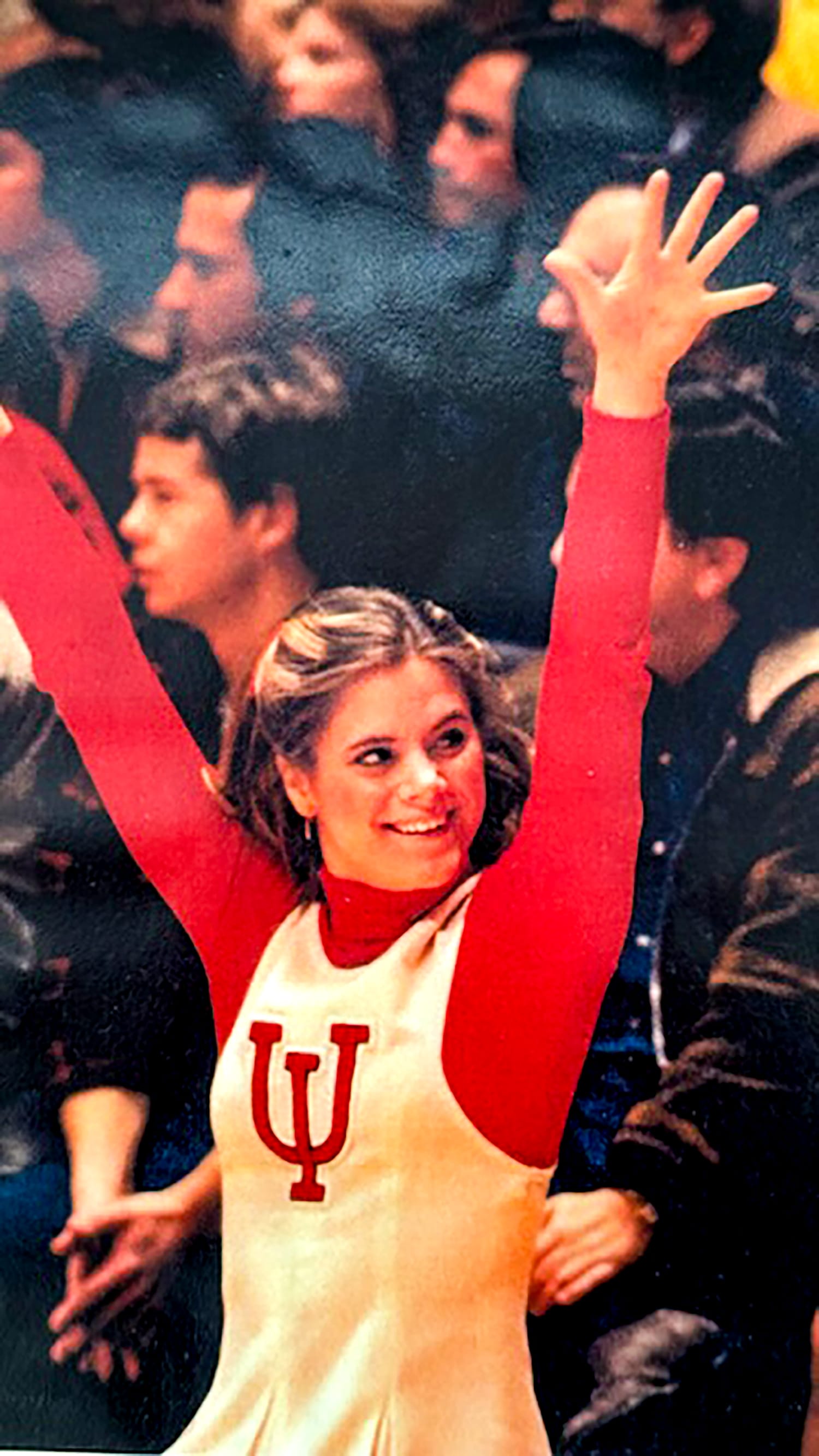
Krisna Hanks was a freshman at IU during the 1976 season and member of the Pom-Pom Squad. She was on the floor for every game at Assembly Hall that season and later went on to captain the Varsity Cheer Squad. She felt the same energy in Assembly Hall as Abernethy. “Assembly Hall was electric, as was the overall enthusiasm on campus,” she said. Hanks had other connections to the team. Jim Wisman, a sophomore on the team, was recruited by Coach Knight from her high school in Quincy, Illinois, where her father, Sherrill Hanks, coached the basketball team and was friends with Knight. Her brother, Mike Hanks, was a graduate assistant for the IU basketball team that season as well.
Jim Roberson, a freshman center in 1976, reflected on the toughest game of the season in his view, in January 1976 away from the home crowd. “The hardest team that I thought we played during the season was against Minnesota at Minnesota and they were lighting us up. Ray Williams had 22 points at the first half at their home court against Scott (May),” Roberson said. The Hoosiers went into the second half trailing by five points. Roberson continued, “Coach Knight said, ‘Look, we are going to have to switch up and put Wilk on him.’ And Bobby Wilkerson shut him down, and we took it out of there.” In the second half, Williams hit only three more shots compared to eleven field goals to start the game, although he finished with 34 points. Roberson pointed out that Minnesota’s Ray Williams and teammate Mike Thompson, who scored 17 in the game, were both first-round draft picks in the NBA. In the end, they were no match for 22 points from Abernethy, 21 from May, 16 from Benson, 14 from Wilkerson, and 12 from Wisman to propel the Hoosiers to a nine-point victory.
Abernethy said the team focused on each game, not the entire season. “I think we were pretty much locked into the ‘one-game-at-a-time.’ Now, obviously, as you get down toward the end of the season and you’re still undefeated, the talk increases. But I don’t think we ever felt like, ‘Oh, we’ve got to win every game,’” Abernethy said. “It was just, ‘We’ve got to win the next game.’ And, fortunately, we were able to do that.” Two games after the Minnesota win, IU had its largest victory of the season by point margin, routing the Wisconsin Badgers at Assembly Hall by a score of 114 to 61, for a 53-point win. This was no surprise, as the Badgers finished second to last in the conference with a 4-14 record in the Big Ten.
The next home game on February 7, 1976, brought the Michigan Wolverines, who had already lost to IU in January in Ann Arbor and were looking for revenge and a chance to take down the team leading the Big Ten. They finished as the runner up to the Hoosiers by season’s end. This game turned into another close call.
Fischer recalls that it echoed the tight victory over Kentucky. “Basically the same thing happened at the end of the game. Benson tipped in a ball that had been shot, I think it was by Quinn Buckner, and Jimmy Crews, I think, batted the ball up in the air, and Kent Benson had tipped it in. Indiana took that game into overtime off that tip-in and won that game in OT. So those are very special moments of that particular season to salvage to keep the team unbeaten.”
Benson has a clear memory of that tip-in, too. IU had an out of bounds play intended for May, but he wasn’t open, so Buckner took the shot. He missed.
“When the missed shot of Quinn Buckner came off it came to Jim Crews,” Benson said. “And he had the wherewithal not to catch it and bring it back down to take another shot because there wasn’t enough time. But he caught it in midair and threw it back up towards the basket. I was in position to where I was watching the whole play and expecting an errant shot. And when it came off, of course, I was in the right place at the right time and timed it and tipped it in. That shot there was a controlled tip. I knew exactly what I was doing and how much time I had as I tipped the ball in. When I tipped the ball, it hit the backboard and went through the basket as time expired.”
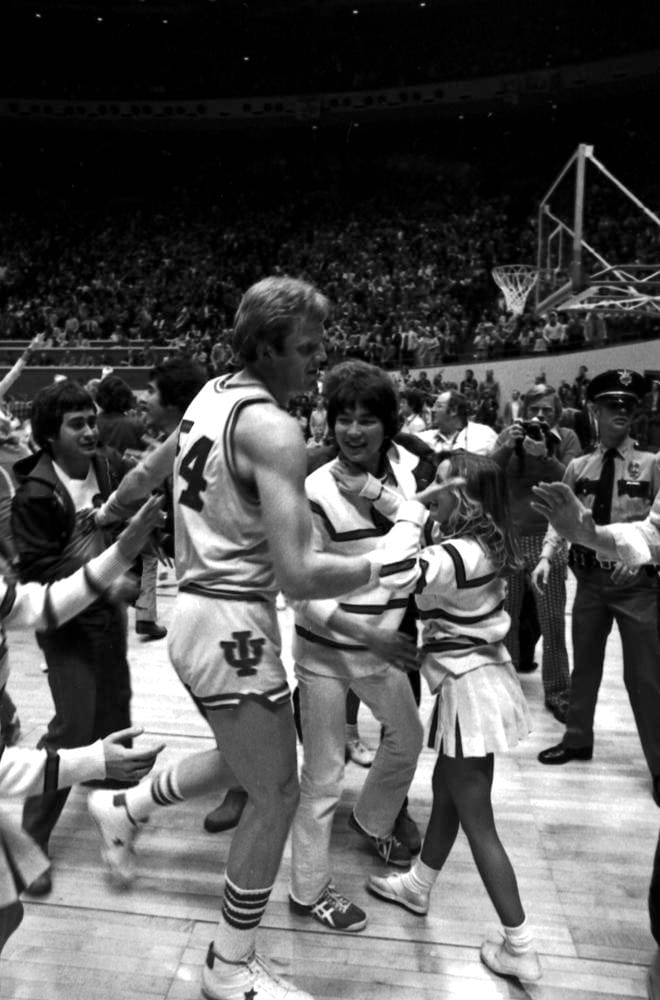
Mark Deal, the IU football player, described being in Assembly Hall for the Michigan game, saying, “That was incredible in Assembly Hall. That day it blew the roof off of it when Benny tipped it in (at the buzzer). That was truly one of the best games ever in Assembly Hall, and certainly a memory there that all the students shared.”
By this point, the win column was growing strong against zero losses. In fact, going back to the final game of the 1973-74 season, through the 1974-75 season, the Michigan win was the 49th regular season win in a row for the Hoosiers. “There’s a lot of pressure when you’ve won thirty-one games in a row the prior year before losing, and that bullseye just gets pretty big,” said Abernethy. “I think Coach Knight probably knew, maybe even more than us players, how difficult it would be to withstand the onslaught that everybody is going to try to take at us. I think we were determined, though, and mature enough to say, ‘Let’s go.’”
Crews knew teams were looking to beat them this season. He said, “Coach reminded us before our senior year. He was reminding us because we had already won three Big Ten championships going into our senior year, and people would give us their best shots.”
“We had a veteran team,” Abernethy said. “Scott May, Quinn Buckner, Bobby Wilkerson, and I were all seniors. Kent Benson was a junior. All five starters had played a lot of basketball and had been through some of the battles. That helped us stay focused.”
The home court advantage is an asset for a team, and Assembly Hall did not let the Hoosiers down. Jim Crews said the team didn’t mind going on the road. “We kind of relished the competition and everyone knowing it was just us, whatever 20 people, whatever number of people there were in terms of players, coaches, managers, and so forth, on the road against, you know, 15,000, 18,000, or 19,000, fans in whatever arena we were playing in,” he said. “And that was fun. We thought that was a great challenge. We stepped up.”
The 21-0 Hoosiers were down early by 11 points in a road game at arch rival Purdue on February 16, 1976. John Archer, a high school senior in Crawfordsville, Indiana, at the time, traveled to the game with his best friend. Archer said, “IU rallied in the second half for the victory, winning 74 to 71. A particular play stood out with Bobbie Wilkerson and Scott May on a fast break, with the ball never touching the floor for the score. What a dominating team, the likes of which we will never see again.”
The Hoosiers played almost equally well at home, on the road, and at neutral sites in the regular season. The home games resulted in 13 wins averaging just under 84 points per game, giving up 64. Away games had 12 wins with an even 83 points per game and 66 for the opponent. Neutral sites tallied two wins at 80.5 points per game for IU and 66 for the opponents. The final eight games of the regular season were all double-digit wins except for a three-point victory at Mackey Arena in West Lafayette. The end of the regular season marked an incredible 57 straight regular season victories across three seasons. The Hoosiers won their fourth Big Ten championship in a row, and completed their second 18-0 undefeated Big Ten season in a row.
The NCAA tournament
“I’d have to say our road to the Final Four was the toughest. I mean, every game was something that we had to prove ourselves, and we did it by executing our offense and playing our team defense and playing to our potential with poise that Coach Knight always talked about,” said Benson. “The other thing that Coach Knight always talked about, and everybody on the team will agree with this, is that mental is to physical as four is to one. The mental is four times greater than the physical. We knew that we could physically accomplish great things. It was the mental aspect of us being mentally prepared. We were physically prepared for the games and Coach Knight did a great job, too, of preparing us mentally.”
The team was determined to capture the national title. Jim Crews said, “We knew the bottom line was the only thing that we hadn’t accomplished as that group was the national championship. We’d won all these other different tournaments. We’ve won the Big Ten four years in a row. We went undefeated twice in the Big Ten. The only thing was that the cherry on top was the national championship.”
The Hoosiers did not have an easy run against their NCAA opponents, who had a combined 125-20 record and top-ten final AP poll rankings. They played 23-5 St. John’s in the round of 32 (the NCAA tournament only had 32 teams that year); 23-4 Alabama (#6) in the Sweet Sixteen; 27-1 Marquette (#2) in the Elite Eight; 27-4 UCLA (#5) in the Final Four; and 25-6 Michigan (#9) in the National Championship game on March 29, 1976, in Philadelphia.
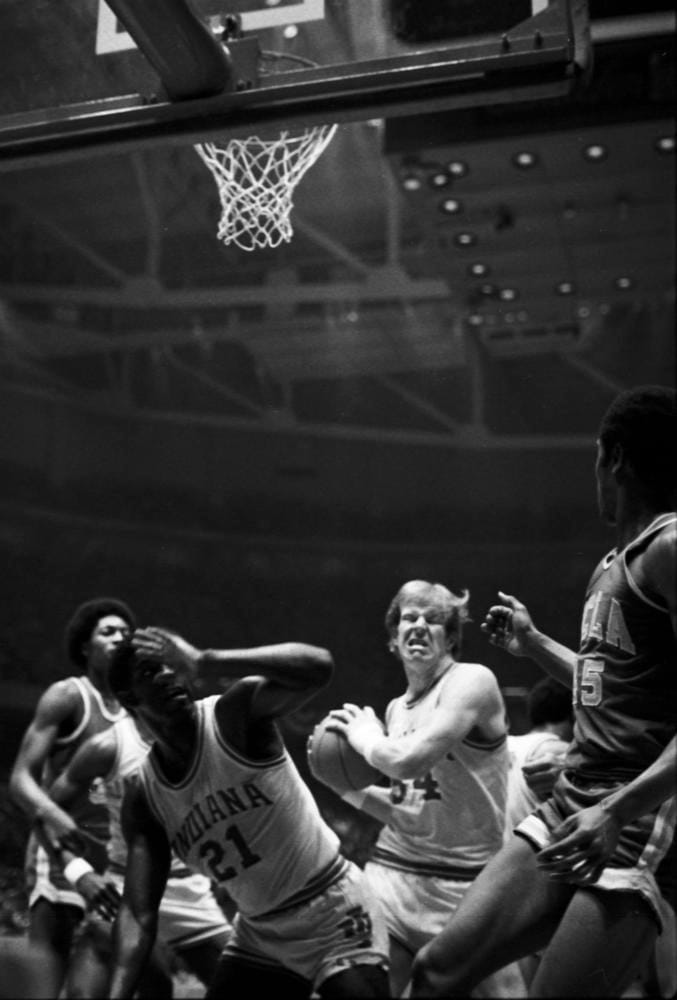
“You know, what was kind of amazing is we were working on fundamentals the week of the Final Four,” said Crews. A Coach Knight-led team would not lose a game due to poor fundamentals. And his players had the will to prepare to win, even late in the season.
Don Fischer set the scene for the championship game. “They played Michigan for a third time that year and played them in the national championship game,” he said. “That was the first time that two teams from the same conference had ever been in an NCAA tournament championship game. And those two teams, of course, battled it out.”
Abernethy likewise saw the game as a battle with Michigan. He said, “I think there was confidence playing Michigan in the championship, but there was also a realization that it’s hard to beat a team three times in one season. And Michigan was a very good team. They had some great players. So, we knew it was going to be a battle.”
“Our focus when we went to Philadelphia was staying focused on the task at hand,” said Kent Benson. “Listening to the game plan that Coach Knight had put together, the scouting report, and just playing to our potential, playing with poise. And executing our offense and playing our team defense. And it didn’t really matter who we played against because we were always playing to our potential."
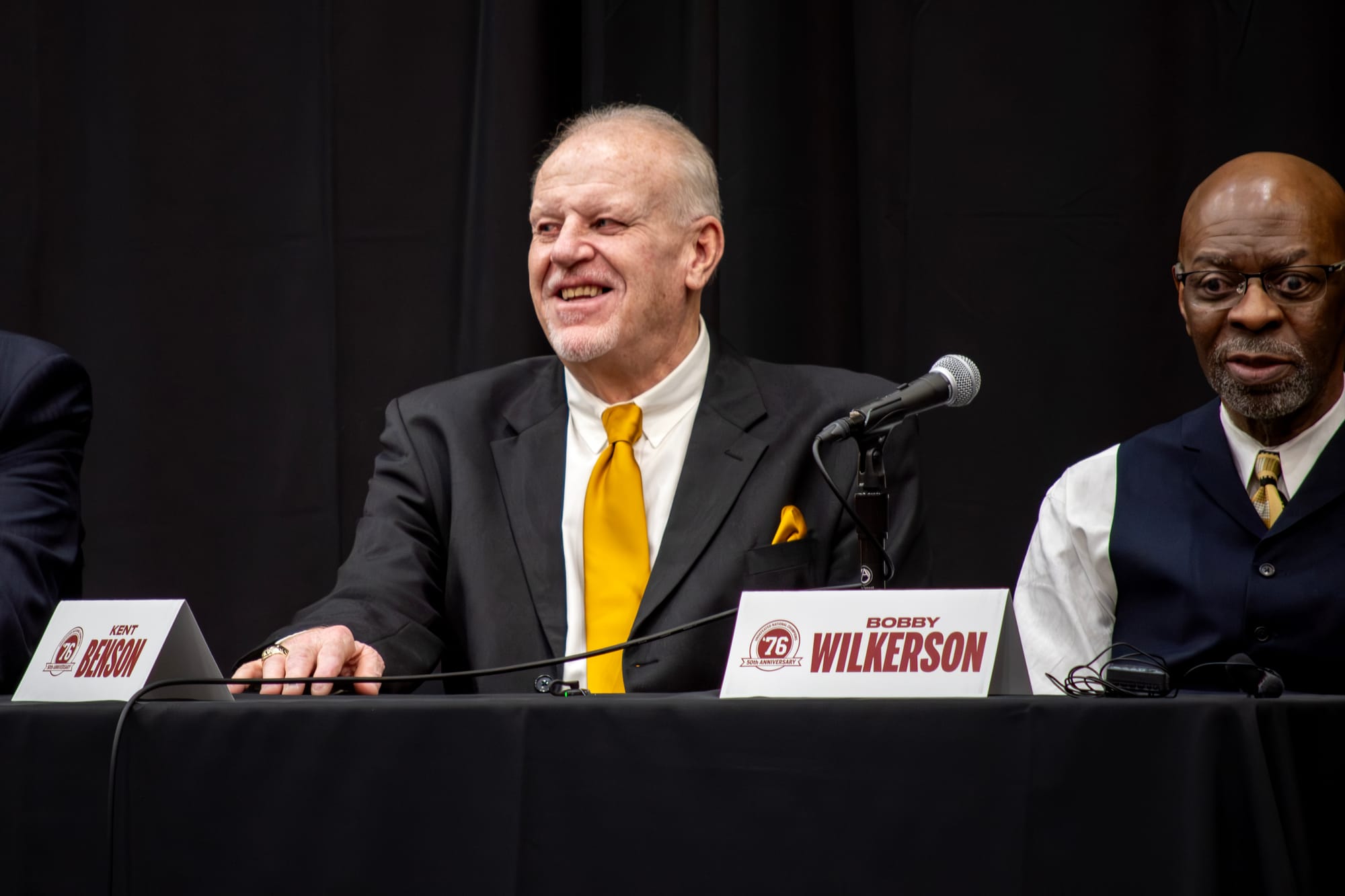
Fans, too, anticipated the significance of the final matchup. Angelo Pizzo, who wrote and produced the iconic sports movies Hoosiers and Rudy, graduated from IU in 1971 and was in Los Angeles for graduate school during the 1976 season. He flew back to Bloomington to watch the national championship game. “I remember making a decision that I wasn’t going to go to Philadelphia. But I wanted to share the experience of crowning the real champions with all my friends in Bloomington. I just knew there would be great parties. I knew it’d be a really fun time. And so I flew back just for that game. I watched in my best friend’s house with his family. I’ll never forget it.”
Krisna Hanks, from the IU Pom-Pom Squad, traveled to the game individually in Philadelphia to meet her brother since the squad did not go. “It was an incredible time. There was huge representation from the Bloomington crowd. Having come from a basketball family, I was used to the intense build up for a championship game, but having seen up close so many games, I had confidence that the team could do it one more time. IU fans are the absolute best and can create an electric, loud, and positive atmosphere wherever they go.”
In that battle for the national championship, IU’s Bobby Wilkerson was knocked out of the game with an injury only a few minutes into the first half. “Bobby was the best athlete by far on our team,” Quinn Bucker said. “I think that the underlying reason we were able to withstand losing Bobby is we’d lost Scott the year before, and there’s no better teacher than experience.”
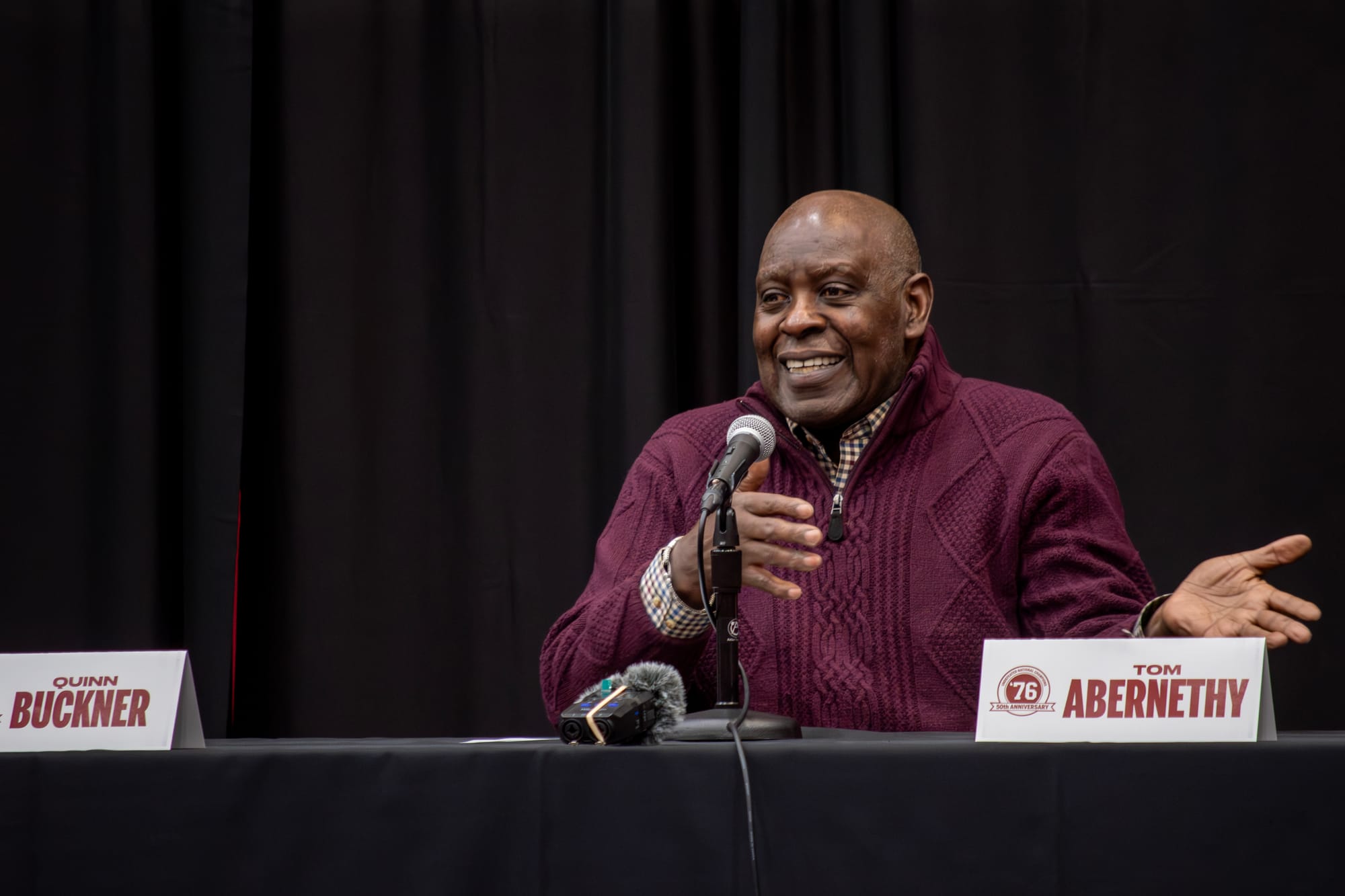
Jim Crews helped fill the void left by Wilkerson’s early injury. “My role was to come in off the bench and play, you know, and some games I’d play a ton and some games I’d play less. It just depends on the game situation,” Crews said. “No one expected what happened to Bobby. And obviously Bobby was so instrumental in our success. But when he went down, you don’t have time to think about it. I mean, you just gotta go in there and play. And that’s what everyone did on the team.”
The Hoosiers hung in after the unexpected injury. “We were down a little bit at halftime,” Don Fischer recalled. “And then the second half, we just took the game over. There was no contest. I mean, they just dominated Michigan the entire second half.” The Hoosiers trailed 35-29 after the first half, a six-point deficit. They outscored Michigan 57-33 in the second half to win 86-68, an 18-point victory to secure the national title.
Coach Knight motivated the team at halftime to finish out the season on a high note. Abernethy recalled of Knight, “He definitely let us know that we weren’t playing up to our potential. But he and the assistant coaches made some adjustments. And I think the biggest thing was just our defensive intensity. We really picked it up in the second half.”
Benson said, “Coach Knight told us in a prophetic way back in 1976 at halftime that we had an opportunity to make history: ‘In the next 20 minutes, you can make history.’ And we didn’t know what that was all about really until we experienced it.”
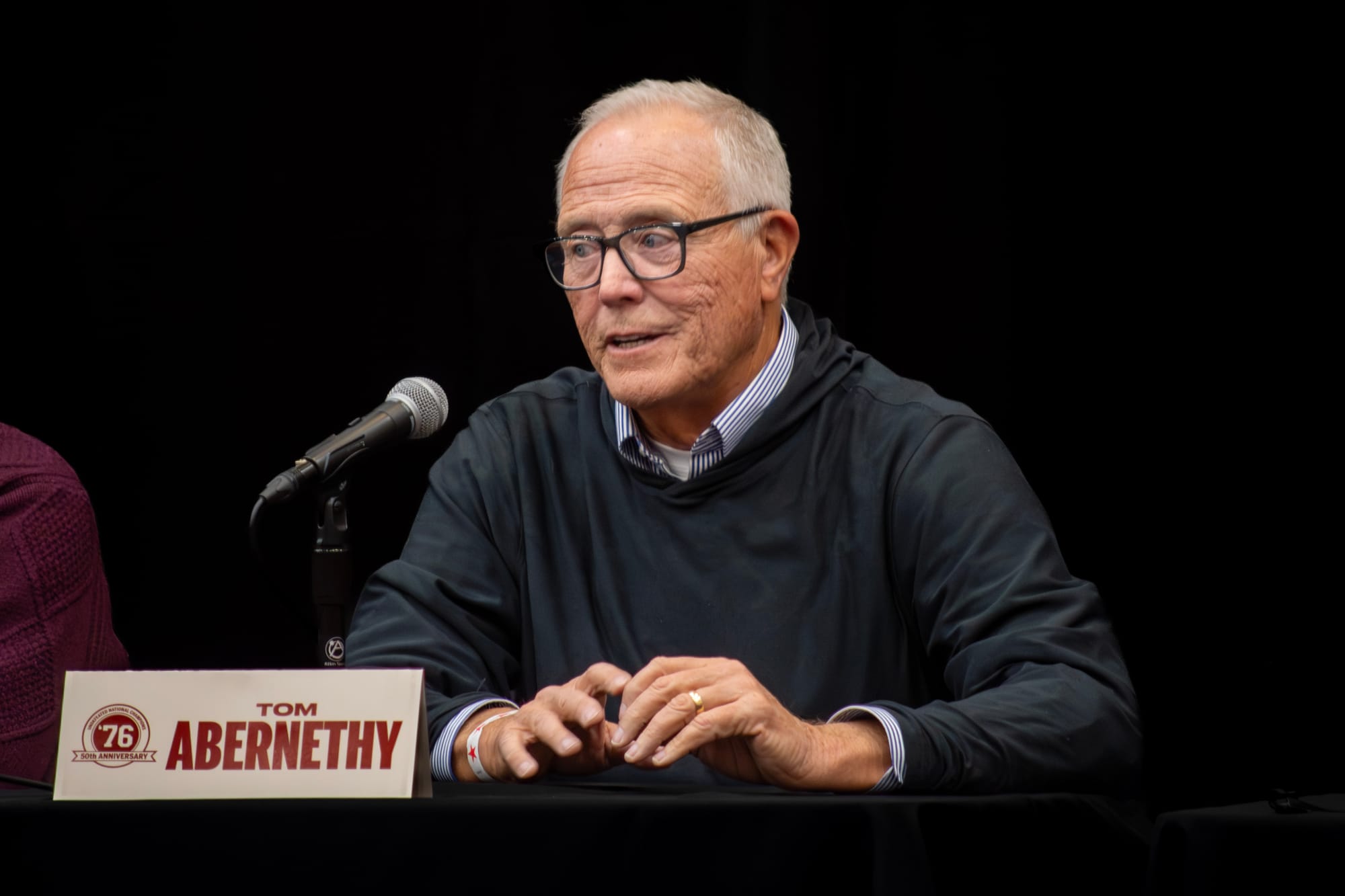
Abernethy talked about how the guys played in the second half. “Quinn Buckner in the second half was unbelievable. Could have been the best half of basketball I’ve ever witnessed, the way QB played. Benny played unbelievably well that second half. Scotty May, those three guys, they were not going to be held back, and we ended up obviously winning that game.”
Don Fischer has a clear memory of the end of the title game. “In the last minute and thirty seconds of that game, Coach Knight started taking those starters, those seniors, Quinn Buckner, and Scott May, Jim Crews, and Tom Abernethy, all those guys, he was taking those kids out of the ballgame one by one. And it was just an incredible, emotion-filled moment for that basketball team, knowing that they were going to go unbeaten and knowing that they were going to win their first national championship under Knight. And it was such an emotional time,” Fischer said. “I was 29 years old at the time. I’d been on the job for three years at that point. And it was just special, it was just a special moment. It’s one that I’ll never forget.”
As for the players, Abernethy reminisced about the final seconds of the National Championship game. “It’s hard to describe the feeling,” he said. “It’s just a — it’s a great feeling of accomplishment. And for the seniors, it was the perfect way to end our careers.”
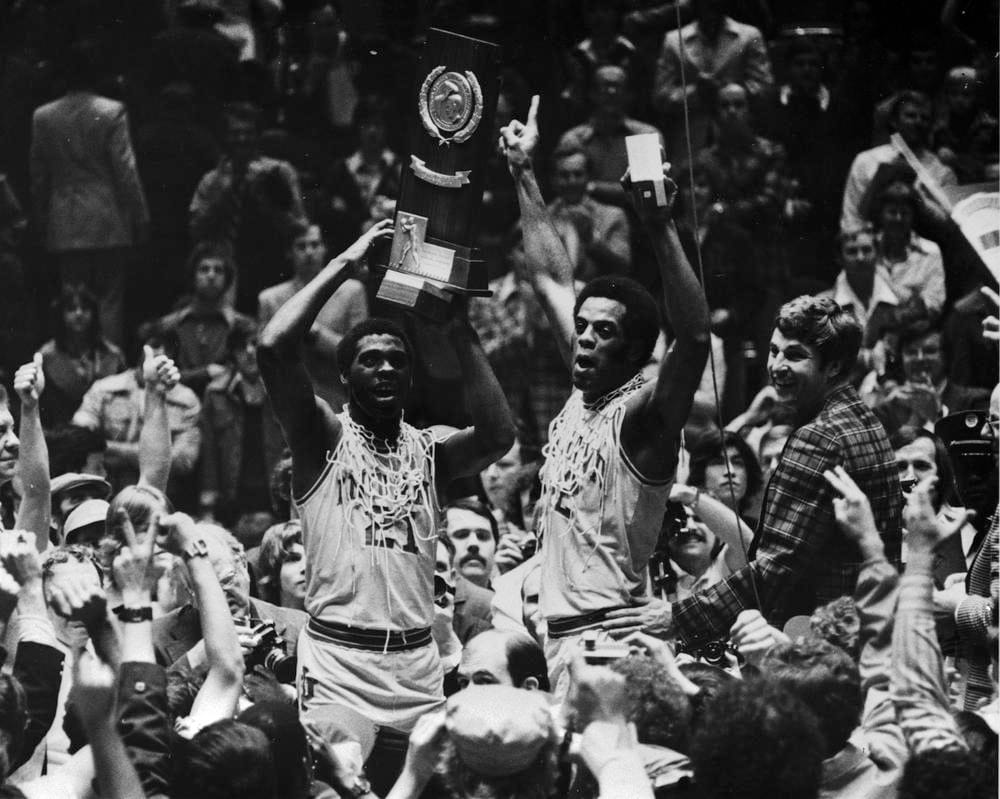
The celebration after the National Championship
“It was insane. It was crazy,” is how Angelo Pizzo described the scene in Bloomington. “We went on campus. I remember going to Showalter Fountain and diving in and partying. So yeah, we partied hard that night. We closed the bars. It was just a nonstop party the entire night. It was crazy everywhere. The entire town felt like it was on a psychological balloon. It was a lift that was so high.”
Mark Deal was on campus as well. “I went to Showalter Fountain where people were jumping into the water and those kinds of things, doing all kinds of silly things there at Showalter,” he said. “The campus went crazy. It was a great celebration.”
Terry Bradburn was a freshman at IU at the time. She watched the game with about ten friends in a dorm on campus. “A lot of people poured out of their buildings, yelling and cheering,” she recalled. “I went with some friends and headed to Showalter Fountain. It was a cold night, and people did get in the fountain and just splashed around. The atmosphere was just electric with excitement.”
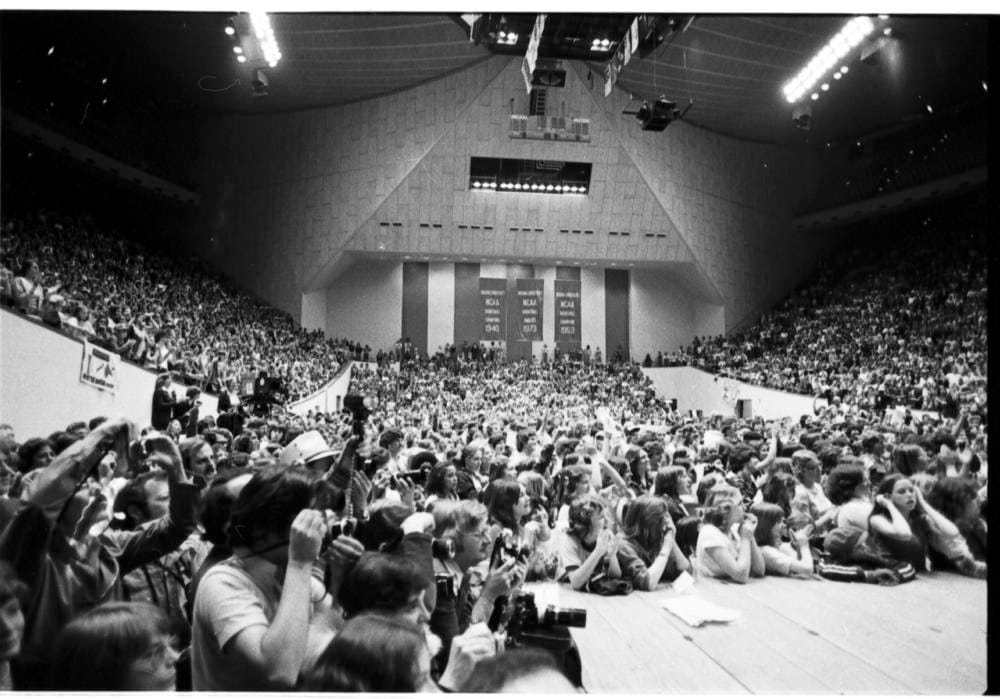
“The city was not prepared for the great excitement that the citizens and the students let out when that championship was won,” said Jawn Bauer (the father of the author of this story), a junior track athlete at IU in 1976. “It was a wild time. There were mass celebrations, there was dancing in the streets — literally, dancing in the streets.”
Alan Pointer, a retired sergeant from the Bloomington Police Department, was working the night shift the evening of the championship game. “It was the typical celebration,” he said. “The whole downtown was flooded with people. We had extra people come in to take care of the crowd.” Pointer said in comparison to other events he covered as a police officer in his career, the 1976 celebration was tame. Little 500 weekends were always the worst, he said, and the later basketball championship celebrations resulted in more damage. “1976 was not that bad. Of course, it was the first one that Knight won. So, you know, it was a big deal, but everybody was just happy.”
Mark Deal recalled the team returning to Bloomington from Philadelphia the day after the game, greeted by a large crowd at Assembly Hall. The football team had spring football practice that day, and players had to make their way through the throng to get to their locker rooms at the IU Fieldhouse. “What’s now the Blue Lot parking lot on the south entrance was just mobbed,” Deal said.
Jim Crews appreciated the crowds from the team bus. “On the way back from the airport, people were out on the roads, just waving and holding signs and all that stuff. So that was amazing.”
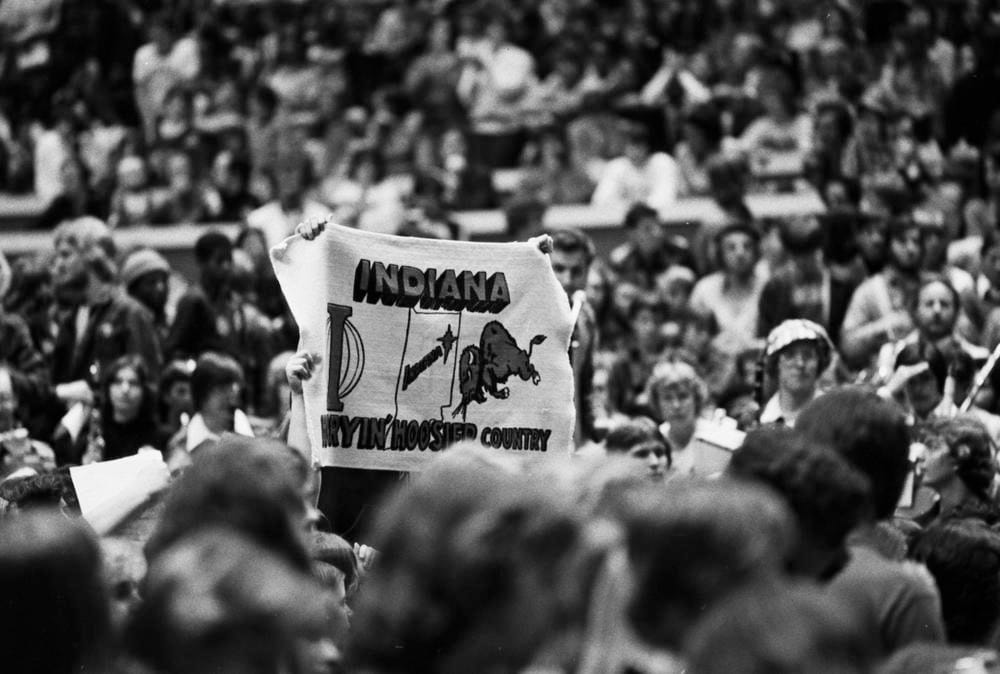
“It was just so cool. 37 and 46 were just packed with people, lined up cars and signs and banners. 46 was full of people and students all the way to Assembly Hall,” said Kent Benson. “When we got to Assembly Hall, the crowd was just even more incredible. It was an experience where we kind of said, ‘Okay, task completed. Task accomplished.’ And our task was to not only win a national championship, but go undefeated in ’76, because we felt we should have been able to do that in ’75 [but] ended up the season with 31-1.”
A theme common to these memories is the joy shared by everyone on the IU campus and in Bloomington. The victory brought people out and brought people together. “A team can bring a community together, it really can,” said Abernethy. “And I think, especially back then, the connection between the university and the town was very strong. The success of the basketball team was something that everyone took pride in.”
Angelo Pizzo noticed the sense of communal pride as well. He remembers flying back to Los Angeles wearing IU gear and being high-fived on the plane. “We’re all part of a tribe and you celebrate as a community,” he said.
Jon Wertheim, who is now well known as a CBS 60 Minutes correspondent and senior writer for Sports Illustrated, grew up in Bloomington and was a child at the time of the championship. He shared a few memories from 1976. “This is totally random, but there was a bicentennial parade on July 4th, and there was still this glow from winning the NCAA title,” he said. “I remember this bicentennial parade kind of doubling as this victory parade for the team.” The town hung onto the victory and continued to take pride in the Hoosiers. Wertheim continued, “The other thing I remember is you could buy a 1976 Indiana National Champs T-shirt in Bloomington for about three years. They got a lot of mileage out of that. You could still get plenty of merch for years and years after the title.”
Accolades of a successful season
The late Bob Hammel, legendary Bloomington sportswriter and author of numerous books about Indiana basketball, praised the work of Coach Bob Knight in assembling what became the 1976 team. He discussed Knight’s efforts and the team’s accolades in an interview with the author on June 27, 2018, in Bloomington. “He recruited what really was the best class I’ve ever seen with Quinn Buckner and Scott May and Bobby Wilkerson and Tommy Abernethy and Jimmy Crews. In their four years, they went 108 and 12. They won four Big Ten championships, and that’s when Indiana became Indiana.”
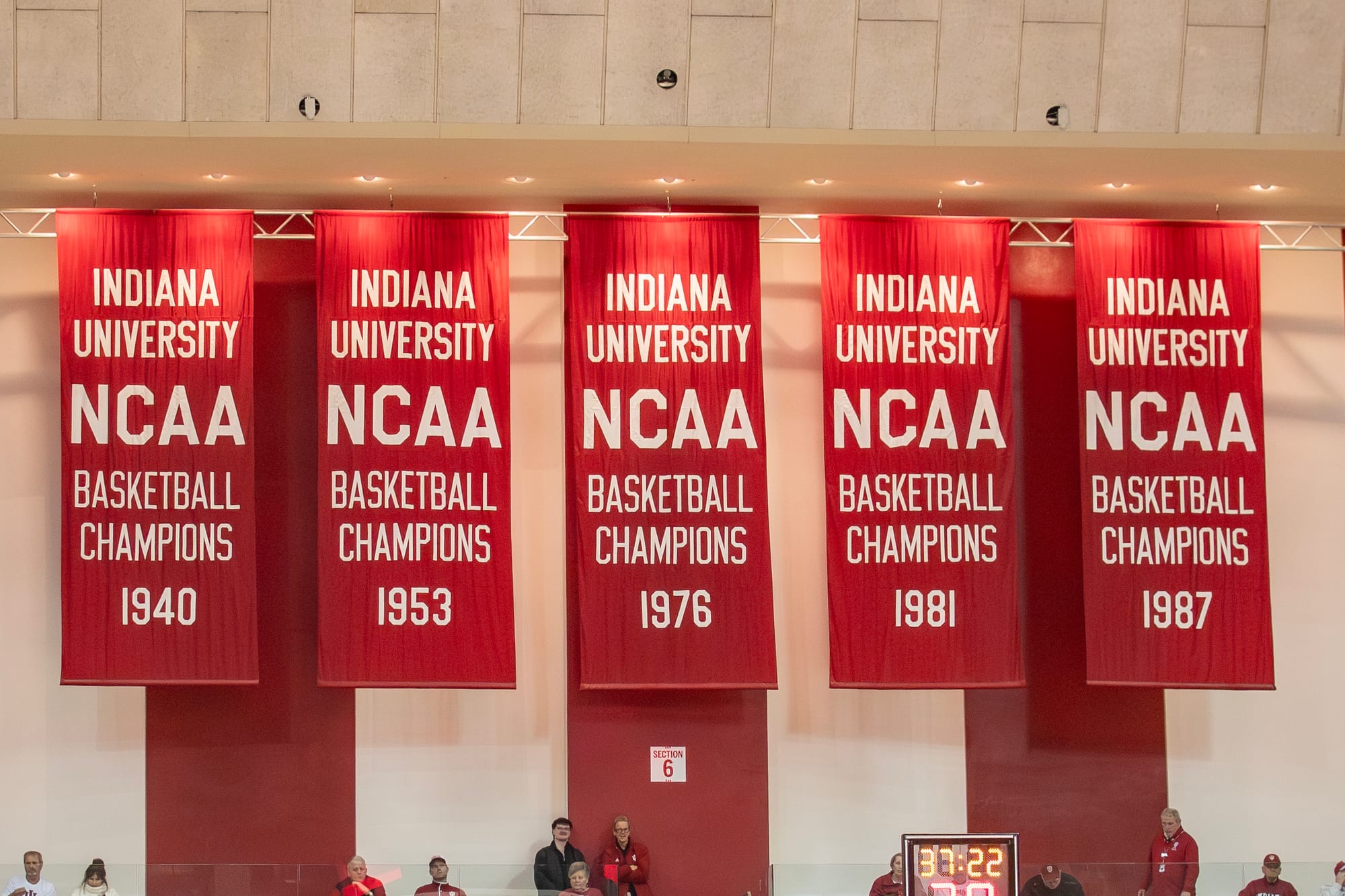
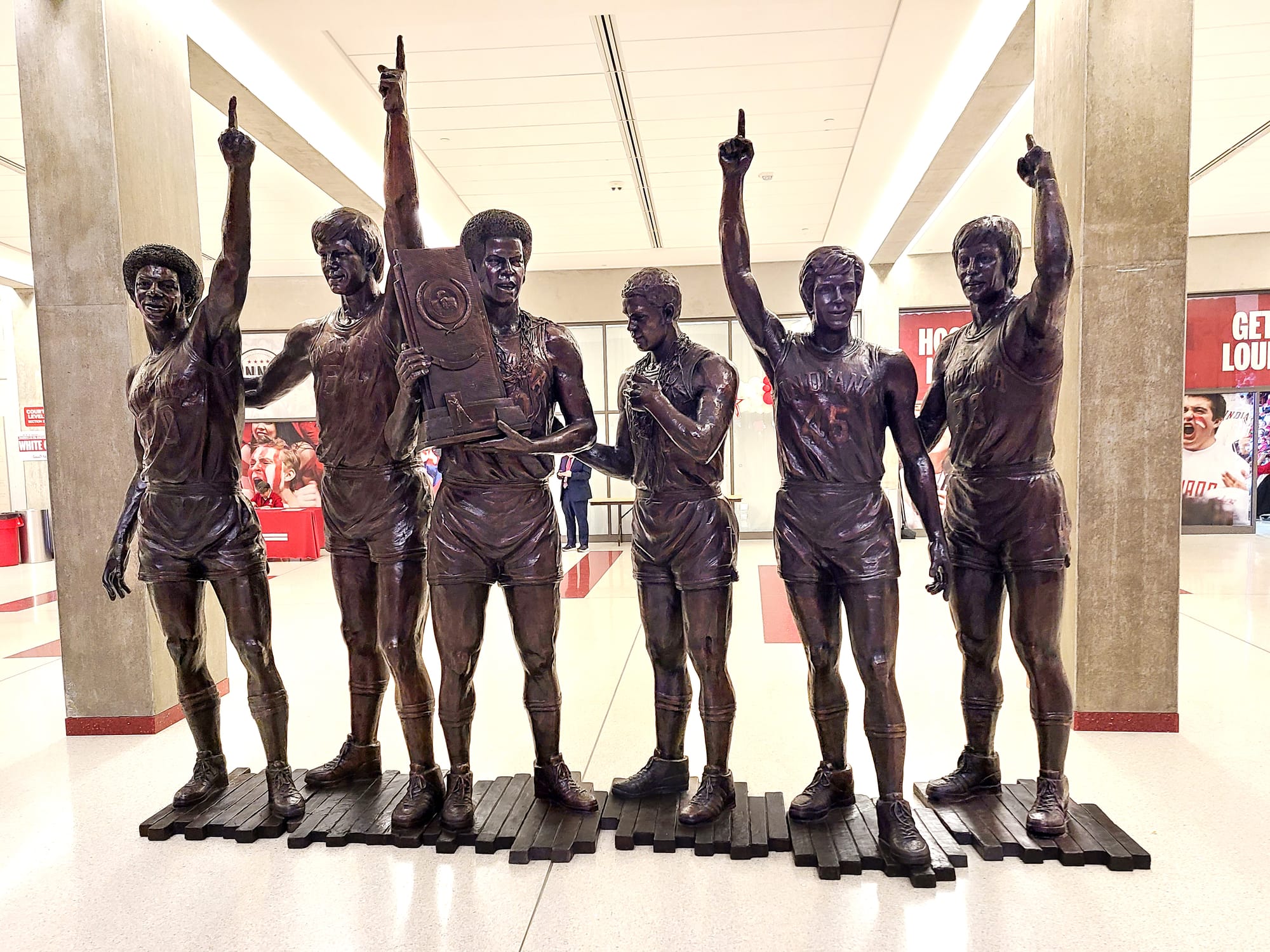
The seniors of the 1976 team won 90% of their games over four seasons, including 92.2% (59-5) in conference play. The closest in the Big Ten was Michigan, who over the same four seasons went 79-31 for a 71.8% win percent and 44-20 (68.8%) in the conference. Five out of the ten conference teams had a winning record. The others were Purdue, Michigan State, and Minnesota. Of course, the seniors didn’t do it alone. They had a great team around them in 1975-76, and the prior seasons they played alongside the likes of future NBA draft picks Steve Green and John Laskowski. The seniors in 1976 who went to the NBA were Scott May (1st round, 2nd overall pick), Quinn Buckner (1st round, 7th overall pick), Bobby Wilkerson (1st round, 11th overall pick), and Tom Abernethy (3rd round, 43rd overall pick). Junior Kent Benson was the 1st overall pick in the 1977 NBA draft and Wayne Radford entered the NBA in the 1978 draft as the 27th overall pick in the 2nd round. All five starters are members of the Indiana University Athletics Hall of Fame along with Coach Knight.
In the AP poll for the 1975-76 season, the Hoosiers were ranked number one in the pre-season poll. They maintained that ranking throughout the entire season, ending as the undisputed number one team in the nation. The Hoosiers were also ranked number one on the Coaches Poll for the entire season. Numerous individual awards at the end of the season went to Indiana players including Scott May, who received the Naismith Award, AP Player of the Year, UPI Player of the Year, NABC Division I Player of the Year, Sporting News Player of the Year, and the Rupp Trophy. Kent Benson was awarded the NCAA Tournament Most Outstanding Player Award. Additionally, May and Benson shared the Helms Foundation Player of the Year Award and both were consensus first team All-Americans. Coach Knight received National Coach-of-the-Year honors in 1976 as well.
Reflections on 50 years as the last undefeated team
Reflecting on the accomplishment 50 years later, athletic director Scott Dolson recalled Bob Hammel’s aptly named book, Perfect: Bob Knight and Indiana's 2-Year Quest. “The team established a standard that everybody tries to live up to and tries to hit,” he said. “As a fan, that’s an enormous sense of pride that, even 50 years later, you look at the fact that people are still trying to hit that standard that this team established a long time ago.”
“Going undefeated, that’s great,” Jim Crews said. “We were just kind of living in the moment, but you know, now it’s a historical thing. And when you’re making history, most of the time, you don’t know you’re making history.”
Forward Jim Roberson recalls that he and fellow freshman Scott Eells had the chance that season to witness some of the best games he has ever seen. “Alabama, Minnesota, UCLA – it didn’t matter, those games were outstanding,” he said. “A team today, they couldn’t have held the candle when they were in their prime.”
Eells echoed Roberson’s thoughts. “We were blessed to really bring all these guys together for that one point in history,” he said.
Bobby Wilkerson agreed that the 1976 Hoosiers were in a class of their own. “Fifty years is a long time,” he said. “The most important thing is we will always be a team, no matter what. We are probably the greatest college team to ever play, and that’s something to hold onto. It’s such a blessing. IU and Indiana has the best fans in the world.”
Buckner remembers Knight telling fans at the end of the season that they’d never see another team like it. “Now, all of us were young enough and we were stupid enough not to know exactly what that meant,” he said. “But, obviously, that’s been the case. No one has gone undefeated in the last 50 years. That’s not what he was alluding to. What he was talking about was how hard we prepared. He did a tremendous job in preparing us for the success we had.”
Dolson said the team’s success has had a lasting impact.
“As Athletics Director, I think the 1976 season adds value in two ways,” he said. “It’s the enormous sense of pride that you have, that you work for. We’re part of an athletics department and university that has such a prestigious and nationally recognized accomplishment of what they did 50 years ago. Also, it’s a lesson — looking at our football team this year, at Doc Counsilman and what he did in swimming, or Jerry Yeagley in the men’s soccer program, and all the great history about athletics — the common thread in any great season is a combination of great leadership and great people working really hard together towards a common mission. When you have examples of seeing that it works, I think then it gives everyone the motivation and confidence to work towards those standards.”
Bob Hammel always knew his history and statistics with perfect recall. He added perspective to the legacy of the team from a poll in 2013. In his 2018 interview, Hammel said, “2013 was the 75th NCAA Final Four, so they did a poll, and they picked the all-time best coach, the all-time best team, and the best player for those first 75 years. Well, of course, Wooden, with all his championships, was the coach, and at center, Kareem Abdul-Jabbar was the best player. The 1976 IU team was the team. That was ahead of all those UCLA teams, ahead of all the others. That team was singled out, and it's still the last unbeaten champion.”
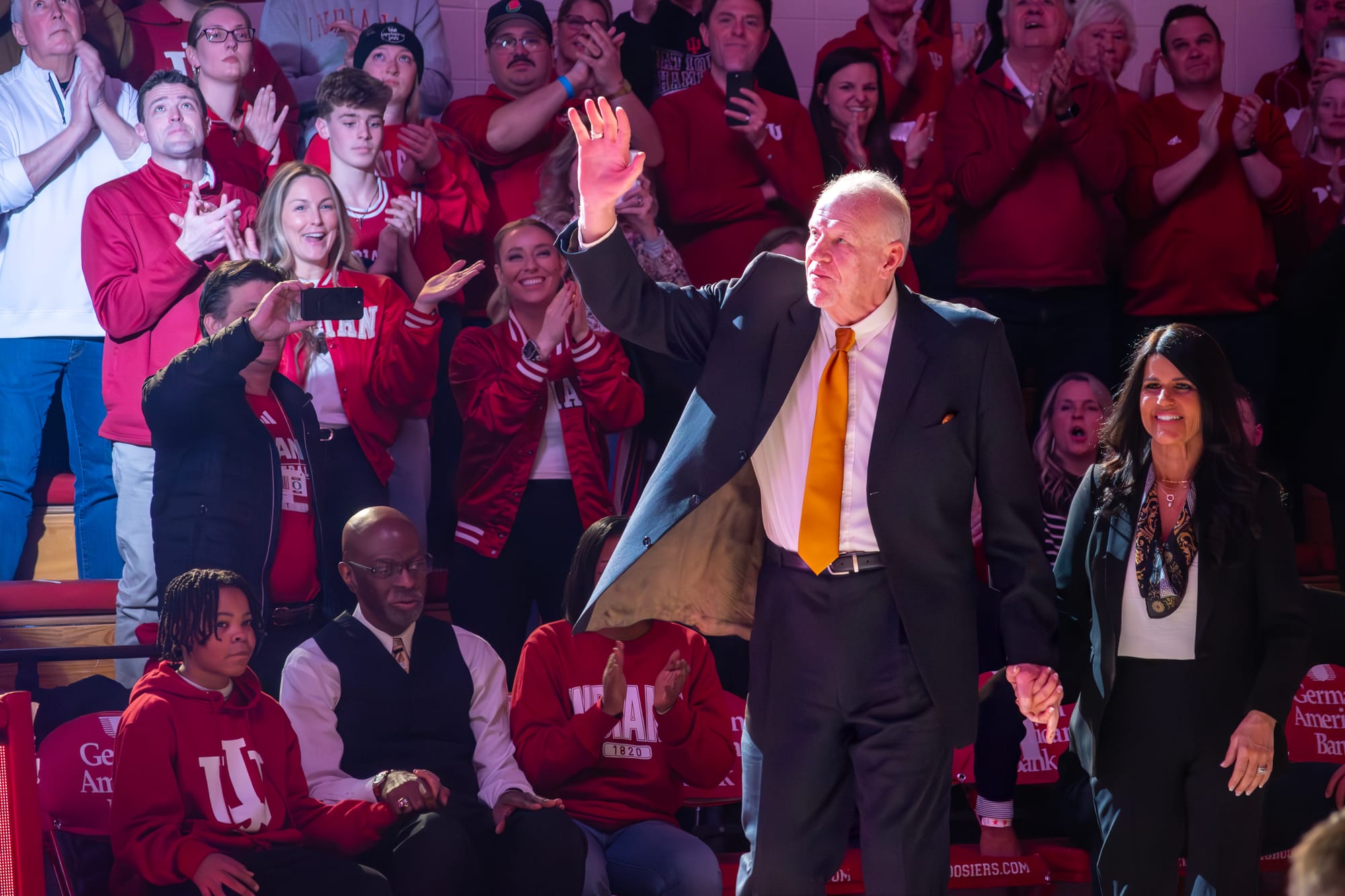
Wertheim said he’s struck in retrospect by what good guys were on the team. “There was no scandal, there was no sketchy academic admit, there was no police beat … it’s not unlike the football team a few months ago. It’s very hard not to like this team,” he said. “I’m also just struck by the absence of a star. You think of the great teams, especially in college sports, and it’s Patrick Ewing, and Michael Jordan, and Hakeem Olajuwon. You go through up to the present, it’s very hard to win a national title and not have a single player on the team who’d score more than 10 points for his career in the NBA. I think (the 1976 team) was very much a kind of team built in the manner of Indiana. There were a lot of Indiana virtues contained in that team. I think it’s a story that’s aged really well. It was definitely one of these teams bigger than the sum of its parts, and it also was kind of a launching pad for Bob Knight.”
The fact that we are talking about and celebrating the team 50 years later shows the enormous sense of pride so many have in the team and in the traditions surrounding IU athletics. Quinn Buckner explained how Coach Knight articulated the importance of the season. “One of the most meaningful things Coach said after we won, he said something to me that I didn’t fully grasp. He said, ‘You’ve done something for the people in the state of Indiana. You’ll never understand what you did for them,” Buckner said. “We just had it happen again in football. Because the ethos of Indiana is about sports, and we were able to bring it on the basketball side, and people have lived with that for 50 years. What it does is it brings people together. That’s really what he was telling me.”
Kent Benson said the championship win seems like yesterday. “Not a day goes by that people aren’t asking, ‘What was it like to win a national championship?’ ‘What was it like to be undefeated?’ ‘What was it like to play with Quinn Buckner, Scott May, Tom Abernethy, Jim Crews, Bobby Wilkerson, with the team you had beside you?’ ‘What was it like to play for Coach Knight?’ These are questions that I get inundated with all the time for the last 50 years.”
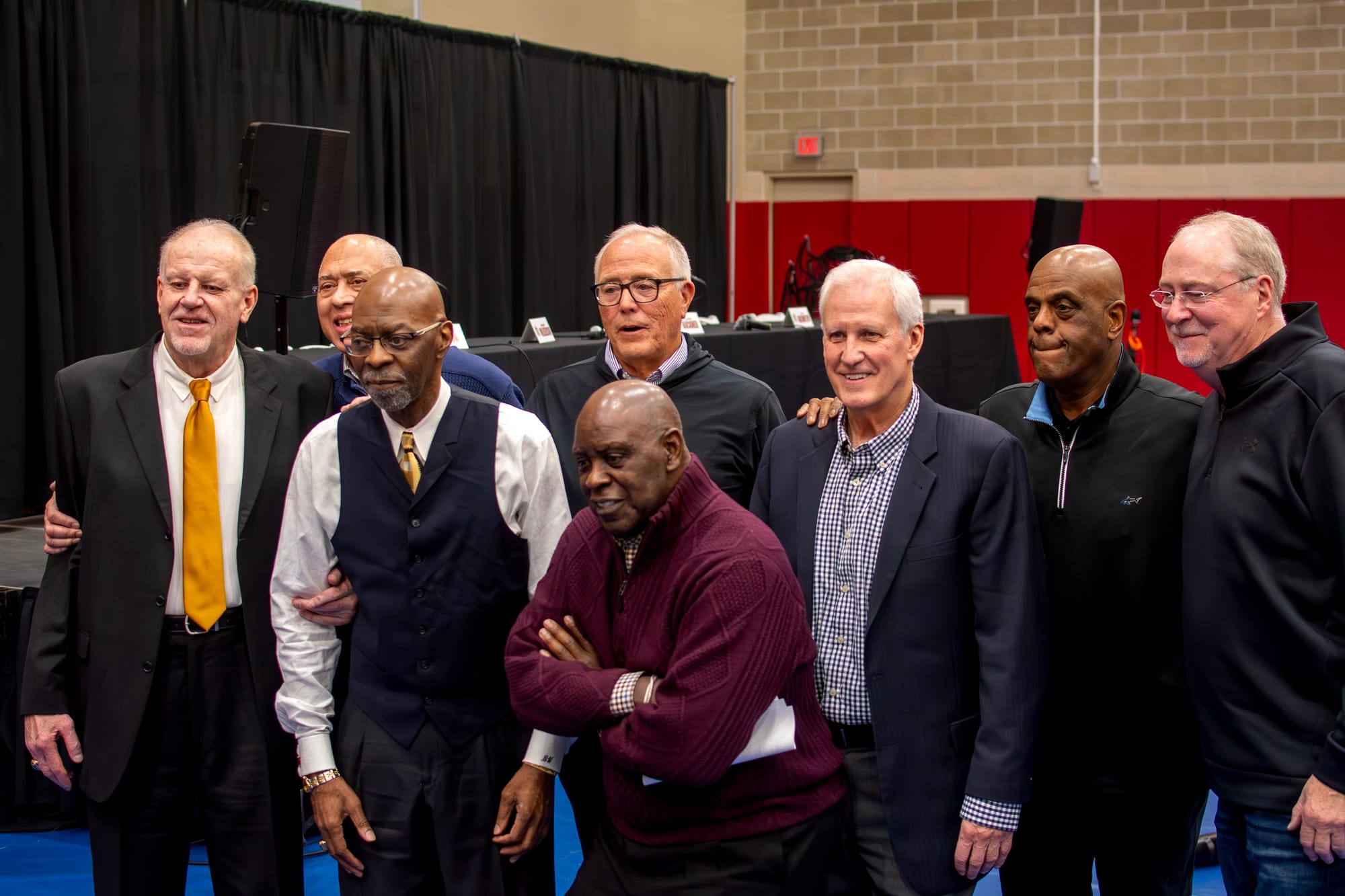
Jim Crews said it never crossed his mind that people would be talking about the season 50 years later. “I mean, we did it, and if someone else does it, that’s great. I just never thought about how long it's going to last.”
Abernethy said if another team finishes a national championship run undefeated on the season, he will celebrate for them. The 1976 Hoosiers agree they would gladly welcome another team into the ranks of the undefeated. Abernethy said they have simply had the good fortune to hold onto the honor for the last 50 years.
Watch the full broadcast of the Indiana vs. Michigan 1976 National Championship game.
Special thanks to the family of the late Mr. Bob Hammel for allowing us to include quotes from an interview he sat for with the author of this article in 2018. Also, thank you to Scott Dolson, Mark Deal, John Decker, and Charlie Duffy, and all of IU Athletics, for welcoming the author to the February 9, 2026, IU vs. Oregon basketball game during which the 1976 team held a pre-game press conference and was honored at halftime.