School Matters: ‘Value-added’ Study Gives Local Schools High Marks
Steve Hinnefeld investigates a state-wide college prep study.


In this installment of Limestone Post’s “School Matters” column, writer Steve Hinnefeld investigates a state-wide study assessing Indiana public school corporations’ effectiveness at preparing students for college.
Public high schools in Bloomington are doing much better than expected at preparing students for college, according to a Ball State University study. Monroe County Community elementary and middle schools and Richland-Bean Blossom schools were about average for performance.
The study, “A ‘Value-Added’ Measure of School Performance in Indiana,” is by Michael Hicks and Dagney Faulk of Ball State’s Center for Business and Economic Research.
It relies on the percentage of students who in 2025 were proficient on third grade and eighth grade ILEARN exams and the share who surpassed college-ready benchmarks on the SAT, which Indiana students take in 11th grade. But comparing schools using raw test scores would be misleading, Hicks said, because research has consistently shown that scores correlate with students’ socioeconomic status. The Ball State researchers calculate that poverty explains 35–40% of the variation in scores among Indiana school districts.
Their study adjusts for that by calculating expected scores for each district — adjusted for poverty, school size, demographics, spending, and the number of English learners — and comparing that with its actual test results. The difference is a “value-added” score that shows if a district is doing better or worse than predicted.
“A study like this is important to remove some of the subjectivity of test score analysis and replace it with a far more objective measure of what’s actually happening in schools,” Hicks said in a phone interview. “It’s a measure of factors that schools are able to control.”
Indiana’s 290 school districts all receive a positive or negative value-added score in the study. They are sorted into five groups, or quintiles, based on scores.
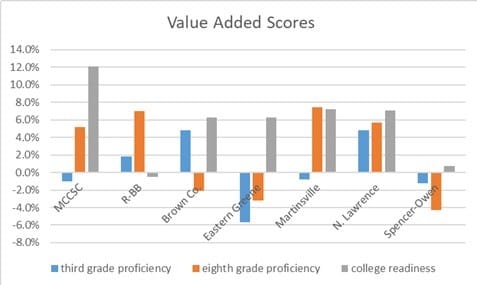
For Monroe County Community School Corporation, the percentage of students who met the college-ready benchmark on the SAT was 12.9 points higher than predicted. That’s near the top of the top quintile. Among large districts, only Avon and Danville — suburban districts near Indianapolis — did better.
Value-added scores for MCCSC third graders were in the middle quintile, about average; for eighth graders, they were in the second quintile, above average. Richland-Bean Blossom schools were in the middle quintile for third grade and high school and in the fourth quintile for eighth grade. Among other area districts, North Lawrence and Martinsville schools did well: North Lawrence was in the top quintile for high school and in the second quintile for third and eighth grades; Martinsville was on the top quintile for eighth grade and high school.
Hicks said MCCSC students’ performance on the SAT suggests the district is doing something right. Unlike with ILEARN assessments, schools can’t game SAT results by teaching to the test or devoting time to test prep. The SAT and ACT exams aren’t perfect measures of learning, but they assess a greater breadth of learning than grade-level tests.
“There’s extraordinary evidence that those are among the best measures of deep learning over the K-12 cycle,” Hicks said. Asked if children of highly educated Indiana University faculty might skew SAT results for Bloomington schools, Hicks said it was doubtful, because the study adjusts for demographic differences.
Around the state, the study may produce some surprises. For the most part, top school corporations for value-added scores aren’t the suburban districts where affluent families cluster because of the reputation of the schools. Carmel, Clay, and Hamilton Southeastern schools, for example, were in the middle quintile for third and eighth grades. Scores in those districts were about what was expected given their low poverty rates.
But there were standouts. “Crawford County, Speedway, Brownsburg, Avon, and North Spencer racked up stunning value-added measures,” Hicks writes in a column about the study, published in the Indiana Citizen and The Herald-Times. “The students at these schools passed their standardized tests at levels ranging from 24.2% to 31.5% higher than they were predicted to do, given their community demographics.”
Brownsburg, Avon, and the MCCSC aside, many of the districts with very high or very low value-added scores were small. Crawford County, which stands out for its value-added scores and its improvement over the four-year period that the researchers examined, is a rural district on the Ohio River with 1,200 students in kindergarten through 12th grade.
Hicks said that’s partly because school improvement efforts can have a bigger and quicker effect in districts with few students. “It’s a lot easier for leadership to matter in a small school corporation,” he said. “And it works both ways. It’s far easier for good leadership to have an impact, and it’s easier for bad leadership to have an impact.”
The study is far from the last word on school quality. It relies on standardized tests, which measure only a slice of what matters. It uses tests of math and English proficiency at only three grade levels. As Hicks said, students and parents may put more value on a strong high school band program or on an elementary school that provides personalized learning. The study doesn’t delve into what makes some districts effective at raising test scores.
That said, it should help counter the all-too-common sentiment that nothing in education matters as much as fancy facilities and high unadjusted test scores. And it suggests schools shouldn’t be too proud to learn from districts like Crawford County.
“Whatever is going on there,” Hicks writes, “you should bottle it and sell it to other school corporations.”

Steve Hinnefeld
Steve Hinnefeld is a journalist and former Herald-Times reporter, IU media relations specialist, and IU Media School instructor. He writes about education at inschoolmatters.wordpress.com and lives in Bloomington with his wife.