
How Federal, State Laws Are Reshaping Health Insurance Coverage in Indiana
An estimated 325,000 to 450,000 Indiana residents will lose Medicaid coverage by 2034.

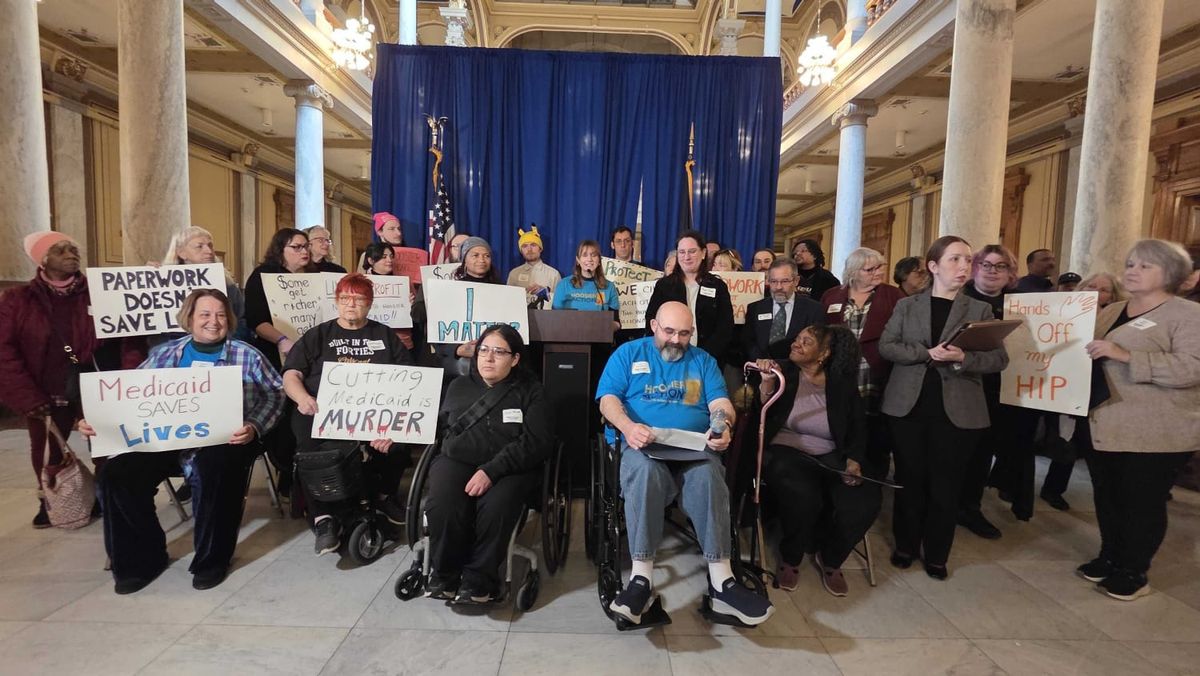
As 2027 approaches, the state of Indiana is facing a compounding health insurance coverage gap.
On January 1, 2027, Medicaid recipients must begin adhering to stricter federal qualifications from H.R. 1 (One Big Beautiful Bill Act) and tighter state requirements from Indiana’s SEA 1 (Senate Enrolled Act 1). Because of these changes, the southern Indiana community organization Hoosier Action estimates that between 325,000 and 450,000 residents will lose Medicaid coverage by 2034.
Though the H.R. 1 and SEA 1 provisions aren’t in effect yet, Tracey Hutchings-Goetz, Hoosier Action’s director of communications and policy, has noticed recipients struggling to navigate and stay on Medicaid within the last year.
“Folks are seeing a real increase in errors on the [Indiana Family and Social Services Administration (FSSA)] side, confusing notices, problems maintaining coverage. I have been doing Medicaid outreach since I started organizing in 2017, and this is the worst I have ever seen,” she said.

Because of enrollment declines and eligibility redetermination changes, including a Medicaid advertising ban, the FSSA projected nearly $466 million in savings for State Fiscal Years 2026 and 2027 in a news release discussing the December 2025 Medicaid Forecast Update.
“Indiana is strengthening the program’s long-term sustainability and ensuring responsible use of public funds,” Indiana FSSA secretary Mitch Roob said. “We must continue working to ensure the program remains sustainable and responsive to the needs of Hoosiers who need it.”
Besides the Medicaid overhaul, enrollment in Indiana’s Health Insurance Marketplace (or Exchange) dropped from around 360,000 last year to about 300,000 in 2026, according to the Centers for Medicare & Medicaid Services (CMS). Hoosiers with Marketplace plans affected by the expiration of Enhanced Premium Tax Credits (ePTCs) at the end of 2025 saw much higher premiums this year, with an overall approved average rate increase of 27.2%.
In addition, Cigna and CareSource won’t offer Marketplace coverage in Indiana next year, leaving only Anthem, United Healthcare, Coordinated Care Corp, and AmeriHealth Caritas, a provider joining the Exchange in 2027. At the start of 2026, the FSSA also removed MDWise as a Medicaid plan option in Indiana, forcing members to choose another provider or be reassigned.
“You can think about the disaster coming for our healthcare system as a series of growing concentric circles,” said Hutchings-Goetz. “The smallest circle that is most impacted right now is the Marketplace people. But then it’s going to expand outward as the system becomes more destabilized. Because when you have a population that is sicker and uninsured, the system relies on having a payer mix of healthy people in there.”
Medicaid, Marketplace shifts
H.R. 1 set a series of Medicaid reforms in motion when President Trump signed the law on July 4, 2025.
On October 1, 2026, a new definition of qualified immigrants for Medicaid and the Children’s Health Insurance Program (CHIP) will take effect, excluding previously eligible refugees, asylees, and other humanitarian populations. On January 1, 2027, Medicaid expansion adults will receive eligibility redeterminations every six months instead of annually. On that same date, Medicaid expansion adults must begin working or engaging in qualifying activities to maintain eligibility.
“New Medicaid applicants will have to demonstrate that they have satisfied the community engagement requirements for one to three (at state discretion) consecutive months immediately preceding the month in which they are applying for Medicaid,” according to the American Medical Association’s summary.
Existing Medicaid adult expansion recipients must meet the community engagement requirement for at least one month between eligibility redeterminations.
Indiana’s SEA 1, signed by Governor Mike Braun on March 4, 2026, includes six-month Medicaid eligibility checks and work or approved activity requirements with quarterly compliance checks starting January 1, 2027. While certain groups, such as medically frail people, are exempt, hardship exemptions like medical emergencies and natural disasters don’t exist. Indiana was the first state to require new applicants to work for three consecutive months for Medicaid eligibility.
The Marketplace’s now-expired ePTCs originated in the American Rescue Plan Act of 2021 and were extended by the Inflation Reduction Act of 2022. These tax credits provided additional subsidies to those eligible for baseline tax credits and extended tax credits to people with annual incomes of 400% of the federal poverty level or higher, allowing them to pay no more than 8.5% of their income for health insurance.
“There’s been an expiration date on these enhanced subsidies for a long time,” said Cole Craven of healthcare insurance planning firm Move Health in Evansville. “We were not surprised by the subsidies going away, but data would support that folks across the country were not aware of these changes or did not know enough about them.”

Declining enrollments
The Georgetown University Center for Children and Families (CCF), which has been tracking Medicaid and CHIP enrollment over the past decade, found Indiana was among the states with the largest percentage decreases from January to October 2025. In January 2025, Indiana had nearly 1.8 million total Medicaid/CHIP enrollees compared to about 1.6 million in October 2025. As of April 2026, the tracker showed just under 1.5 million total Medicaid/CHIP enrollees in Indiana.
CCF mentioned Indiana is one of 16 states where only CMS data, which can lag up to six months, is available for Medicaid adult expansion enrollment. The Indiana FSSA Medicaid Monthly Enrollment Report shows more than 1.5 million enrollees as of May 2026. The state agency’s Medicaid Enrollment Dashboard also reveals a steady decline since March 2025, when there were close to 2 million enrollees.
Regarding child Medicaid and CHIP enrollment percentage declines, CCF found Indiana tops the list with 19.8% in April 2026 compared to January 2025. The state ranked third in absolute decline in child Medicaid and CHIP enrollment with more than 174,000 children. CCF referred to Indiana’s SEA 2 (Senate Enrolled Act 2), another Medicaid reform bill signed in 2025, as the likely cause of the reduction.
According to the Indiana Hospital Association, some of the dip in Medicaid enrollment reflects eligibility redeterminations, but administrative barriers have also contributed to the downtrend. The IHA said many patients turn to emergency departments when they lack access to timely routine care. In 2025, state hospitals saw accelerated growth (16.8%) in emergency department visits through August, compared to relatively flat growth (1.4%) nationally.
“The reality is losing coverage does not reduce the need for care — it shifts care to emergency departments, delays preventive and chronic care, and leads to worsened outcomes and higher costs,” said Laura Brown, IHA’s deputy general counsel. “And coverage gaps also make it harder for patients to afford medications, manage chronic conditions, or access routine care.”

In Monroe County, Elizabeth Higgs lost her Medicaid coverage in December 2025 because she no longer met the income requirements, and she had to pay retroactively for chiropractic appointments. As a self-employed college student who also had a part-time job, the young adult earned too much to qualify for Medicaid, yet she can’t afford the Marketplace.
“My access to Medicaid has been so unstable that I just don’t even try to go to the doctor anymore,” Higgs said. “I was bursting into tears because I felt so ashamed and just, like, dysregulated and unworthy.”
Indiana was also among the states with the steepest Marketplace enrollment decreases from 2025 to 2026 at 16.5%, but that percentage may be higher now. In June, new data from the U.S. Department of Health and Human Services revealed about 19 million people are currently enrolled in ACA Exchange plans nationwide compared to nearly 23 million at the start of the year.

Michelle Higgs, Elizabeth Higgs’s mother, had a Marketplace plan for several years because she and her husband are self-employed. However, with the ePTC expiration, their monthly premium would have jumped from $600 to $3,200 for her family of four (two adults and two children under 15). The deductible and out-of-pocket costs were also expected to rise.
“It was just untenable,” said Michelle Higgs. “And the only other plans that would have been even ballpark in the same range price-wise, we were going to have significantly high deductibles and nothing really covered. So you’re paying out of pocket from the get-go, on top of your monthly premium. In the end, we just couldn’t afford it.”

Outlook and options
The Indiana FSSA is in the process of hiring 400 new employees to handle increased Medicaid eligibility monitoring and renewals in 2027. In August, the state agency plans to rebid $68 billion in Medicaid contracts for Healthy Indiana Plan, Hoosier Healthwise, Hoosier Care Connect, and Indiana PathWays for Aging.
The state also recently secured federal approval to update the Hospital Assessment Fee (HAF) program and the State Directed Payment (SDP) initiative, rewarding hospitals that lower commercial costs with increased Medicaid reimbursements. Indiana has the eighth-lowest Medicaid inpatient reimbursement rate (57%) in the nation, according to the IHA.
“This action provides a critical lifeline, underscoring a simple reality: base Medicaid rates do not cover the cost of care,” said IHA President Scott B. Tittle in a news release. “This funding is certainly significant; however, it does not fully close the gap, and more work remains to ensure Medicaid reimbursement is sustainable long-term.”
Hoosier Action offers several resources to help Medicaid recipients navigate the system, including proactive measures to keep coverage and reactive steps after losing coverage.
“With Medicaid … the most effective thing that we train people to do is to contact their state legislator,” said Hutchings-Goetz. “We’ve had the best results when people bring that issue to their state senator, their state rep, and then that state senator, that state rep gets to bump up their information with FSSA. It has had a high success rate so far.”

While Michelle Higgs dropped her Marketplace plan and is exploring urgent care and telemedicine, Hoosiers with pre-existing conditions may have no choice but to work higher premiums into their budgets to ensure coverage. Healthy residents might look into off-marketplace plans with medical underwriting for potential savings. Craven also suggested people work with a financial planner to reduce their modified adjusted gross income.
“Because if you get under that magic 400% threshold, it unlocks these [baseline] subsidies,” he said. “Medical debt is the number one cause of bankruptcy in the United States. It’s something you certainly want to be cautious around.”
Michelle Higgs added, “At the end of the day, part of it feels like crossing your fingers and praying and hoping, which is not exactly how you want to set yourself up for success.”
The Bloomington Health Foundation is an underwriting partner of Limestone Post. As the local philanthropic expert for improving community health for more than 50 years, Bloomington Health Foundation is expanding its mission to address the most pressing health needs in Bloomington and neighboring communities.
Mitzi S. Morris
Mitzi S. Morris is an independent journalist, content writer, and copywriter currently living in western Kentucky. Mitzi spent 17 years in TV and digital journalism before starting her freelance writing career in 2021. More at www.mitzismorris.com.