Public School Supporters Sound Alarm as Voucher Program Grows
Critics say Indiana’s private school voucher program takes funding away from public schools.


Editor’s note: This is the first article in a series called “Monroe County News: Unpacked,” a collaboration between WFHB Local News and Limestone Post, made possible by a grant from the Community Foundation of Bloomington and Monroe County.
Indiana’s private school voucher program has made all the difference for Covenant Christian School, a small but growing school on Bloomington’s south side.
It has expanded from about a dozen students when Rob Akers became head of school in 2014 to 135 students today. It has received over $5 million in state-funded tuition vouchers in the past eight years. It moved to a new facility in August.
“It’s been transformational,” Akers said. “I think we could have kept the doors open without the voucher program, but we would be a much smaller school.”
But the voucher program, in which the state pays tuition and fees for students to attend private schools, also puts pressure on public schools. Money for vouchers comes from the same state budget line that funds public schools and privately operated charter schools.
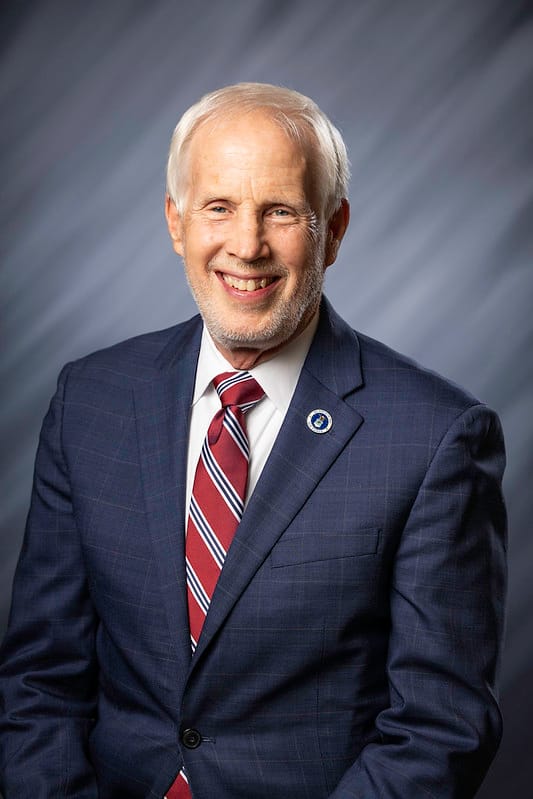
“I think the biggest thing is, it’s siphoning off money that’s desperately needed to run the public schools,” said Rep. Matt Pierce, D-Bloomington. “The fact is, the legislature has to fund three school systems: the public schools, charter schools, and private schools with vouchers.”
The voucher program, created by the state legislature in 2011, started small but has grown rapidly, driven by the Republican legislative majority’s embrace of school choice.
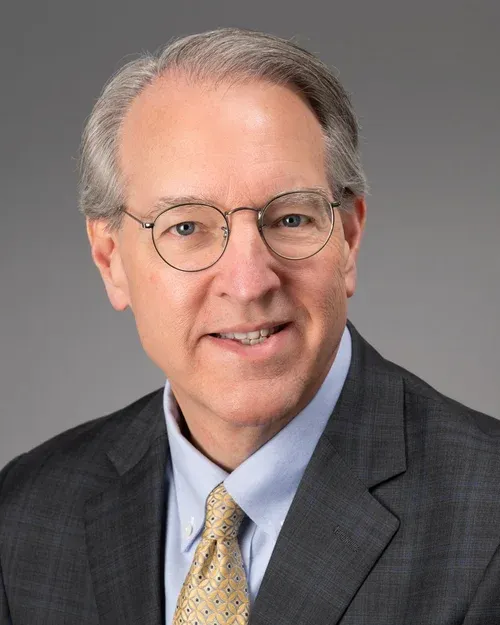
Rep. Bob Behning, R-Indianapolis, the author of the voucher law, said the program is working as intended. “It’s doing exactly what we hoped it would,” he said, “allowing parents to choose the school that meets their son’s or daughter’s needs.”
The Indiana Department of Education’s 2025-26 Choice Scholarship Report — vouchers are called choice scholarships in state law — provides a detailed picture.
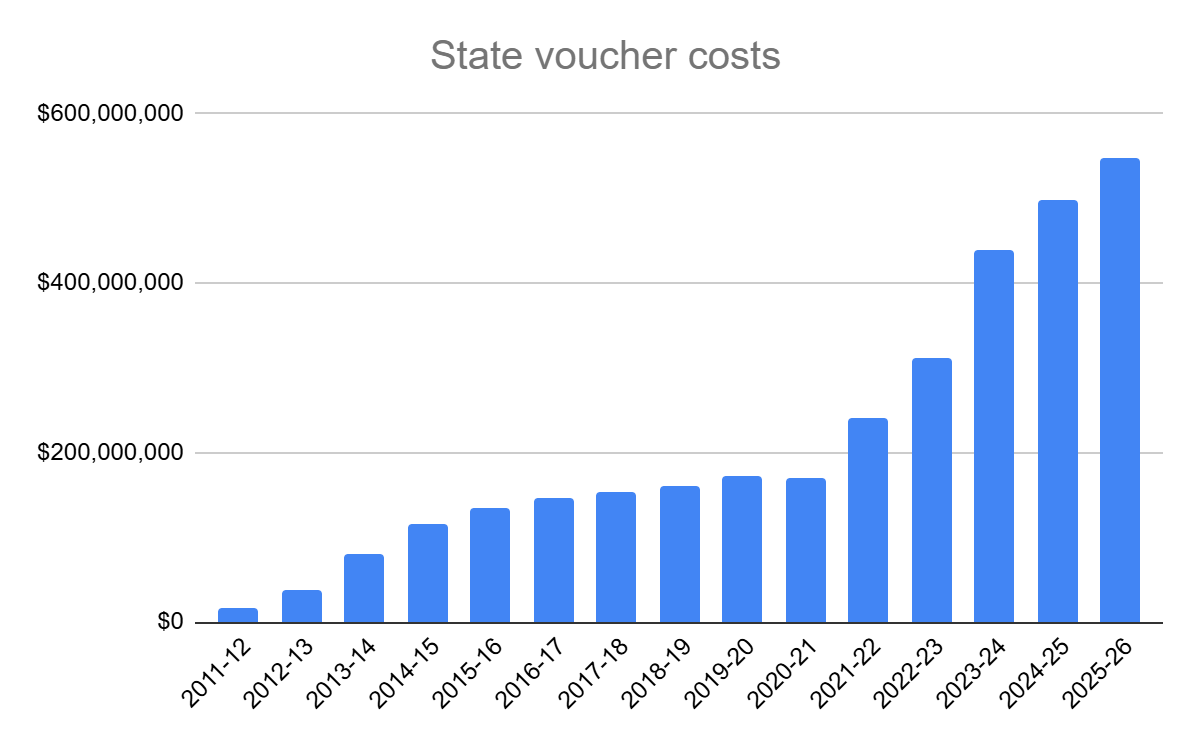
The state awarded $548 million in vouchers in 2025-26, a 10% increase over the prior year. They went to 80,548 students, who attended 385 private schools, nearly all of them religious schools. More than half the families that received vouchers made over $100,000 a year.
Those figures will rise this school year with the launch of “universal” vouchers, in which all private school students qualify, regardless of family income. Based on 2025-26 numbers, expanding the program could add 23,700 students at a cost of $162 million.
“All we’re doing is subsidizing the wealthiest families,” Pierce said. “That doesn’t make one iota of change in the education system. When you have scarce resources, you should be doing everything you can to put the money where it’s needed.”
Along with vouchers, public schools are dealing with state education funding that hasn’t kept pace with inflation and with new state-mandated limits on property tax revenue from 2025’s Senate Enrolled Act 1. Some districts, including the Monroe County Community School Corp., are also losing money from demographic shifts and a decline in school-age population.
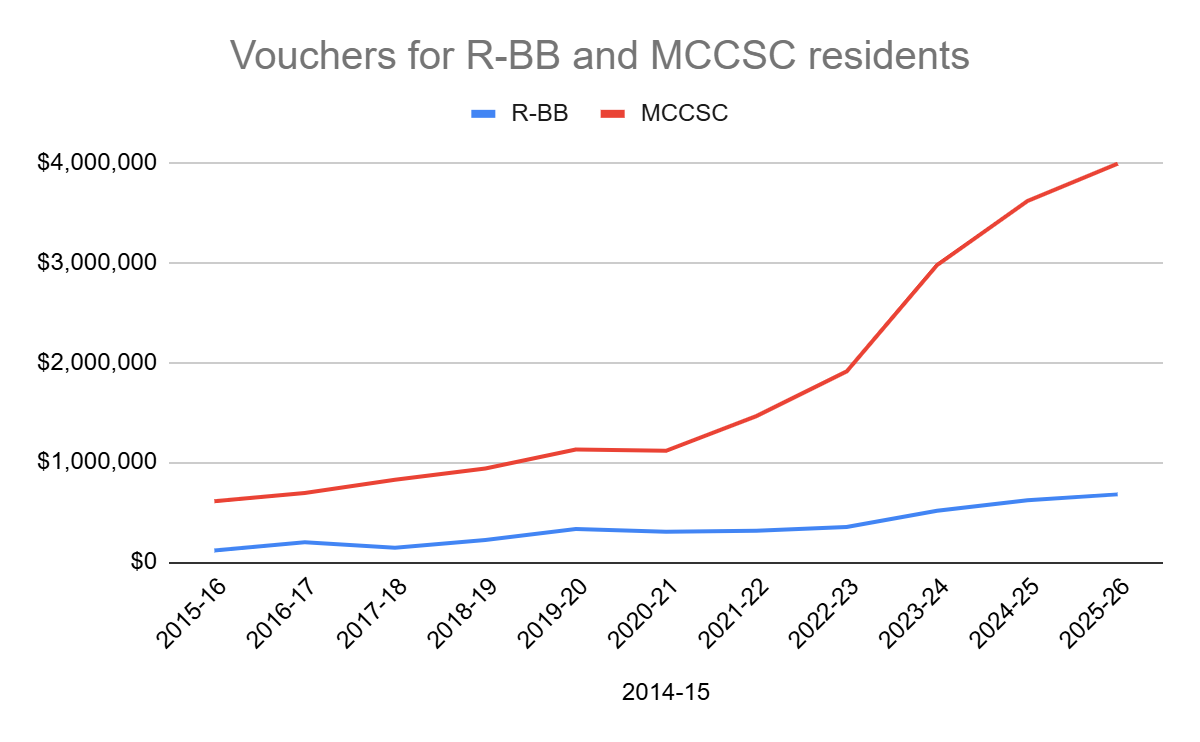
For each voucher, the state pays 90% of what it would provide for the student to attend a local public school. Students who live in the MCCSC district have received nearly $20 million in vouchers in the past decade, according to the state report. Students in the Richland-Bean Blossom district have received almost $3 million.
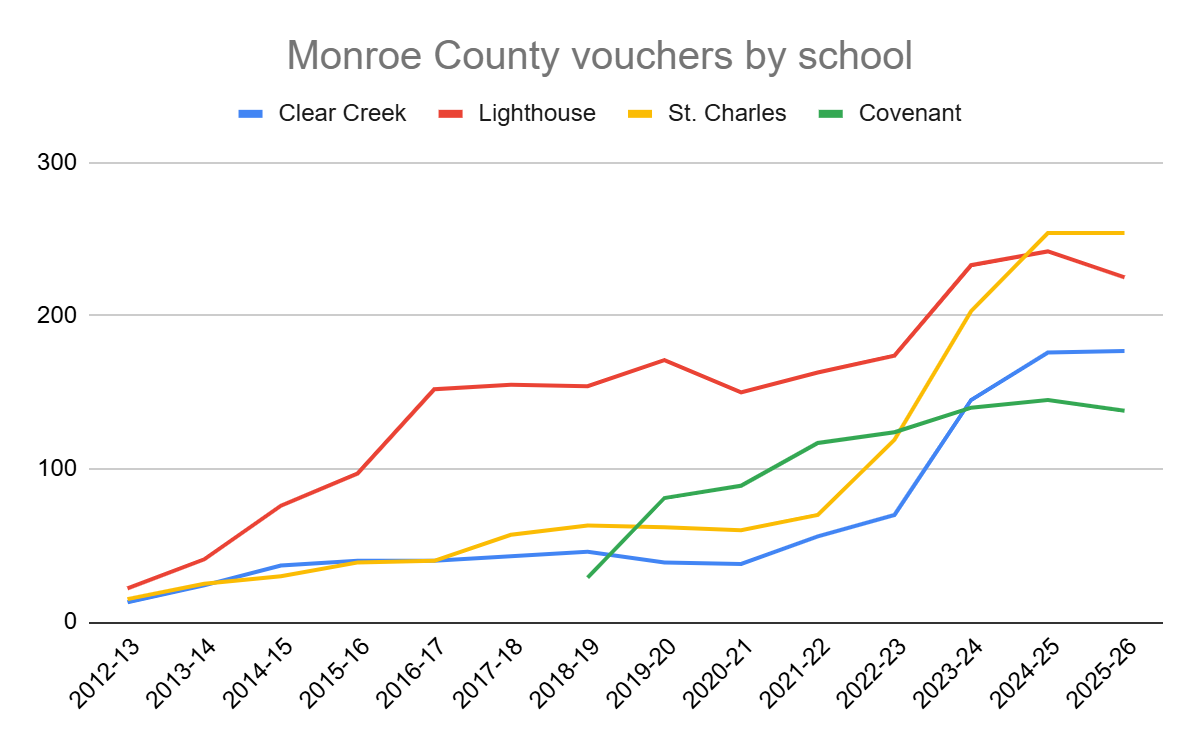
Local private schools benefiting from vouchers in 2025-26 were St. Charles Catholic School, $1.67 million; Lighthouse Christian Academy, $1,54 million; Clear Creek Christian School, $1.16 million; Covenant Christian School, $943,117; and Adventist Christian Elementary School, $110,805.
Leaders of St. Charles and Clear Creek Christian schools did not respond to multiple requests for interviews. The head of school at Lighthouse declined to be interviewed or to answer questions for this article.
Roots in segregation and libertarian thought
The modern voucher movement dates from 1955, when economist Milton Friedman published an influential paper titled “The Role of Government in Education.” Friedman argued that the government should fund schools but shouldn’t run them. He proposed giving parents vouchers that they could use to pay tuition at private schools.
The idea caught on in the South, where politicians were calling for resistance to the school desegregation ordered by the U.S. Supreme Court. States and localities provided money for white families to send their children to “segregation academies” that barred Black students.
“The context is important,” said Christopher Lubienski, a professor of education policy and director of the Center for Evaluation and Education Policy at Indiana University Bloomington. “You have to remember that private school choice first really launched as an ideological agenda in the wake of Brown v. Board of Education.”
As Jim Crow segregation faded, vouchers were a fringe idea, embraced by small-government libertarians. But they got new life as a strategy to help students in struggling urban districts. Small-scale voucher programs began in Milwaukee in 1990 and Cleveland in 1996.
In Indiana, a business-funded group called Commit Inc. lobbied for vouchers in the 1990s, but the legislature didn’t buy the idea. That changed after 2010, with Republican Mitch Daniels in his second term as governor and the GOP in control of the House and Senate. In 2011, the legislature adopted education reforms that included vouchers.
Voucher opponents sued, arguing the program violated a section of the Indiana Constitution that prohibits public funding of religious institutions. But the Indiana Supreme Court, in a decision called Pence v. Meredith, reasoned that the money wasn’t going to religious schools but to the parents who directed it to the schools for tuition payments.
As a result, “we have this situation where our tax dollars fund people’s religious speech and religious indoctrination,” said Pierce, the Bloomington legislator.
Voucher program grows in size and cost
Initially, the Indiana program was targeted to low-income families, and its size was capped. Students had to spend one year in a public school to qualify. In the program’s first year, 3,911 of the over one million Hoosier students received a total of $16.2 million.
Daniels, in a speech to the American Enterprise Institute, embraced the idea that students should first attend a public school. “The public schools will get first shot at every child,” he said. “In other words, if the public schools deliver, no one will need to exercise this choice.”
But the program grew as the state loosened eligibility criteria. It extended vouchers to siblings of voucher holders, students in special education, and students in schools that received an F in Indiana’s school grading system. It raised the income cutoff. And it dropped the requirement that voucher students first attend a public school. Costs grew year after year.
“I kind of call it a big, long, rolling bait and switch,” said Pierce, part of the Democratic minority that has consistently opposed vouchers.
The rhetoric for vouchers also evolved. Advocates talked less about school quality and emphasized helping students find a school that was the right fit. They lauded “education freedom.” The mantra became: In Indiana, the money follows the child.
“At first it was about academic improvement,” said Lubienski, the IU education professor. “Now, especially since studies showed that was not happening, we’re starting to see the justification that school choice is a good in itself.”
Today, 70% of voucher students have never attended an Indiana public school. Cathy Fuentes-Rohwer, president of the Indiana Coalition for Public Education and a former MCCSC school board member, said vouchers have become “an entitlement program for the wealthy to send their kids to private schools that do not accept all children.”
Meanwhile, private schools have boosted tuition to take advantage of vouchers, according to research by Jim May, a Carmel parent and an ICPE board member. May estimates that tuition increases have eaten up a third of the voucher funding that private school families receive. If tuition is higher than the value of a voucher, typically about $6,850, families pay the rest.
In Monroe County, Lighthouse Christian Academy charges up to about $12,000 per student in tuition and fees, according to its website. St. Charles charges non-Catholic families $9,500. A voucher covers full tuition at Covenant and Clear Creek Christian schools. But both have increased tuition to take full advantage of vouchers.
“We’re a small business,” Akers said. “We don’t want to leave money on the table that’s available to us through the program.”
Behning, the author of the voucher law, said the initial limits on vouchers, including the requirement for a year in public school, weren’t intended to be permanent features. “It was an effort to make sure we could get the program through the General Assembly,” he said.
He said universal vouchers make the system simpler for families to navigate. And he echoed the state supreme court in arguing that Indiana is not funding religious schools — it’s funding students who attend those schools.
“The reality is, we’re giving a scholarship to the parents or the guardian of the student,” he said. “It is not going directly to the school. We’re looking at allowing parents and guardians and caregivers to choose the school that best meets their needs.”
Behning equated vouchers to Indiana’s Frank O’Bannon grants, which provide financial aid to students attending public and private colleges. Those grants, however, are based on financial need and not awarded equally to all students.
Growth in independent, evangelical schools
While voucher use has grown across the board, the greatest increases have been in what the state calls “independent nonpublic schools.” Most of these are evangelical Christian schools. A handful are Muslim and Jewish. A few are non-religious.
Over the past decade, enrollment in independent schools increased by two-thirds, according to state figures. Catholic schools, which account for more than half of Indiana students in private schools, grew by only 2.7%. Lutheran schools grew by 20%.
And the growth of independent schools continues: So far in 2026, the State Board of Education has approved accreditation for 17 new or expanding schools. All are independent schools and plan to participate in the voucher program.
Akers, the head of school at Covenant Christian School, said a hunger for alternatives has fueled a boom in Christian schools, charter schools and, especially, homeschooling.
“Parents want more control,” he said.
Covenant Christian School was founded in 1975 and had a loyal following, but it had fallen on hard times by the early 2010s, Akers said. It set on a course of improvement, earned accreditation, and qualified to receive vouchers in 2018.
Through a partnership with Southside Christian Church, it acquired property on Empire Mill Road and spent $4 million to convert the church to a school with classrooms, a cafeteria, facilities for sports and music, and plenty of parking.

“We’re very, very happy with how it turned out,” Akers said. “We just feel like, through this partnership with Southside Christian, we hit a home run.”
Covenant is a fundamentalist Christian school that targets its appeal to members of apostolic Pentecostal churches, of which there are about 20 in Bloomington, Akers said. Its curriculum, which comes in part from conservative Bob Jones University Press, includes creationism.
Church involvement isn’t required. “Many of our families don’t attend church anywhere,” Akers said. “Our policy is, if you want to be here, we want you here.
“We’ve had students who were not permitted to return to public school because of behavior issues, but they needed somewhere to go,” he added. “We’ve had some real success with that.”
Akers said the divide over public funding of religious instruction is “probably an unbridgeable gap. I hear both sides: ‘Why should a government school have a monopoly on education?’”
Dollars to discriminate?
While Covenant takes pride in accepting all students, that’s not the case for all private schools. State law says voucher schools can’t discriminate on the basis of race, color, or national origin. But they may reject students for their religion, sexual orientation, or gender identity.
Lighthouse Christian Academy got national attention in 2017 over its stance that homesexuality and transgender identity are contrary to a “biblical lifestyle.” Chalkbeat Indiana found that one in 10 Indiana voucher schools had policies suggesting LGBTQ+ students weren’t welcome. A 2016 study titled “Dollars to Discriminate” showed that voucher states didn’t protect students.
Behning, the author of the voucher law, said lawmakers took care to keep hands off schools’ religious principles, including enrollment policies, when they created the program. “We did not want to take away the very fiber and uniqueness of these individual schools,” he said.
Private schools can also turn away students for low test scores, a history of behavior issues, or simply because they don’t seem like a good fit. Some voucher schools post on their websites that they don’t have the staff or facilities to accommodate students with severe disabilities.
Fuentes-Rohwer says billing vouchers as school choice is a misnomer. “The schools are the ones doing the choosing,” she said. “Private schools get to pick and choose.”
Students with identified disabilities are underrepresented in the voucher program. About 7% of students receiving vouchers qualify for special education, according to the 2025-26 report, compared to 18% in public school districts and 15% in charter schools.
Janet Decker, an IU School of Education professor who studies special education law and policy, said a key point is students in private schools give up their rights under the landmark 1975 Individuals with Disabilities Education Act. Those rights include a right to an Individualized Education Plan that schools follow, placement in the least restrictive classroom environment that suits their needs, and procedural rights to challenge school decisions.
“Public schools, unlike private schools, have a legal responsibility to provide an education to all students, including some students with disabilities who may have intensive and expensive needs,” she said. “Diverting funding from public schools harms the students with disabilities who remain at the public schools.”
Another is that private schools aren’t subject to government oversight; their curriculum and personnel policies are mostly unregulated. Unlike in some states, Indiana voucher schools are required to administer state tests and are included in the state’s A-to-F school grading system. But they are not subject to state public records and meetings laws.
A key argument from supporters of public education is that vouchers take state funding from public schools. Jenny Noble-Kuchera, president of the Monroe County Education Association, the MCCSC teachers union, said she has seen the impact of vouchers and other factors.
Two years ago, she said, there were 834 teachers and certified professionals in the MCEA bargaining unit. This year, there are 736. A recent memo from state officials said the district can expect $760,000 less than last year in its education fund, which pays teacher salaries.
Noble-Kuchera said MCCSC has so far avoided layoffs, pay cuts, and program losses. “The train is still chugging down the tracks,” she said. “I hope it stays that way, but time will tell.”
But Behning, the longtime chairman of the Indiana House Education Committee, insists vouchers haven’t hurt funding for public schools.
“We have had restrictions put in place,” he said. “SEA 1 has had an impact on traditional public schools in terms of the (property tax) revenue that is generated. But, in general, over the last decade we’ve increased funding to traditional public schools in a fairly significant way.”
It’s true that school funding has increased, but it hasn’t kept pace with rising costs, according to the Indiana Coalition for Public Education. If funding had kept up with inflation since 2009, its analysis finds, schools would receive $473 more per student.
Learning loss comparable to Hurricane Katrina and COVID
Voucher supporters can point to studies suggesting that public schools improve when they have to compete with private schools. But there’s limited evidence of academic gains for students who receive vouchers.
Studies of the small, early voucher programs in Cleveland, Milwaukee, and Washington, D.C., showed positive effects on test scores, including for Black students, said Joseph Waddington, a professor and director of the Office of Impact and Improvement at the University of Notre Dame, who has studied vouchers and school choice.
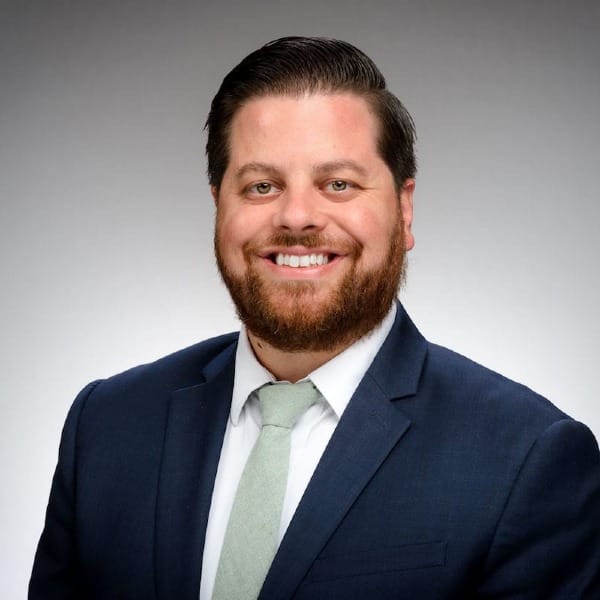
But the results turned negative with studies of state-wide voucher programs. In 2018, Waddington and colleagues published a study showing that Indiana students who transferred to private schools using vouchers fell 0.15 standard deviation behind their public school peers in mathematics. There was little impact on English/language arts test scores.
Studies of vouchers in other states found similar results in Ohio and worse results in Louisiana. The learning loss in math was comparable to the impact of Hurricane Katrina on New Orleans students and the COVID-19 pandemic on U.S. students overall, Lubienski said.
In September 2026, The New York Times asked 37 experts to rate ideas for improving academic performance. Vouchers ranked among the least effective and the most expensive.
Waddington said giving vouchers to students already in private schools, as Indiana is doing, isn’t likely to affect academics one way or another. “That still raises the question of whether this is a worthwhile public investment,” he said.
He cautioned that, while research matters, it doesn’t shed light on individual schools. “There’s a lot of variation in the charter sector, there’s a lot of variation in the public sector, there’s a lot of variation in the private sector,” he said. “Treating these monolithically is not helpful.”
Public schools are responding to vouchers
Public school officials say they recognize that school choice is a reality in Indiana. That means it’s not enough to offer high-quality education; they also have to tell the public about it, which requires resources for marketing and communications.
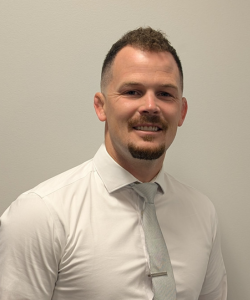
“I think, in the environment that we exist in, parents are going to make the choices that they think are best for their families or for their children,” said Matt Irwin, MCCSC chief financial officer. “We try to do the best we can to make sure that we educate them on what we have to offer and what type of opportunities and outcomes that their kids would have with us.”
To that end, the district’s website is packed with news releases and feature stories about schools’ accomplishments. A recent item boasts that three high schools, Bloomington South, Bloomington North, and the Academy of Science and Entrepreneurship, placed in the top 25 among Indiana’s 490 high schools in recent U.S. News & World Report rankings.
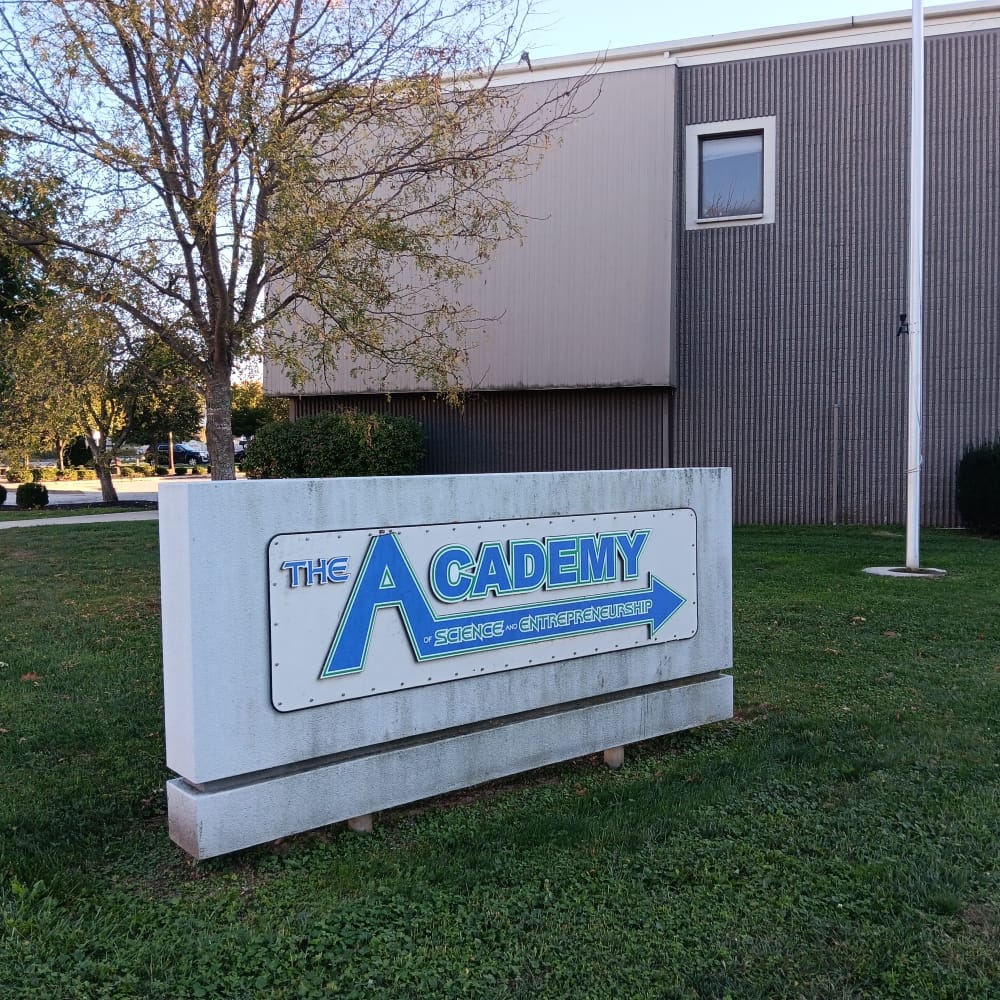
The website also provides budget information and updates on the district’s voter-approved property tax referendums, The page highlighting district schools is labeled “Choose MCCSC Schools.” The district maintains active social media feeds and parent newsletters.
“In the world of school choice, let alone the school choice vouchers, that is something we’re very much in tune with,” Irwin said.
Jiin Hur, a senior at Bloomington High School South, said she values the school’s range of activities and varied course offerings. She competes on the speech and debate team and has taken a range of Advanced Placement courses.
Hur said her teachers create an inclusive environment and take time to answer students’ questions. She appreciates the diverse perspectives encountered in a large public high school while recognizing there are inequalities in how students experience education. Students who are proactive, she said, can find ways to make the most of school.
“If the goal is to challenge yourself to the best of your ability, I think South does a pretty good job of that,” she said.
Even so, MCCSC enrollment has declined by about 1,000 over the past decade, now standing at around 10,000 students. Officials point to a decline in Monroe County’s working-age population as a factor.
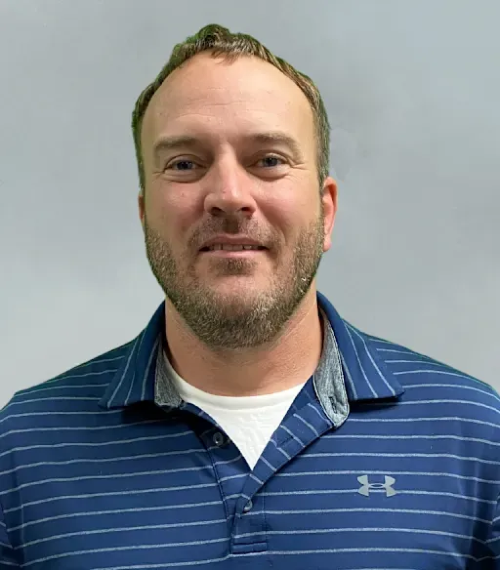
Richland-Bean Blossom Schools have held steady at around 2,850 students. Kent Rentschler, principal of Edgewood Junior High School, said R-BB is facing the same pressures as other Indiana districts but still attracts students.
“That’s the great thing about Edgewood right now,” he said. “We’re doing some amazing things, and our trend data has been increasing.”
Common good or competitive marketplace?
Every debate about school vouchers leads to questions about the nature and purpose of education. Is it a common good that should benefit everyone equally? Is it a consumer marketplace in which families shop for the best product?
Are schools meant to train workers and boost the economy? Are they supposed to educate citizens to participate in democracy? Should they reflect local, state, or national values?
For Fuentes-Rohwer, the ICPE president, public schools are essential to the common good. “We owe every child a high-quality public education,” she said. “Not this illusion of choice. And that costs money.” She says that public education, like democracy itself, is “a group project we have to succeed at if we are going to be healthy as a society.”
Journalist Jennifer Berkshire, who has written extensively about vouchers, has found strong support for public schools among rural voters in red states. As vouchers eat up more education funding, she said, “We’re going to be hearing louder calls from the public asking for more guardrails, and more evidence that this approach is actually working.”

But vouchers have become Republican orthodoxy. The 2024 national party platform called for universal school choice. Trump’s 2025 budget legislation created a federal tax credit program to pay for students to attend private schools. Over a dozen states and the District of Columbia now have voucher programs, according to EdChoice, an Indianapolis-based advocacy organization. Other states have voucher-like tax credit and education savings account programs.
“Here in Indiana, we are so far down the road to choice,” said Waddington, the Notre Dame professor. “It’s not going away anytime soon.”
Instead of debating whether vouchers should exist, he said, policymakers should focus on what works and what doesn’t — on supporting aspects of voucher programs that help students and putting guardrails around the elements that don’t.
But Noble-Kuchera, the MCCSC teachers union president, rejects the idea that the voucher tsunami can’t be turned back.
“I am never naive, I am always skeptical, but I am also always optimistic,” she said. “And I think it is possible, if enough pro-public education candidates can make their way through in the next couple of election cycles, we can chip away at that.”
Monroe County News: Unpacked
In 2023, Limestone Post and WFHB launched the award-winning series “Deep Dive: WFHB and Limestone Post Investigate,” a journalism collaboration between WFHB Local News and Limestone Post Magazine. Deep Dive debuted as a year-long series, made possible by a grant from the Community Foundation of Bloomington and Monroe County.
Now, thanks to continued support from the Community Foundation, these two organizations are once again collaborating to produce in-depth news segments about Monroe County. In the “Unpacked” series, Limestone Post and WFHB will produce tandem reports “unpacking” the data and details of important topics such as local education, housing accessibility, and Monroe County governance in relation to state and federal legislation. Following WFHB’s news broadcast and Limestone Post’s published article, our reporters will join for a round table discussion, further breaking down the story at hand.
Steve Hinnefeld
Steve Hinnefeld is a journalist and former Herald-Times reporter, IU media relations specialist, and IU Media School instructor. He writes about education at inschoolmatters.wordpress.com and lives in Bloomington with his wife.