
Should Kids Run Marathons?
A look at the science and injury rates of kids running marathons.


When my 11 year-old announced his goal to run a marathon that year, I had questions.
While not common, there are some marathon training programs for youth, as well as marathon events that track youth participation rates, completion, and injury rates.
The Twin Cities Marathon in Minneapolis-Saint Paul is one of those events. Over 300 youth from age seven and up have finished that marathon. Over 26 years, there were four cases of mild exhaustion that did not require hospitalization. The rate of medical encounters for adults in the same event was almost twice as high.
LA youth marathoners more likely to graduate

A second group studied was youth who participated in the Students Run Los Angeles (SRLA) program. Each year, more than 3,200 under-served middle and high school students across LA train alongside adult mentors towards completing the entire Los Angeles Marathon. 99% of those who start the marathon finish it. Pediatric doctors Mark Halstead and Joel Brenner reviewed the program and found it had no significant adverse effects, but their program does have a positive correlation with marathon completion and graduation rates.
Now it’s a few years later after my own child asked me the marathon question and I’ve got two runners in high school, so I’m going to take a hard left and ask: If the risk of kids running marathons is so low, how does the risk compare to participating in high school running sports like cross country or track?
Injury rates for marathon training vs high school cross country
To setup a comparison, I’ll be using Joshua Goldman’s study of Students Run Los Angeles for youth marathon injury rates. For injury rates for cross country, data comes from a 15-year study following ninety-nine cross country teams. The study uses a unit of athletic exposure, or AE. Every time you train or complete, that’s an athletic exposure.
In that study of cross country teams, boys had an injury rate of 10.9 per 1,000 AEs while girls had an injury rate of 16.9 per 1,000 AEs.
The study of LA youth marathoners doesn’t provide the number of athletic exposures, but we can calculate it. The program is known to be 28 weeks long, and it’s published that they run three or four times after school and on the weekends. At four runs per week, that’s 112 total athletic exposures per student during the program. 411 injuries were reported in 1,930 runners, for an estimated 216,160 total AEs. Check my math here, but that’s an injury rate of 1.9 per 1,000 AEs. That’s about 10 times fewer injuries than the cross country study. To use a second lens, there’s another way to measure injuries, which is to consider what percentage of participants got any injury at all.
In a separate study of 469 students training for a marathon, 39.6% were injured. That sounds like a big percentage, but it’s practically the same as the injury rate found for high school cross country by an Oxford Academic study, where they found 38.5% of cross country runners were injured during an 11-week season, with 35% of boys and 42% of girls reporting injuries.
Injury rates for girls in marathon training vs high school cross country
It stands out that the injury rate for girls cross country is noticeably higher than for boys. Girls track was found to have the highest injury rate of twenty high school sports. That study was not alone. Other studies also found girls in cross country getting injured at significantly higher rates than boys.
So what about the injury rates specifically for high school age girls who have done marathon training?
A couple of studies have been done to compare the injury rates for high-school-age boys and girls in marathon training, one from LA and one from Boston. Neither found significant differences — 46.7% vs 53.2% in LA and 48.8% vs 51.2% in Boston.
Injury rates appear to be similar or lower for students in marathon training compared to cross country. While cross country was found to have notably more injuries for girls, marathon training was not.
This invites more questions about the best way our institutions can serve and support girls who want to run and stay healthy.
A marathon at 11
My son’s goal to run a marathon at 11 didn’t come out of the blue. When he was nine, he told me he wanted to run a half-marathon. He put in months of training leading up to the event, finished in the middle of the pack, and decided to run several more runs when he was 10 that were the half-marathon distance or longer.
With that context, I supported his marathon goal as realistic as long as he put in the training to prepare for it, which he did. Like the LA marathon program, he completed weeks of advance training. And like the 99% of students in the LA program who toe the starting line, he finished.
There were no significant injuries during training or during the event.
My son trained for months for his first half-marathon. | Video by Mark Stosberg
A too common story for girls high school running?
My daughter also runs and followed the conventional path of middle school and high school cross country and track programs. Despite following the coach’s advice on distance, warm ups, cool downs, and stretching, she sustained the kind of overuse injuries that are now more common in high school girls running than I realized.
So learning now about the relative risks of marathon training versus high school cross country, especially girls, hits home.

Closing thoughts
Marathons are not for everyone.
My marathon training runs with my child were spent playing outside. And what kid doesn’t want to play outside for longer? We jumped over creeks, climbed trees, and vaulted benches parkour-style. We ran from one Pokémon Go stop to another. We stopped to take photos and drink bubble tea.
Over generations, spending time outside has become less and less normal for kids, while the time and distance they explore has been shrinking. Until here we are today, reviewing the scientific literature to study the question of whether a child spending four or six hours outside to complete a marathon is maybe just too much.
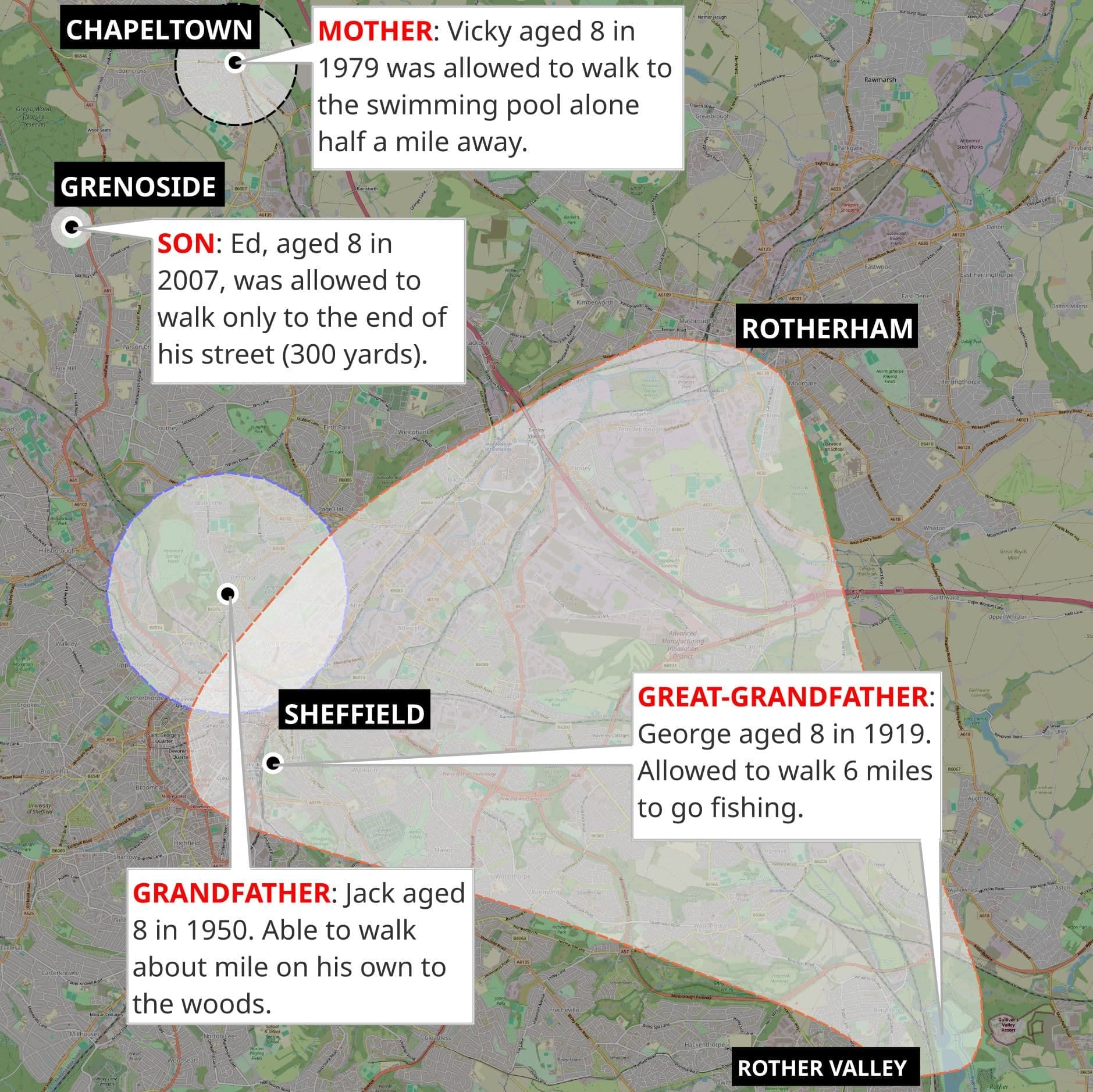
I am not surprised by evidence suggesting that training for a marathon is safer than competitive cross country. Students are training for their first marathon. The goal is to finish the event, not race it. Training for that — what I did with my kid — is almost all at an easy effort. It’s a lower-stress pace. Marathon training incrementally builds up volume over time. By contrast, cross country season involves sustained high-intensity races multiple times per week.
All this mirrors my own experience — I’m more likely to get injured during sprint intervals than I am during an easy-effort, high-volume week of training.
Unlike most other high school sports, running is one that could be a life-long healthy activity, if you can avoid serious injury. Consider how many people you know in their fifties who run compared to those who regularly play soccer, basketball, football, or baseball.
Maybe Los Angeles and Boston are on to something with their high school marathon training programs.
Mark Stosberg
Mark Stosberg is a software engineer and spatial analyst. He grew up on a wooded farm in Kentucky but didn't appreciate the value of open spaces until he left home. Now, long runs provide a grounding counterbalance to his screen time.