A Night at the Armory: Tracing the Lost History of John Mellencamp
50 years of John Mellencamp — a retrospective.

It was no lonely ol’ night.
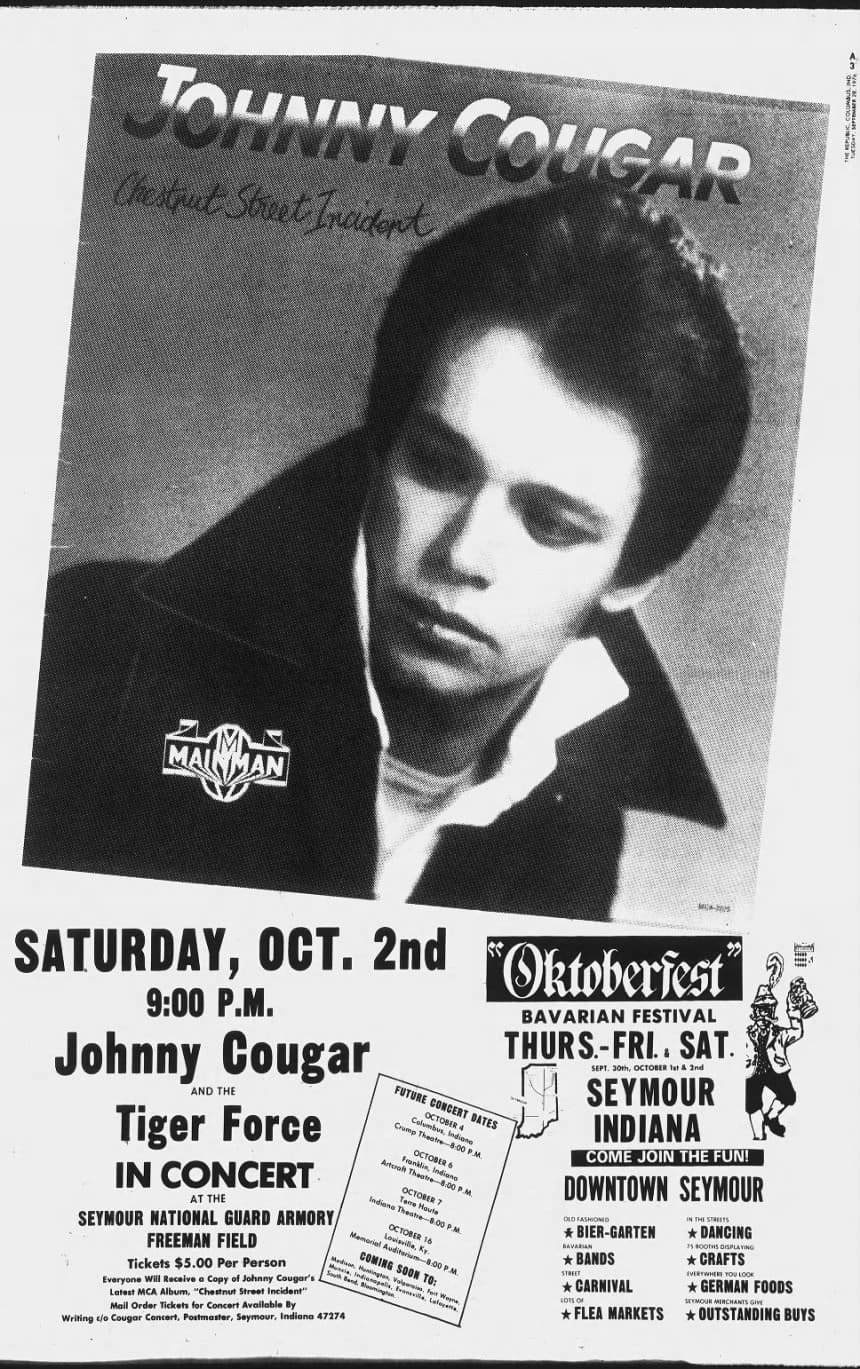
Fifty years ago this month, on the evening of October 2, 1976, a standing-room-only crowd of 1,500 gathered in Seymour’s National Guard Armory to hear a hometown troubadour who was just five days shy of his 25th birthday.
Outside it was Hollywood in Hoosierland, with a pair of searchlights sweeping the southern Indiana sky. Inside, a young lady started the 9 p.m. show with a harp rendition of “Somewhere Over the Rainbow” — a curious choice, since the event was billed as a rock concert and the musical act wasn’t even Toto. But moments later, the star attraction launched into an anthem of youthful frustration, “Chestnut Street Revisited,” set on Seymour’s main drag: “Well, I’ve lived and breathed and been disbelieved in these small-town streets too long.”
And so began the very first concert in the very first concert tour of the artist once known as Johnny Cougar, an occasion that seems less a part of this year’s golden anniversary celebration than a forgotten chapter in the Lost History of John Mellencamp.
Consider this: The Indiana legend, who turned 75 years old on October 7, has spent much of 2026 commemorating his five decades in music, notably with his summer concert series, Dancing Words Tour — the Greatest Hits, and the recent release of his book, John Mellencamp: The Songbook: 50 Years of Song and Poetry. Earlier this year, after accepting the Icon Award at the 2026 iHeartRadio Music Awards, he mused that “I’ve been doing this 50 years, and I’ve enjoyed most of it.”
But the event that draws mention and attention isn’t his world premiere at the armory or the heavily Hoosier concert tour that followed. Mellencamp’s official website marks a different milestone: “His professional music career began in earnest in 1976 when MCA Records released his first album … Chestnut Street Incident.” People magazine echoed the sentiment: “Mellencamp released his debut album in 1976 and has been rocking ever since.”
His debut album, however, is a dubious cause for celebration, considering that it sold only about 12,000 copies and was panned by everyone from Rolling Stone magazine to an older Mellencamp. “Johnny Cougar is a comically inept singer who unfortunately takes himself seriously,” sneered Rolling Stone reviewer John Swenson. “His debut album is full of ridiculous posturing with virtually nothing to back it up.”
Mellencamp was scarcely more charitable toward his first album, as well as his first stage name and his first manager, Tony DeFries, founder of MainMan Ltd. In a 1985 interview with veteran music writer Timothy White, he called his album “a total flop, every bit as bad as the jungle-animal last name that he [DeFries] sneaked onto the album jacket and stuck me with.”
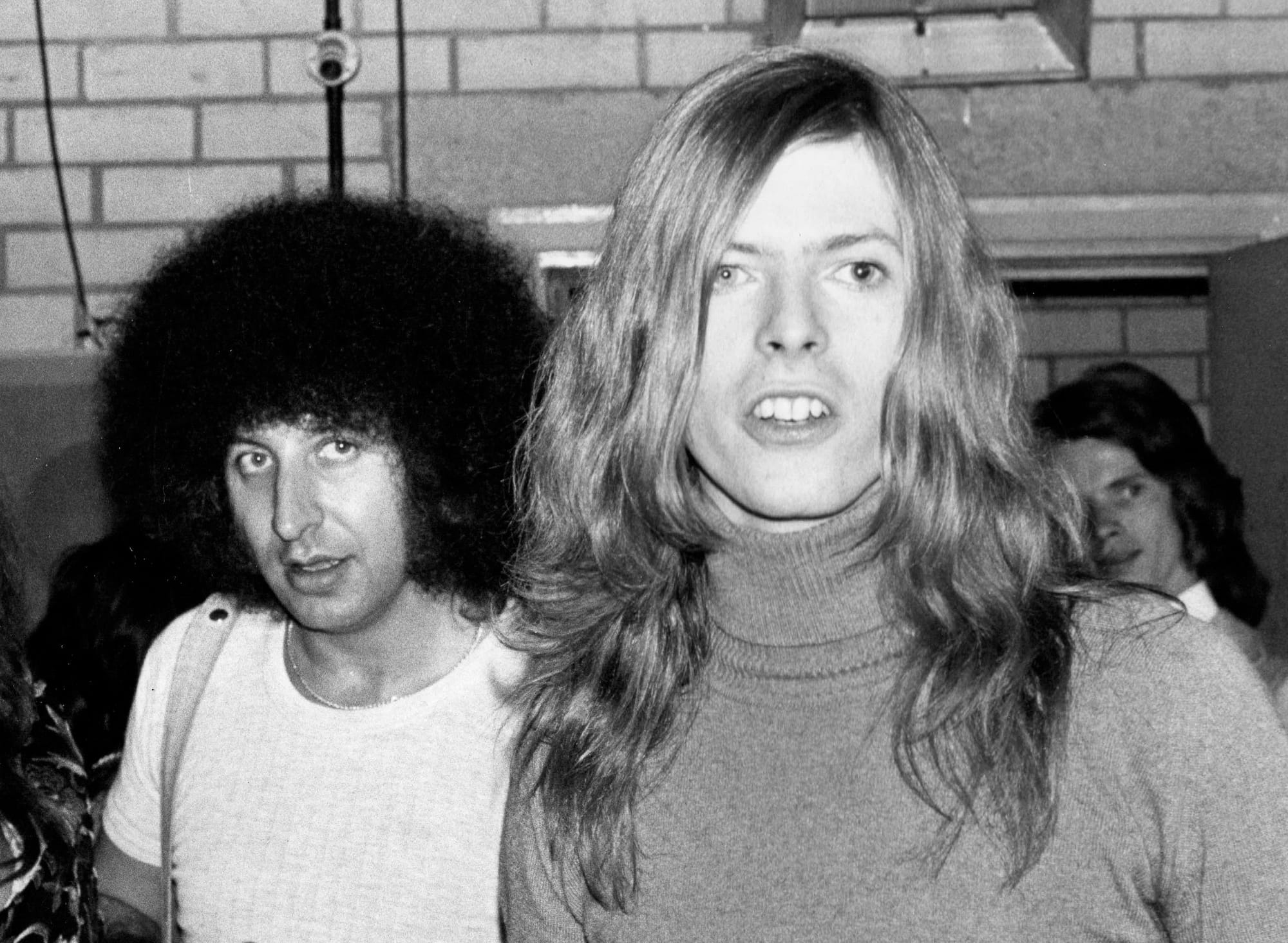
But everyone’s salad days contain their share of limp lettuce. The true test of any aspiring entertainer is whether his first-step stumbles lead to a last gasp or a last laugh.
Mellencamp’s half century of musical prominence speaks for itself, but to really appreciate the journey, it takes a boots-on-the-ground retracing of the Cougar Trail — starting at the National Guard Armory and winding through the concert tour, and the anniversary, that nobody seems to remember.
The first thing to know about the Lost History of John Mellencamp is that it exists only as far-flung fragments in newspaper and magazine archives, obscure internet pages, and personal memories. But a deep dive into these treasure troves retrieves enough 50-year-old artifacts to bring this very Hoosier story into focus.
Let’s begin with the tale of how a young musician named John Mellencamp came to be known as Johnny Puma.
OK, so that wasn’t really the “jungle-animal last name” he first recorded under, but it could have been. MainMan, the same management company that dubbed “Mellencamp” a “not very American” surname, pondered other beastly monikers besides Cougar — not only Johnny Puma, but also Johnny Impala and Johnny Mustang. Not to mention Johnny Indiana.
The fierce feline theme continued with the naming of Johnny Cougar’s original band, Tiger Force. And when it came to promoting their Midwest musical discovery, the MainMan crew turned their hype machine up to 11.
Before Cougar had so much as cleared his throat in the National Guard Armory, he was being compared to rock and roll royalty — by his manager, at least. “I think John has enough appeal and talent to become an international hit,” DeFries told Zach Dunkin of the now-defunct Indianapolis News. “He reminds me of early Presley. He has that sound of rock ’n’ roll that Presley, the Rolling Stones, and Chuck Berry had. He’s the most American artist I’ve seen since Dylan.” And if there’d been four of him, and one of them had played drums, the MainMan magnate might have crowned Cougar the heir apparent to the Beatles.
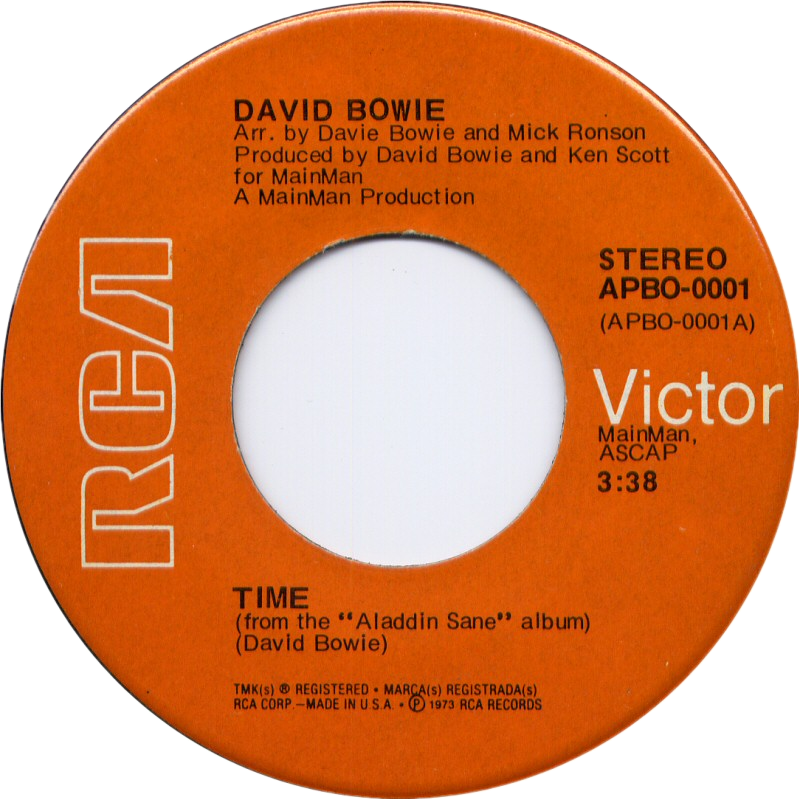
Only DeFries knows for sure whether he believed everything he was saying, but the self-declared impresario certainly put his money where his mouth was. Having attained music-industry stature as David Bowie’s manager from 1971-75, the native Brit poured buckets of U.S. currency into the first Cougar concert. As Rolling Stone reported, “The one-night tab, including TV commercials and press parties, came to $50,000.”
That presumably encompassed the cost of airfare to haul a gaggle of leading music journalists — from such publications as Rolling Stone, Creem, the New York Daily News, and even Penthouse — for a seat at the unveiling of DeFries’s latest can’t-miss. MainMan’s main man had already persuaded the city of Seymour to proclaim October 2 “Johnny Cougar Day,” and because it fell on the same Saturday as the annual Oktoberfest parade, he made the 1976 procession a focal point of his rock star rollout. The guest of honor rode halfway out of the open sunroof of a white limousine flanked by Cougarettes — young women in yellow T-shirts with “Cougar” emblazoned across the front — while his hometown tried to comprehend the spectacle.
“The people of Seymour thought he was a joke, a complete joke,” said his former bassist, Robert “Ferd” Frank, in Homeward Bound: John Mellencamp, a 2008 documentary produced for A&E’s biography channel, Bio. “They laughed at him. ’Cause John was just some kid … a punk kid.”
But that didn’t stop the punk kid from getting star treatment. The Seymour post office sold commemorative envelopes bearing the image of Johnny Cougar’s first album and an October 2, 1976, postmark. And at the armory that evening, the first 1,000 concert-goers received a free copy of that very album, which had been released by MCA Records the day before.
Following his opening number, the son of Seymour gave a decidedly unflashy introduction. “Hello, I’m Johnny Cougar,” he said, “and the band you are about to meet is the Tiger Force band.” That meeting amounted to 90 minutes of “almost nonstop music with no dialogue,” wrote Dunkin of the Indy News. “Midway through the performance, Cougar stripped away his tight-fitting black T-shirt and finished the night bare-chested.”
Like his first album, his setlist featured both original and cover songs — a combination that generated enough crowd response to provoke an encore: the Rolling Stones’ “Brown Sugar.” Only later, at his post-concert party, did the singer confide that he’d had more to worry about than the judgment of elite music scribes. “I had two death-threat phone calls,” Cougar explained. “They said they were going to shoot me while I was on stage.” He admitted he was scared, but not enough to back out. “There was nothing that was going to stop me. I’d waited too long for this.”
And how did the concert reviews go? Better than the album reviews.
Granted, the big shots took their predictable big shots at the 47274. Creem writer Rick Johnson described Seymour as a place where “people pick weeds, paint water towers, scrape dead possums off the road, all that good stuff.” Steven Gaines of the New York Daily News called Cougar “the most exciting thing that happened in Seymour since a tornado blew the Mayor’s house away.” But in a way, that only put the journalists on the same team as the local vocalist singing “Dream Killin’ Town.”
When it came to his personal acidic critics, Johnny Cougar had a knack for turning the abusive into the effusive. Creem writer Johnson grudgingly conceded that the Hoosier crooner was “really decent in fact,” while Gaines of the Daily News saw superstardom. Calling that first concert a “fascinating performance, for either a debut or a seasoned pro,” he likened Cougar to a more famous gravelly voiced rocker, Bruce Springsteen. “I promise the comparisons between the two are going to be as common as corn in Indiana,” he said. “I’m a believer. Cougar really is a star.”
The 2026 Dancing Words concert tour of John Mellencamp filled the urban and suburban arenas of major cities, including Indianapolis, Houston, Boston, Atlanta, and Los Angeles. The 1976 Chestnut Street Incident concert tour of Johnny Cougar played to lesser venues. And crowds. And success. No wonder it’s barely remembered today ... even by the man whose name graced the marquees.
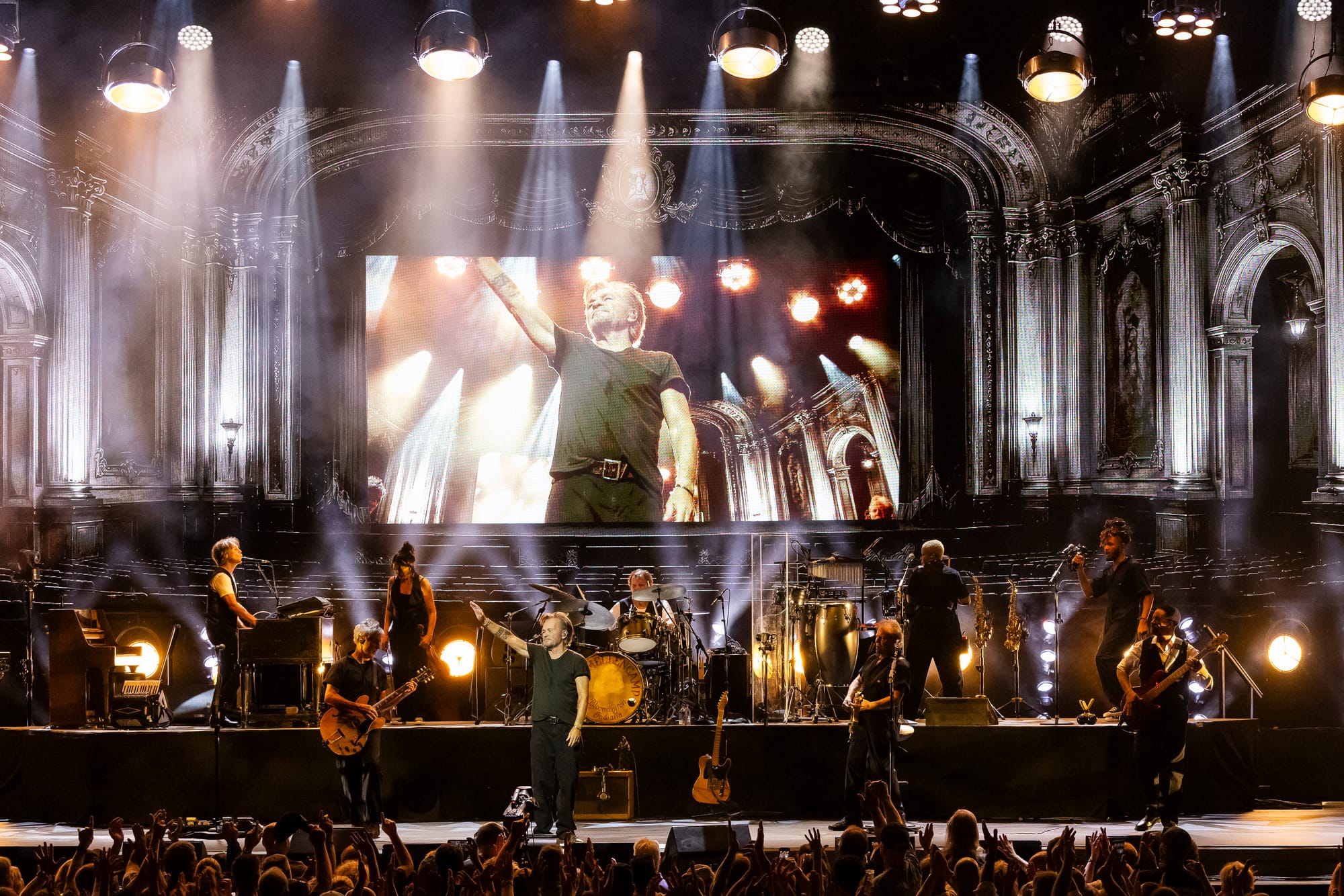
The original idea (naturally, it was DeFries’s) was to wander Indiana, playing to large, medium, and — wait for it! — small towns. “Indiana is where he’s from and what he relates to, so the people of Indiana will see him first,” he explained.
A full-page newspaper advertisement in Bloomington’s Daily Herald-Telephone, as it was then known, outlined the scope of the envisioned tour. The September 28 ad promoted Cougar’s upcoming premiere in Seymour, along with “FUTURE CONCERT DATES” — four other scheduled October gigs in Columbus, Franklin, Terre Haute, and Louisville, Kentucky, with dates and venues specified.
And that wasn’t the half of it. A “COMING SOON TO” heading announced future shows in 10 more Hoosier cities: Madison, Huntington, Valparaiso, Fort Wayne, Muncie, Indianapolis, Evansville, Lafayette, South Bend, and Bloomington, with details to be announced. The relatively close cluster of communities looked more like a list of school bus stops than concert locations, but MainMan tour manager Jamie Andrews said it was all part of the plan. “We are going to do a grassroots campaign and let nature take its course,” he said, in an effort to “stimulate the interest of Hoosiers in their home product.”
Yet the grass didn’t root. And the walls came crumblin’ down.
On October 4, two nights after his SRO debut in Seymour, Cougar trekked a half hour north to Columbus for the second stop on his concert tour, the historic Crump Theatre. But the Crump wasn’t cramped: The 700-seat venue welcomed fewer than 200 people, theater owner Mike Rembusch told Franklin’s Daily Journal — and that included three busloads of Seymour teens. Mellencamp’s first wife, Priscilla, called the turnout a disappointment.
It was about to get more disappointing.
The Cougar Trail would continue north, this time picking up Franklin on October 6. For the third concert, MainMan chose the venerable Artcraft Theatre and put the word out with a flurry of local media buys: TV commercials in Indy, advertisements in area newspapers, a full-page ad in the Franklin College student newspaper, The Franklin.
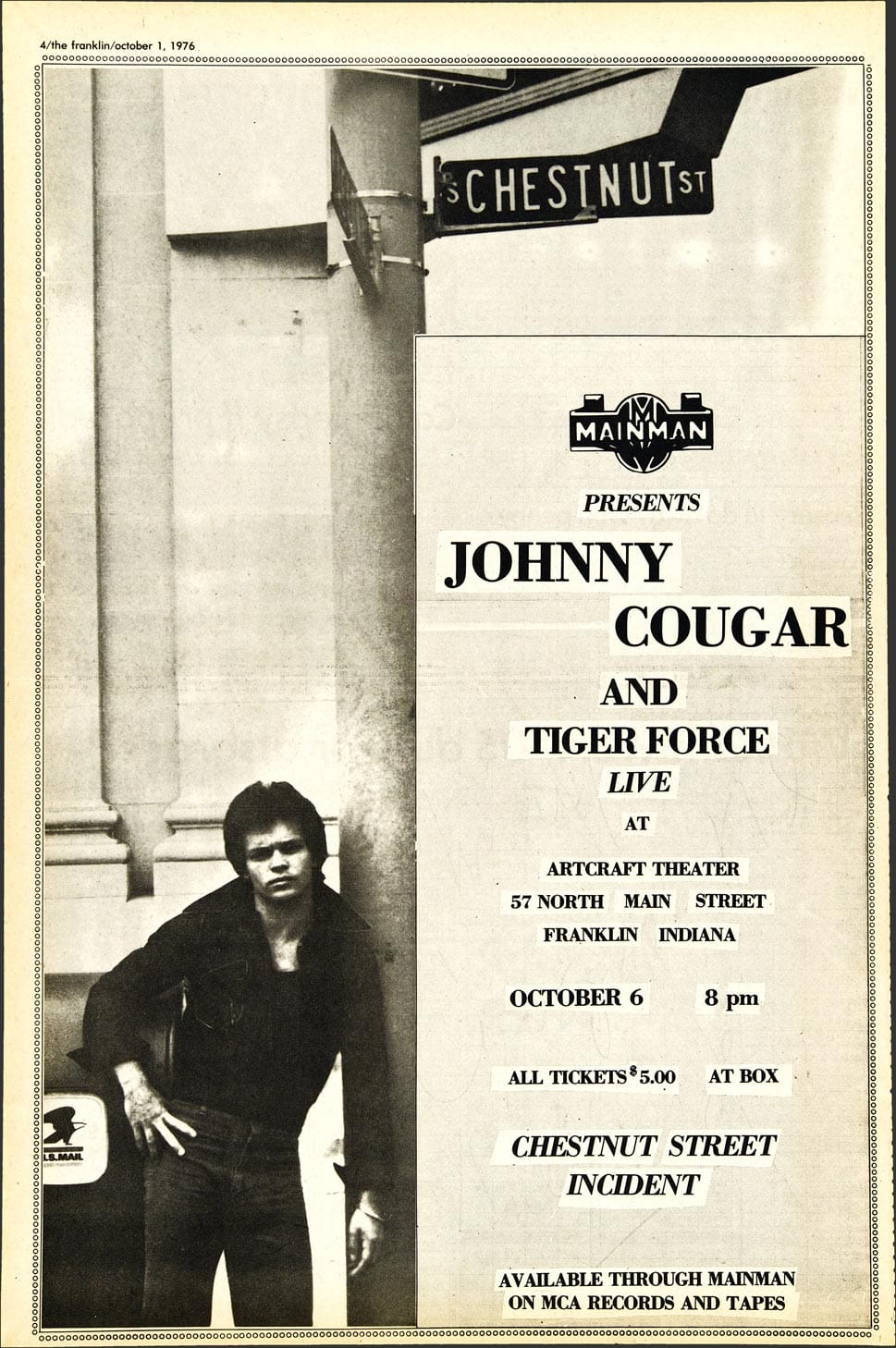
But the happening didn’t happen. “No show tonite. Johnny Cougar show cancelled,” read the Artcraft ad on the day of the concert.
It shouldn’t have been surprising. Despite playing for a full house in Seymour before national music writers, Johnny Cougar remained relatively unknown to the average Hoosier. Songs from his first album never grazed the Billboard Hot 100, so they reaped scant airplay except on adventurous stations such as progressive rock legend WMMS in Cleveland.
Besides, bare-chested guitarists with amplifiers were never the norm at the Artcraft. Theatergoers were much more accustomed to G-rated kiddie matinees and family-friendly films.
The concert tour only got stranger from there, slowly unraveling along with the budding career of Johnny Cougar. Somewhere along the way, DeFries went full P.T. Barnum, hiring animal trainers to bring two live cougars into a radio station interview without warning.
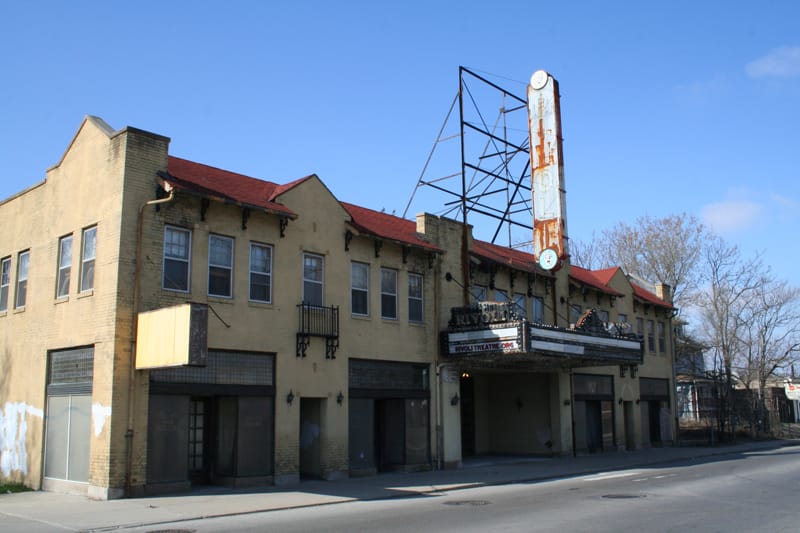
Halloween night saw the first Indianapolis engagement, staged at the Rivoli Theatre, a state-of-the-art cinema when constructed by Universal Pictures Corp. in 1927. Cougar was one of many live music acts to appear at the aging showplace that fall. During the week of his concert, the Rivoli fleshed out its schedule with constant showings of the X-rated film “Love Match.” Indy newspaper ads touted “John (Big Boy) Holmes in his first all-male cast.”
John (Song Boy) Cougar found plenty of less tactile love within the walls of that same theater. A throng of “possibly 2,000,” with reactions of “mild to wild,” assembled for a show that “varied little from the Seymour concert in format,” all the way down to the encore, said Dunkin.

Had every scheduled performance gone as well, the pride of Seymour might have glided into the rock star stratosphere with nary a cloud in sight. But in a 1977 Columbus Republic interview, Cougar stated that under MainMan, he got to play only seven of his 15 planned concerts and wound up losing money.
Besides Seymour, Columbus, and Indy, definitive details of localities are elusive. But a contemporaneous MainMan document lists six October shows that include Terre Haute on October 7; Louisville on October 16; and Toledo, Ohio, on October 26.
The info seems accurate: Terre Haute newspaper ads point to the upcoming concert, while a YouTube video billed as Mellencamp’s first TV appearance shows him singing on a Louisville morning show one day before the event. Meanwhile, the University of Toledo website confirms that not only did Cougar give a Homecoming concert at the Student Union, but admission was free. Concert No. 7 may have occurred in Akron, where ads trumpet a November 4 show cosponsored by MainMan and Cleveland’s WMMS.
Wherever the Cougar Trail led, it reached its terminus in 1977. Displeased with the dismal sales of Chestnut Street Incident, MCA Records dropped Johnny Cougar from its label. MainMan’s DeFries followed suit, dispatching the young man he once compared to Elvis. Rather than slink home and use his guitar as kindling, however, Mellencamp signed on with Rod Stewart’s manager, Billy Gaff, and began building a career that would land him in the Rock & Roll Hall of Fame. He even reclaimed his birth name on his recordings.
DeFries probably didn’t make Mellencamp’s Christmas card list after the split. Yet, for all his opportunism, the ex-manager had been right about one thing. He really had discovered “something special” and given him a spotlight before the influencers of the day. Take away that night at the armory, and John Mellencamp might never have made a name in the music industry — even if it wasn’t his own. As he later explained to Rolling Stone: “I would call record people up and say, ‘This is John Mellencamp, I’d like to speak to …’ ‘Sorry, he’s not in.’ I’d call back 10 minutes later and say, ‘Hi, this is John Cougar.’ ‘Okay, hold on.’”
In the Homeward Bound documentary, Mellencamp initially cringed at the recollection of the Johnny Cougar Day parade and the accompanying hoopla in the heart of his hometown. “It was a creepy situation,” he said. “But (at) the same time, you know, here it is 35 years later, and without that beginning, I don’t think we’d be here today.”
A&E network didn’t consider Mellencamp’s world premiere a worthwhile memory, either. The creators of 2008’s Homeward Bound were supposed to present a return concert at the place he first performed, but instead they played the Crump card — choosing the Art Deco trappings of his second concert over the military-grade design scheme of his first.
But that’s the usual outcome of History vs. Hollywood. The joke was on A&E, though, when the 56-year-old Mellencamp admitted at the start of the concert, “I played here 30 years ago. I hate to say it, but I don’t remember anything about it.”
So which golden anniversary should we celebrate — his first album on October 1 or his first concert on October 2? Maybe both. Maybe more. Perhaps the State of Indiana should have designated October 2026 as Mellencamp Month, honoring the 50th anniversaries of his first album, his first concert, and his first concert tour, along with his 75th birthday.
Whatever the case, we shouldn’t consign his night at the armory to the dustbin of Lost History — especially for the sake of architectural style. In the ongoing battle of History vs. Hollywood, sometimes History deserves to win.
Not until 2023 did the townsfolk of Franklin finally get a second chance to show their appreciation for John Mellencamp and his music. An estimated 11,000 spectators flocked to an outdoor concert at the Youngs Creek Park amphitheater and were treated to an evening of “Hurts So Good,” “Pink Houses,” and other classics.
But Mellencamp wasn’t singing. He wasn’t even there. His songs were performed by a tribute band called Mellencougar.
It’s an ironic footnote that in 1976 the real Mellencamp couldn’t sell out a 600-seat theater in a small town, yet nearly a half century later, his songs so moved fans that even an imitator could sing them and draw thousands to a park only three blocks from the original venue.
Ain’t that America?
Brian D. Smith
Franklin native Brian D. Smith shared a Pulitzer Prize at the Fort Wayne News-Sentinel and spent 13 years as senior editor of Indianapolis Monthly. The Greenwood-based freelancer has written for Reader’s Digest, Family Circle, and The New York Times.