Building the Future with Dirt: Bloomington Company Turns to Autonomous Robots for Earthen Homes
Local builders, designers manufacture low-tech homes with high-tech equipment.

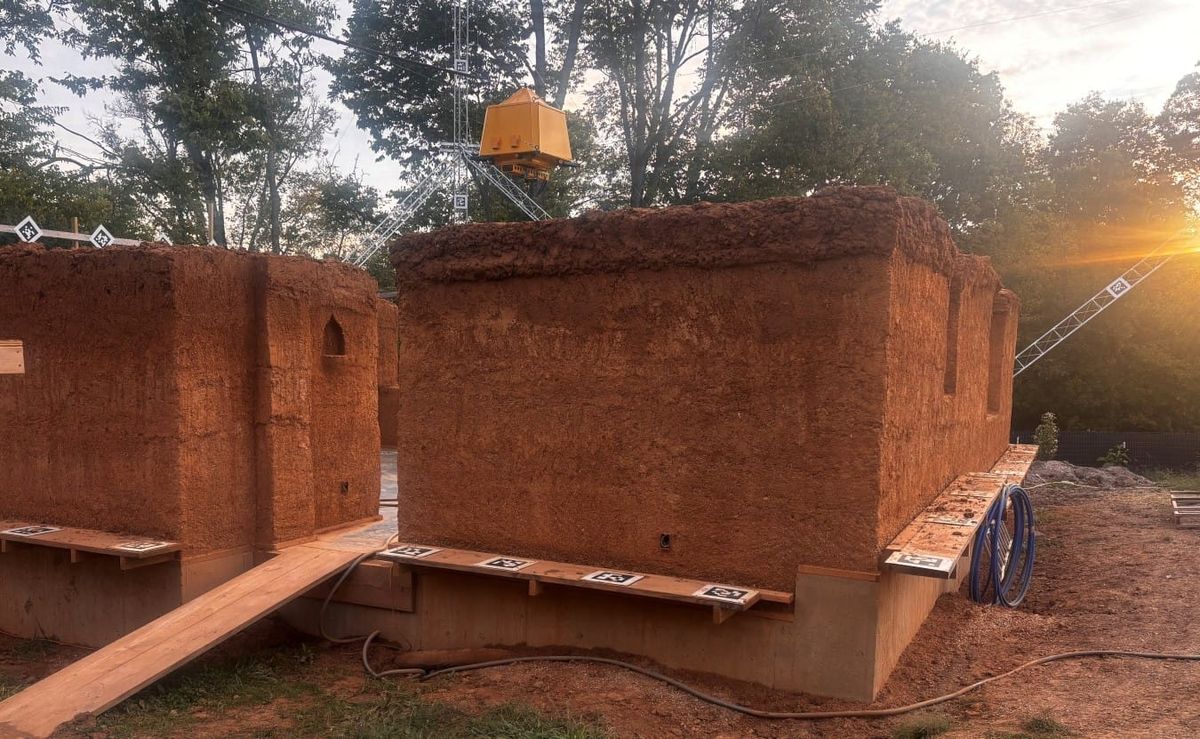
The walls of Ryan Zaricki’s future Bloomington home begin with four decidedly low-tech ingredients: clay, sand, straw, and water.
When mixed together, the result is known as cob, and humans have built homes from this material for thousands of years.
The high-tech part comes next.
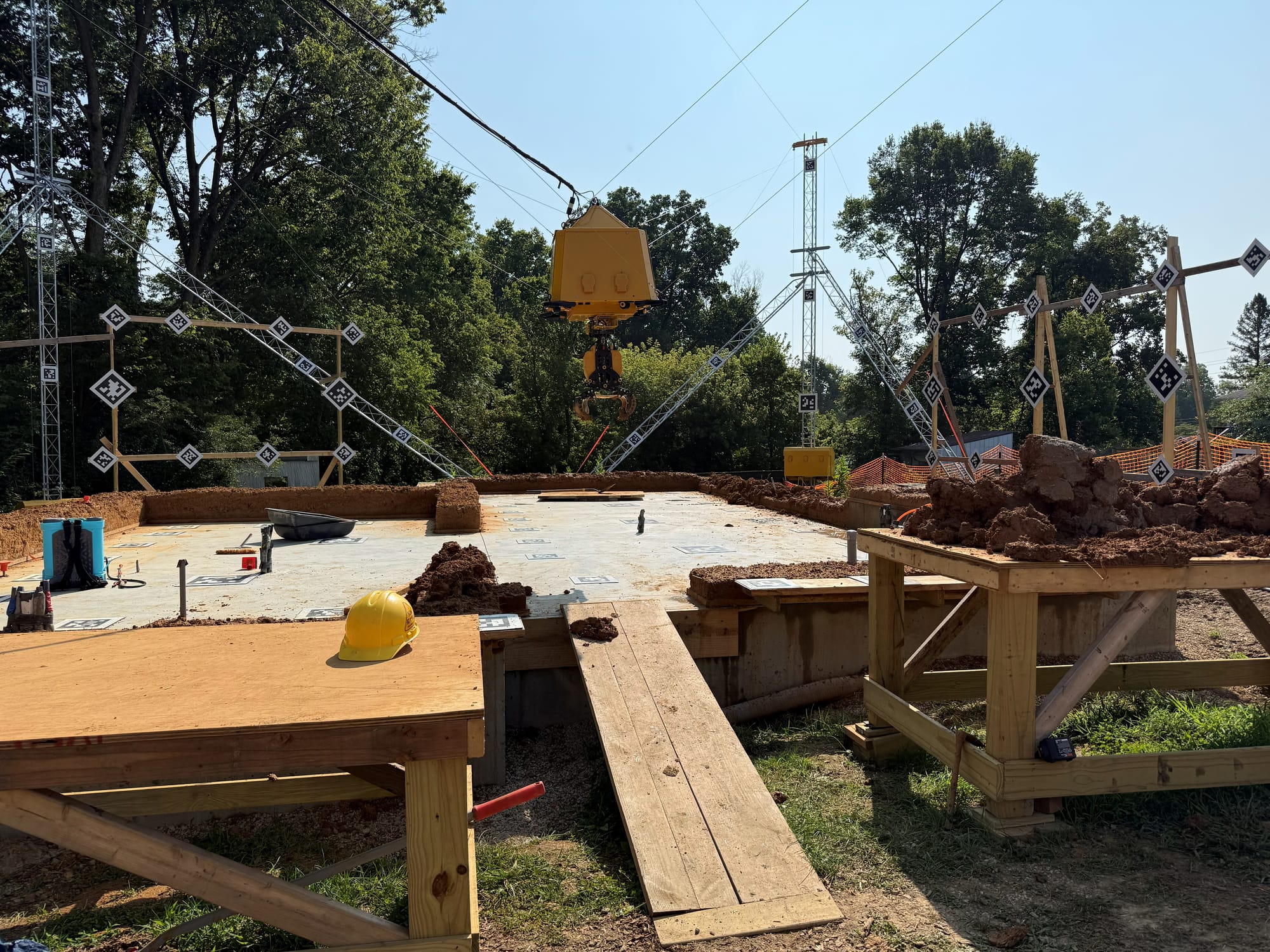
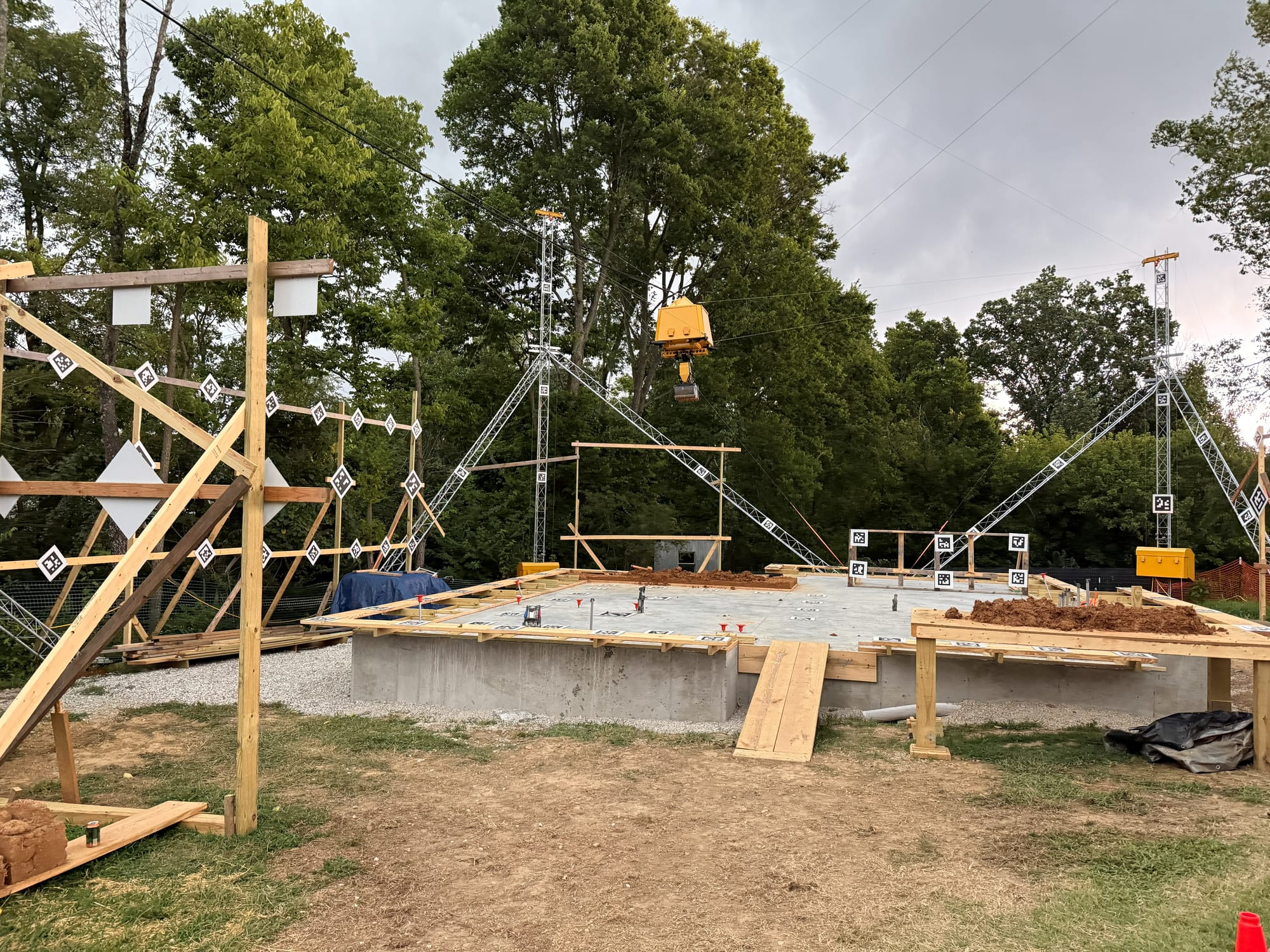
Suspended from cables stretched between towers on a Banta Avenue lot, a robot grabs the earthen mixture and carries it into place, slowly building the walls of what will be an approximately 675-square-foot home for Zaricki.
A Bloomington-based company, Terran Robotics, is betting that combining one of the world’s oldest building materials with autonomous technology could address a distinctly modern problem: housing costs.
“We use an autonomous cable-driven robot to build monolithic adobe homes,” said Daniel Weddle, co-founder and chief design officer.
Weddle and his cofounder, Zach Dwiel, first met in the early 2000s while working on Dandelion Village, an intentional, sustainable ecovillage initiative on Bloomington’s west side. At that time, they explored earthen construction using a compressed earthen block machine.
“We chose earth because it’s so cheap,” Weddle said.
They found earthen construction too labor-intensive to make both affordable and sustainable, and Dandelion Village moved forward without earthen homes.
But as technology and AI advanced, the duo explored the idea again.
“The thesis is: the material itself is the cheapest thing you can build a house with, but it costs a lot to deploy it because it’s high labor,” he said.
When building earthen homes, roughly five percent of the cost is for materials while the remainder is for labor.
“If we automate away the labor, we can make the cheapest house,” Weddle said.
And, if it can be done at scale, Weddle said, it could solve a lack of affordable housing.
“The material is common. The approach is unique to us,” he said.
The business, founded and headquartered in Bloomington, has its robots built in Brazil, Indiana. Half the company moved to Texas in November to begin printing homes in the Lone Star State, where they have completed two homes, are currently printing the third, and have another six homes in the cost-planning or initial contract phases.
Zaricki’s home on South Banta Avenue will be the second home to use this approach in Bloomington. Weddle’s personal home at 917 Fairview Street, which is also known as the Pink Poodle, was the first build.
For Nathan Harman, field services manager for Terran Robotics at the Banta Avenue project, the robot is solving a problem that he first encountered more than 20 years ago.
Harman graduated from Indiana University in 2004 with a degree in earthen architecture through the university’s individualized major program.
This combined his love of clay with his love of experimentation, handcraft, and building.
“Then I built any number of a handful of small buildings either with cob or slip straw or straw bale or timber framing or stone, whatever natural materials in the area, but it was never an economically viable model. It just didn’t make sense. There was too much labor involved. I wasn’t really trying to build billion-dollar homes,” he said. “I was trying to build reasonable, small permaculture bits of art.”
Harman switched careers, going into agriculture, and didn’t think about earthen homes until one was plotted in his neighborhood. Zaricki stopped by just to talk, and by the end of the conversation, Harman was working for Terran Robotics because of his long history of working with the materials.
“In some degrees it’s not fair because the robot is taking the fun part of actually putting mud on the walls, and that’s a bummer,” he said, adding that he wished the robot did the mixing. “As of now, the robot is taking over the large-scale bulk building of large flat planes, and that’s just tons of material that would have otherwise [have to] be lifted by a human and isn’t necessarily particularly inspiring.”
Harman said it takes material that is easily accessible, widely available, and affordable that was previously limited by the ability to produce the labor necessary to use it.
“It solves basically the problem of my career in earthen architecture, which was getting enough people reliably to be able to pull this thing off,” he said. “It doesn’t yet do crazy artistic hand-sculpted aspects. It just builds long, tall, straight walls, but it turns out that’s what most people want in a house.”
Harman said a human can still do the creative elements such as shaping rounded corners, digging out an alcove, building a shelf, adding murals, and embedding geodes into the wall.
Harman explained the process used to build the home.
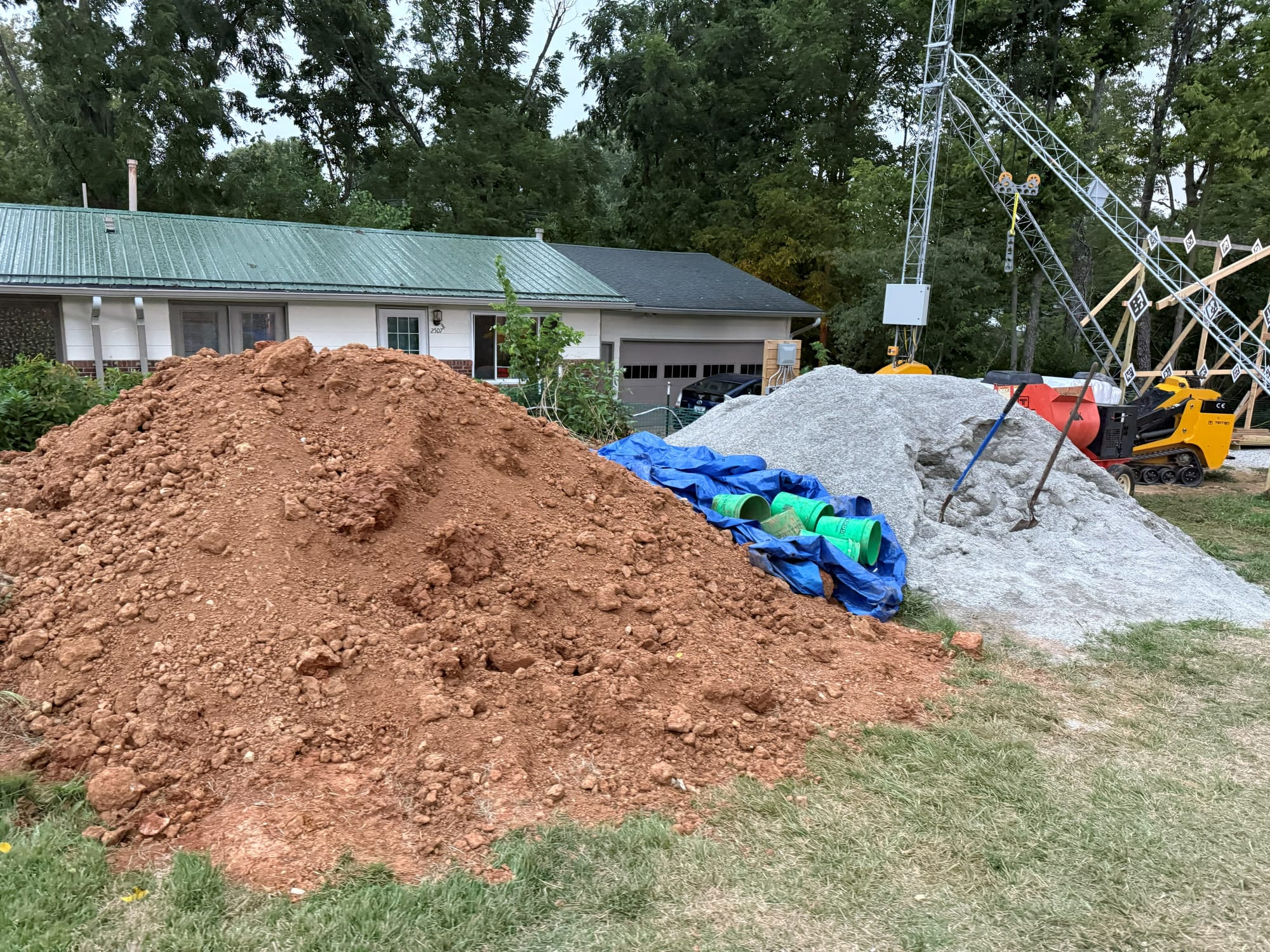
Currently, an electric mortar mixer is used to mix the cob, following a recipe of clay, sand, straw, and water. He said a silage mixer is also on the way.
Then, a dingo or mini skid steer with a bucket is used to load the materials into the mixer.
“It’s just carrying those four ingredients: clay, sand, straw, water. That’s it. It all comes from within 11 miles of here,” Harman said.
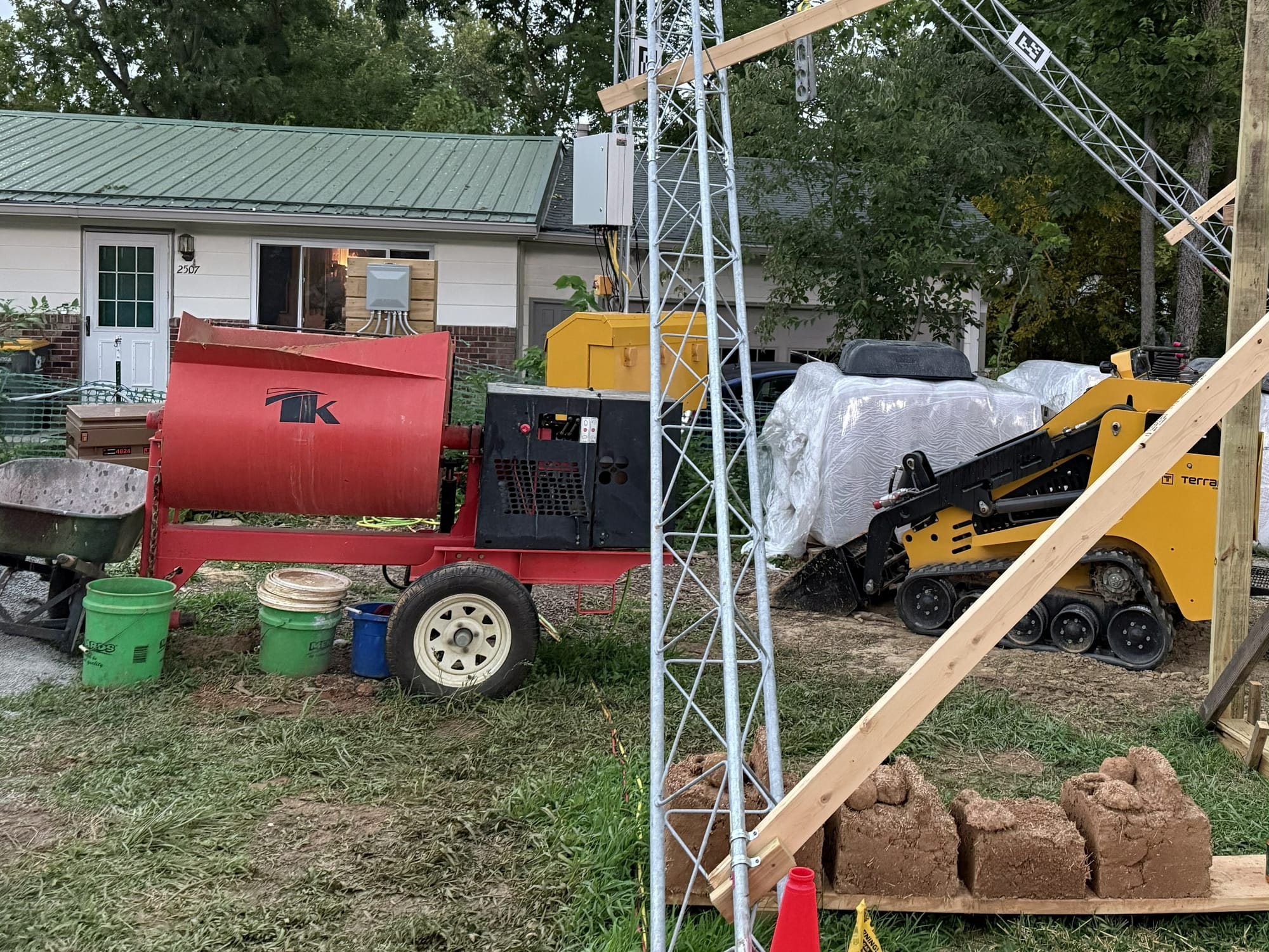
He said the cost of the raw material is minimal, in part because the clay comes from fill dirt that would otherwise have little value. Instead, much of the material expense comes from transporting it.
After they’re mixed together, they use the dingo to move the mixture to a table where the robot, suspended on cables, uses a claw attachment to pick up the material and place it where it belongs.
“As of now, the human part is basically feeding materials,” he said.
The robot is accurate within two centimeters from tower to tower. It uses a model that shows where the windows and doors will go, as well as how thick and long to make the wall.
“It knows exactly where the walls are supposed to be because of all the tags. Those are vision placers,” Harman said.
The AprilTags look like QR codes for the robot to read and know where it is at.
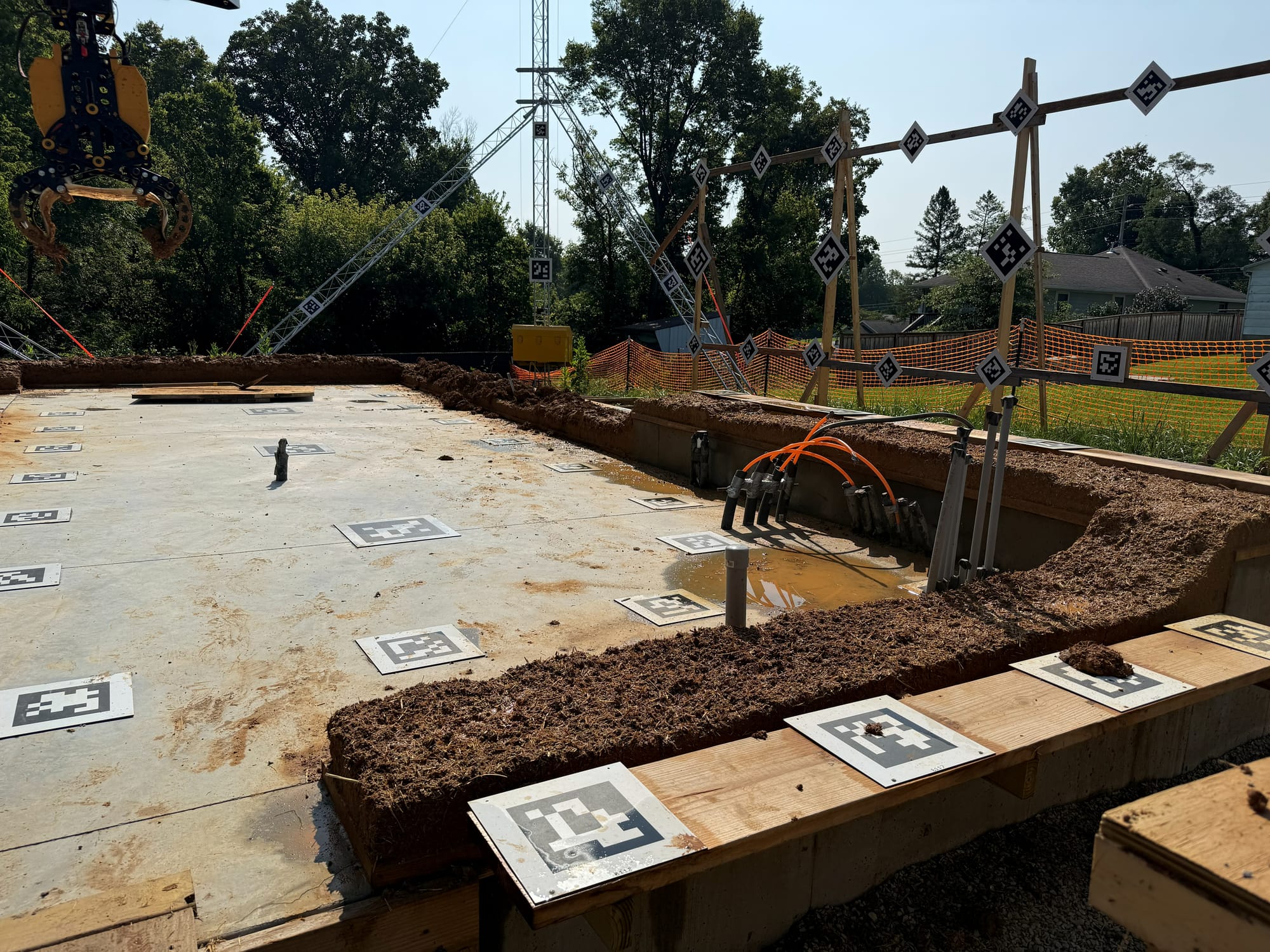
“The reason there’s so many [AprilTags] is at some points the robot will be looking over here and working on the thing, and then it’ll be looking down. And then, it’ll be on the other side looking over here, but it needs to have accurate placement in all of those planes. So everywhere it is, it has to be surrounded by this kind of knowledge,” he said.
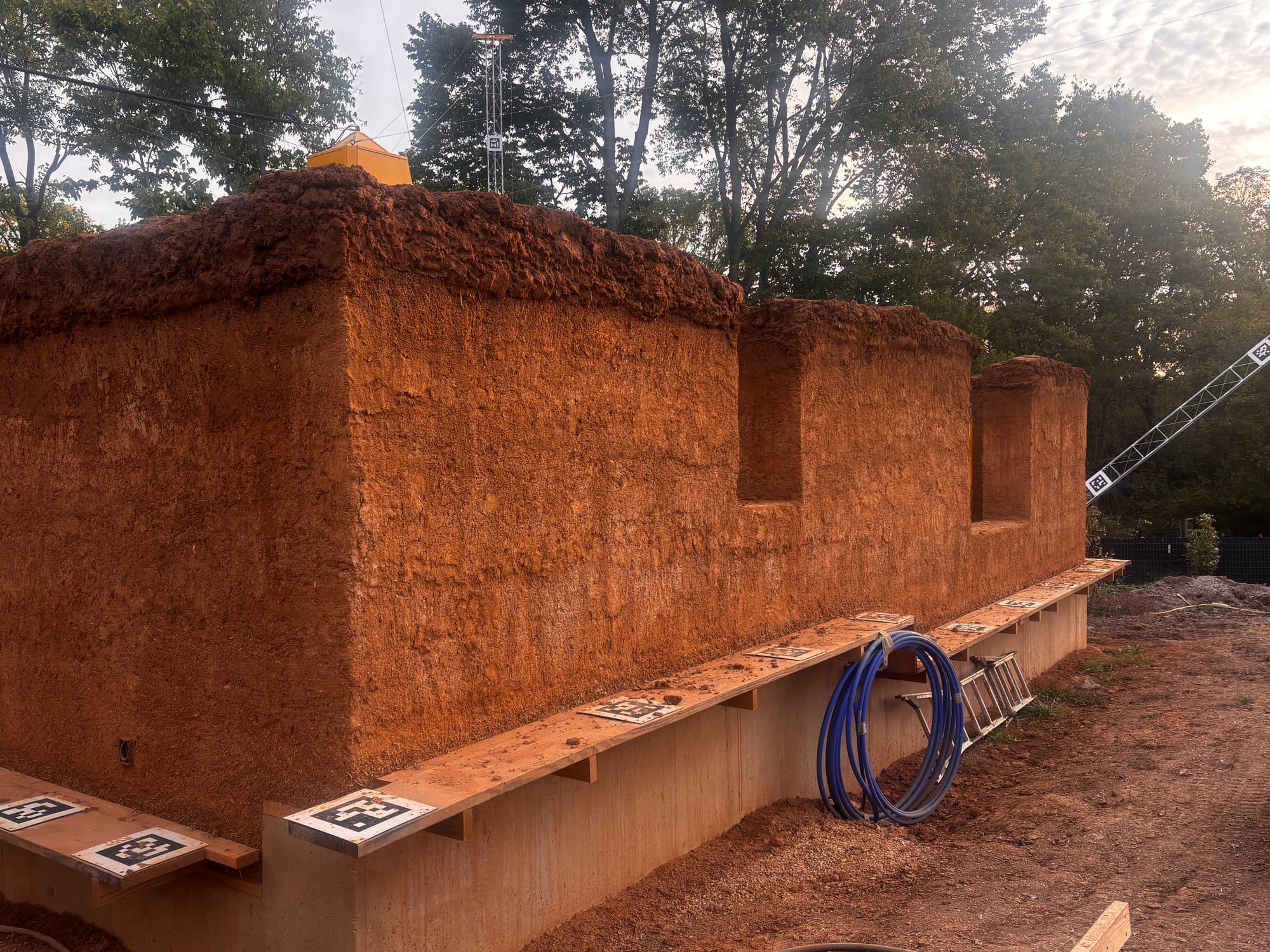
After seven or eight inches are placed in an area, the robot's claw is switched out for a hammer tool that pounds the cob into place, making it flat on the sides and the top.
Harman said switching between the two tools only takes a couple of minutes.
Prior to the open house, his role was fairly involved because he was working on the concrete foundation, the drainage, and the AprilTags.
Now, it’s feeding the robot.
“In Texas, where we’ve been tracking minute by minute, it’s about two hours of intervention time, we call it. Times when we stop the robot and a human comes on and does something,” he said, across an eight- to ten-hour shift.
Those interventions could be anything from using a level to ensure the wall is being built straight, using a hand mallet to tap it, picking up extra cob on the ground, or cleaning the AprilTags with a hose if they get dirty.
“There’s a very small handful of interventions that all matter and require an eye and some strength but are not complex tasks,” he said. “The dream would be that one person with an iPad and a dingo could manage this build per shift, and you could run three shifts a day with three people. And actually that they could do three different houses at the same time if they were being built right next to each other.”
Currently they need about three people per shift: an engineer, a laborer serving as a monitor, and a laborer to help with mixing duties.
“It’s not like concrete. It doesn’t dry. There’s no chemical reaction. If it gets over dry, you just wet it again. You can just throw it back in the mixer. It’s permanent material. You could literally take a 50-year-old cob wall, blast it down, get it wet and remixed and put it back up,” Harman said, adding that the straw is the only biodegradable part of the mixture.
There’s a balance between ensuring the straw doesn’t rot and mold.
“You want it wet enough to be built easily, and then you want it to dry quickly,” he said.
Though, because you have to bond wet clay to wet clay, the top surface is soaked each day.
And what happens when it rains?
Harman said that normal rain isn’t an issue for building with cob. But if heavy downpours and flooding are expected, the walls still in progress can be covered with a tarp to prevent damage.
“Unless soil is eroding out of your front yard, it’s not really falling off this wall either,” he said. “But for the most part, we want it to dry, and it’s really good at absorbing a little moisture and releasing that moisture. It’s certainly subjective. There are very few ways to go wrong on the moisture level.”
Once the walls have dried completely, Harman said cob can last thousands of years.
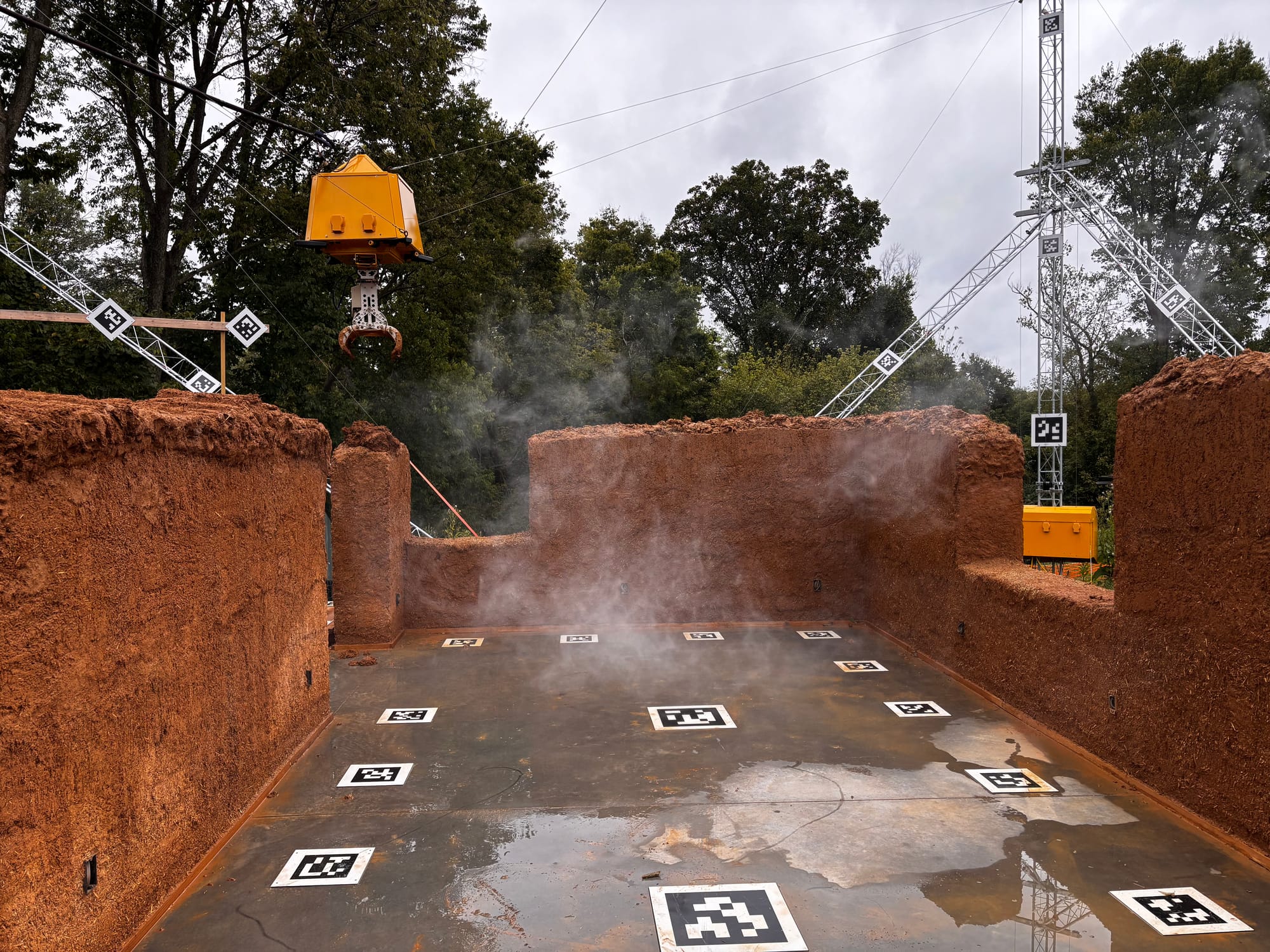
“If you have a good roof with a wide overhang and you have a high enough foundation to prevent water streaming by and keeping the bottom of the wall wet, it’s ridiculously sturdy. It has amazing compressive strength. It’s fireproof. It’s bulletproof. It’s just so heavy that it’s not going to blow over. You can drive a truck into it. It’s a strong-ass wall for cheaper than building a two-by-four wall,” he said.
The home will feature hydronic heating or heating through water pipes in the floor and solar panels.
“The clay absorbs excess humidity and re-releases [it] when the air is too dry, so you don’t need a dehumidifier; you don’t need HVAC. It just feels good because it’s earth,” he said. “Cob is an amazing material that makes sense in every way except for using it.”
Zaricki, who studied mechanical engineering at Rose-Hulman, first signed up as a customer but then started working for Terran Robotics because of their mission to find a sustainable, affordable way to build houses.
He’s known Weddle and Dwiel for nearly 20 years, since Dandelion Village, and has watched the duo build Terran Robotics.
“I just wanted to support what they were doing. I totally understood the vision. Earthen building is a really wonderful way to build houses and a wonderful space to live in. Their idea was that it’s dirt-cheap building materials, but it’s really labor-intensive, so developing a robot to take care of the labor side of things just made sense,” he said. “Part of the vision is how do we help solve affordable housing, and one of the big ways that we can do that in Bloomington is by doing dense development on existing lots.”
The first home on the property will be an ADU, or an Accessory Dwelling Unit. The City of Bloomington allows ADUs so long as it or another unit on the property is owner-occupied.
Zaricki’s future home, the 675-square-foot ADU, is expected to have the walls completed by the middle of October and it ready to be moved into by the end of the year.
He has plans for a duplex on the front half of the property, with construction beginning in the spring.
Currently, they are racing against the clock and Mother Nature, as a freeze would impact the cob, which relies on water.
“The hard freeze is the major thing. We need to get the walls done before it starts freezing because we do a wet material, and obviously that can be catastrophic if it freezes and expands and it cracks,” he said.
Once it is completely dry, they will add a metal roof, windows, doors, and solar panels.
The inside of the home will have earthen clay plaster, which can be done throughout the winter. But the outside of the home will have lime plaster that may have to wait until the spring, unless there are ten days without freezing temperatures this winter, as it is also applied wet.
Every other part of the home is like its traditional counterparts.
“We’re inserting our walls into traditional plumbing, traditional electric, traditional HVAC. There’s a little bit of framing for the room. But none of it’s really out of the norm other than our walls are different,” Zaricki said.
After graduation, he spent time out west building straw bale houses. He learned framing, electrical, solar panels, and radiant floor heating along the way while finding his passion as a builder. That passion sits at the intersection of sustainability coupled with his engineering background.
“I kind of pivoted away from building and was focusing on solar for a lot of years, and as that chapter is kind of closed, it’s been really fun to circle back and open this new chapter which rhymes with a lot of my past but also sprinkles in that sort of autonomous robot element which is obviously super cutting edge and new and also super exciting to be part of,” he said.
He pointed to the scalability, as two robots will be running concurrently in Texas in September and four are planned to run concurrently there in December.
“There really is an opportunity to scale there when we have a small, highly skilled team that’s able to run multiple robots on a site building multiple houses at the time,” he said, allowing for homes to be built quickly, cheaply, and made to last. “That’s the whole point of the autonomy; it’s basically press play and let it start and let it do its thing. It’s exciting, and it’s right around the corner.”
Zaricki said he was unsure whether to bring up the artificial intelligence aspect, given the negative connotation the technology has had.
“I do really think that doing what we’re doing uses those tools in a really appropriate way to do some really cool cutting-edge stuff, but people have been building with clay and sand and sticks for literally tens of thousands of years,” he said. “It’s really cool to add the old and add the new and sprinkle together, mix it up, and then build awesome houses and hopefully build thousands of awesome houses. It’s a really fun thing to be a part of.”
Nicole DeCriscio
Nicole is a freelance journalist based in Bloomington, Ind., with more than a decade of experience. She founded The Owen News and serves as National President of the Society of Professional Journalists. She enjoys hiking with her two black labs.