Confronting History: Photographs of Remembered Tragedy
An exploration of how the term “massacre” operates as historical lens.

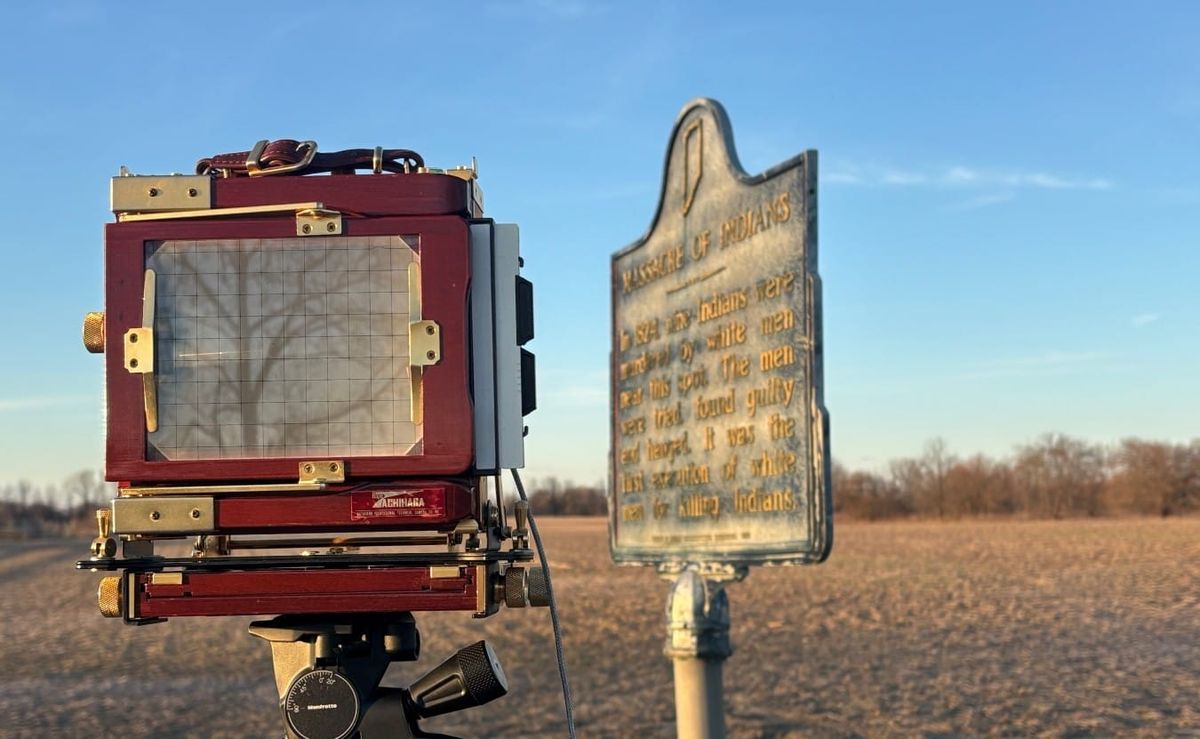
For close to a decade, I have been photographing a personal project that offers a visual survey of the American landscape at sites of historic conflict between the United States government and Native American peoples, including sites in Indiana. The project centers on the idea of “massacre,” and how these sites and events have subsequently been commemorated and memorialized. The images explore whether our collective understanding of these shared histories can be reconciled with inherently confrontational and oppositional historic narratives.
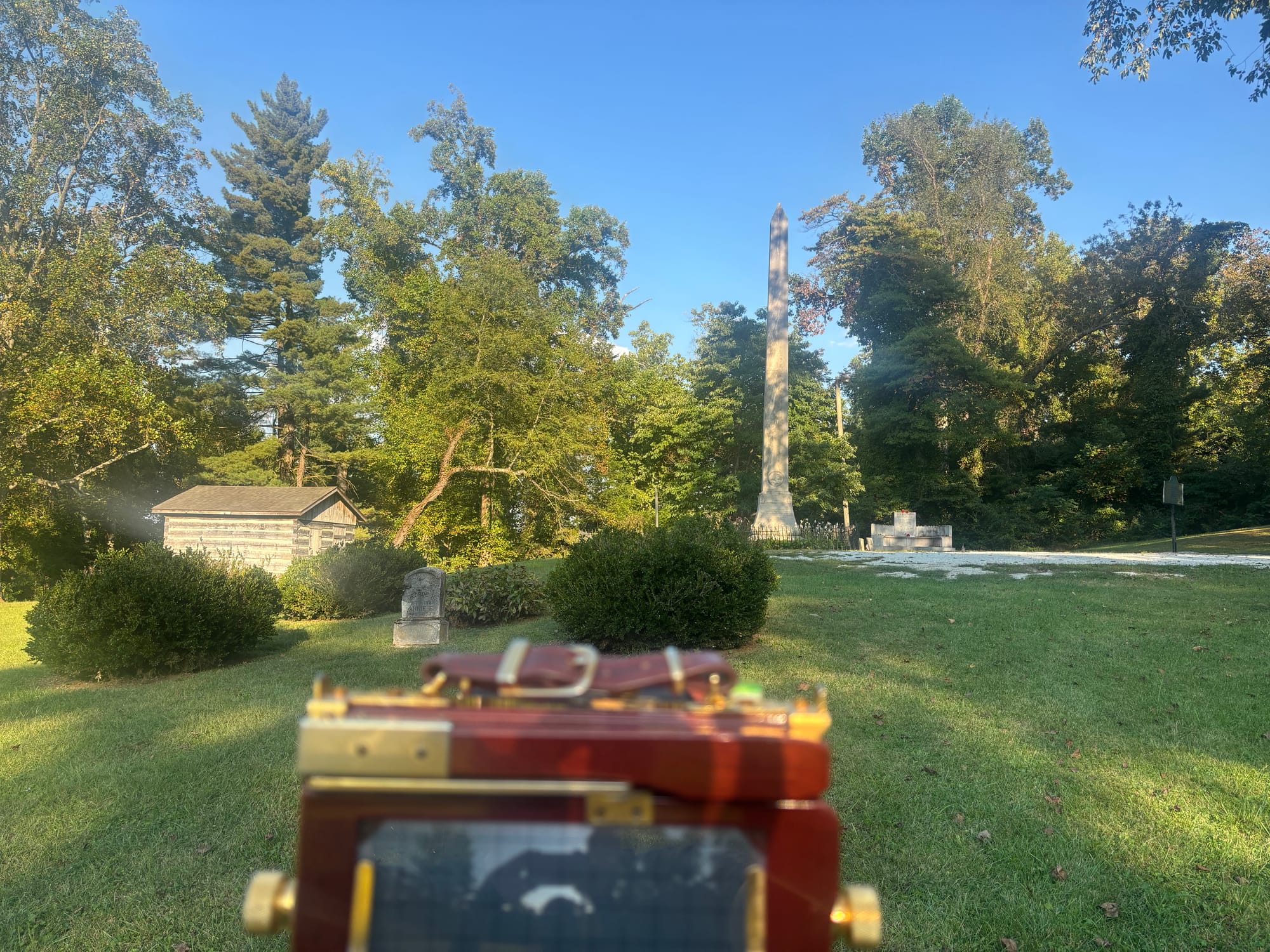
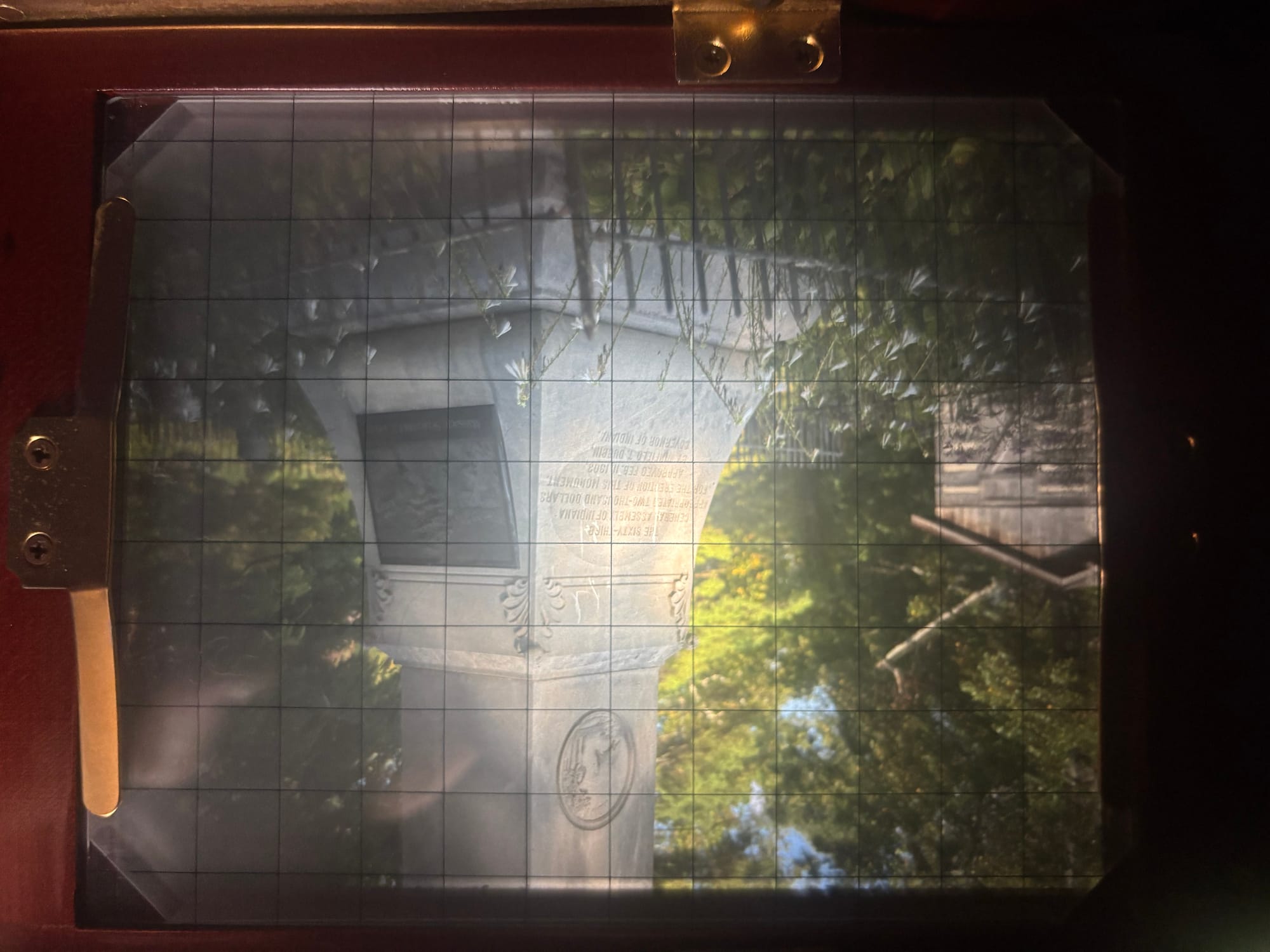
Since 2018, I have researched and photographed over twenty sites throughout the country that relate to the wider US-Native American conflict. From this broader survey, I pulled together those images that can qualify as “massacres” for inclusion in the project’s current iteration. Photographed on color film with a 4x5 field camera on or near the anniversary at the site of each event, the images offer a visual timeline chronicling America’s westward expansion. Documenting these sites around the time of their anniversaries reinforces the act of remembering and the importance of historic memory, while also imbuing the landscape itself with an accurate sense of seasonal ambiance.
I include events commonly acknowledged as massacres, those that arguably qualify, and still others whose historical framing has shifted over time, regardless of who is cast as victim or perpetrator. The story is a complex narrative about the importance of place, history, and remembrance that challenges longstanding myths of American exceptionalism. The goal is not a comprehensive catalog, but rather an exploration of how the term “massacre” operates, whether as a rhetorical weapon, as historical shorthand, or as a lens through which we view the past.
While the aesthetic focus is on the land, elements of memorialization are seen in many of the images. The memorials and names given to these events imply interpretation, which in turn relies on a broad consensus of how an event is understood. I believe that, just as important as the events themselves, the history of how we have come to remember and memorialize them reflects a society’s understanding and values at any given moment in time. Simply put, history is curated, and whether or not a massacre is remembered and acknowledged oftentimes depends on who is doing the remembering.
Here in Indiana, I have photographed two specific sites for the project, both acknowledged massacres: the Pigeon Roost Massacre (1812) and the Fall Creek Massacre (1824). Additionally, I have also documented two sites that address the broader history of US-Native American conflict: the Battle of Tippecanoe (1811) and the start of the Potawatomi Trail of Death (1838).
For a state deliberately, and rather generically, named after its Indigenous inhabitants, Indiana was a pivotal battleground throughout the 19th century as the U.S continued expanding further westward. Largely playing out within and around the adversarial relationship between the Shawnee leader, Tecumseh, and the Indiana Territorial Governor, William Henry Harrison, Indiana’s history is punctuated with iconic battles and massacres against a ceaseless backdrop of forced land cessions eventually culminating in displacement and outright removal of tribal nations. Like the slow spread of spilled ink from a parade of disingenuous treaties, Indiana’s final state borders slowly took shape as they crept north from the banks of the Ohio River and east from its border with Ohio.
The first treaty established in part of Indiana, prior to statehood, was the Treaty of Greenville in 1795, marking the end of the Old Northwest War. This treaty granted settlement of some Native American lands north of the Ohio River. Later, William Henry Harrison brokered many duplicitous treaties to purchase Native lands throughout much of the Midwest. In addition to much of Indiana, swaths of what would become Illinois, Michigan, and Wisconsin were acquired between 1801 and 1809, affecting an array of tribal peoples, including the Delaware (Lenape), Shawnee, Miami, Potawatomi, Kickapoo, Wea and Eel River, and Sac and Fox. These fraudulent and underhanded land-grabs set Harrison on a collision course with Tecumseh’s growing tribal confederacy, culminating in the Battle of Tippecanoe and continuing into the vicious frontier fighting of the War of 1812.
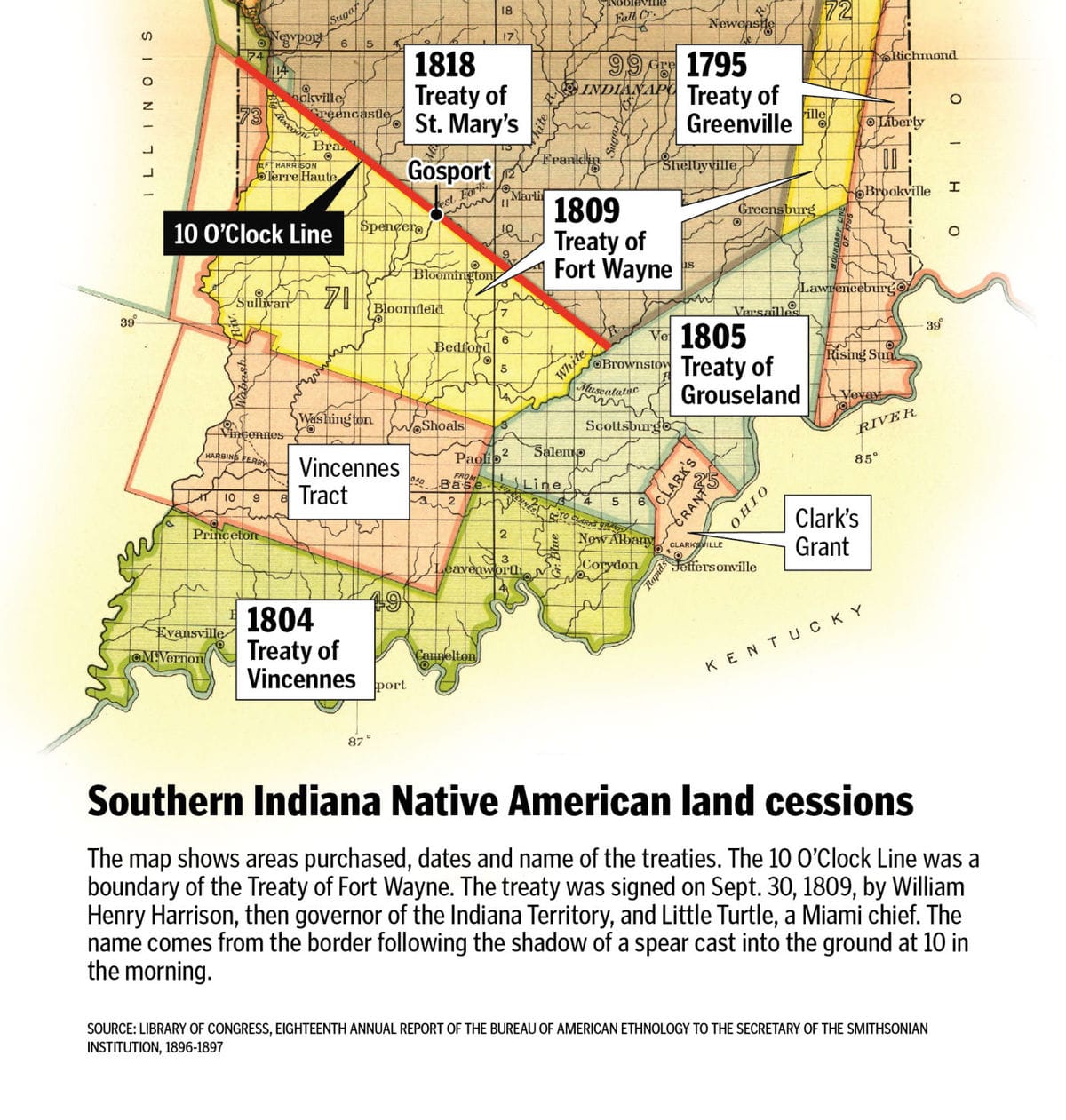
The conclusion of the War of 1812 and official statehood in 1816 saw the return of aggressive land cession treaties in Indiana, inevitably leading to outright forced removal of Native American tribes in the 1830s and 1840s. Following the passage of the federally mandated Indian Removal Act of 1830, the remaining tribal peoples, including the Delaware, Kickapoo, Miami, Potawatomi, Piankashaw, Shawnee, and Wea, were forced to relocate from Indiana to reservations in Kansas and the designated Indian Territory in what is today Oklahoma. However, some Potawatomi and Miami remained on private land allotments in accordance with prior treaty provisions.
Battle of Tippecanoe
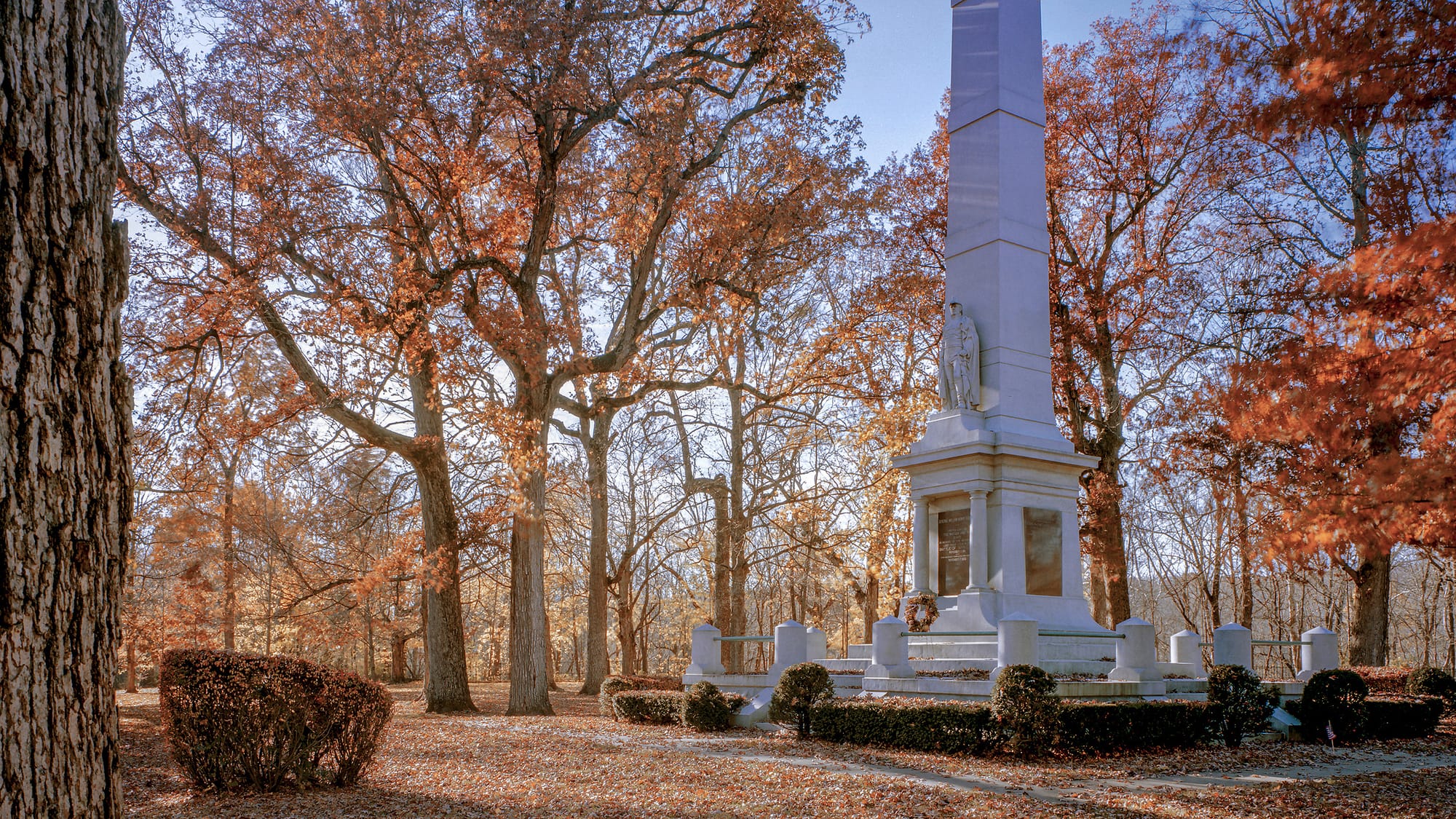
The Battle of Tippecanoe was fought between American forces led by Governor William Henry Harrison of the Indiana Territory and Native American forces allied with the Shawnee leader Tecumseh and his brother Tenskwatawa (“The Prophet”), leaders of a broad tribal confederacy opposed to white settlement along the frontier. The battle took place near Prophetstown, the tribal confederacy’s capital, near present-day Lafayette, Indiana. Harrison, who was on a mission to destroy Tecumseh’s tribal alliance, repelled an attack led by Tenskwatawa in the early morning hours of November 7, 1811. Tecumseh was not present during the battle; he was on a tribal recruitment mission in the South. The fierce fighting that morning lasted approximately two hours, and an estimated 70 Native American warriors were killed and 80 wounded. American losses totaled 63 soldiers killed and 126 wounded. Deemed a U.S. victory, the battle resulted in the destruction of Prophetstown and largely ended the threat of Tecumseh’s tribal alliance.
Tippecanoe is Indiana’s most well-known event in US-Native American history and was the very first site I photographed for this project back in 2018. I just happened to visit with a friend on the anniversary weekend when the trees were at peak autumn color, and the project grew from there. The focal point of the 16-acre Tippecanoe Battlefield Park is the Battle Monument. This 85-foot marble obelisk, dedicated in 1908, features a statue of Harrison himself in military uniform and honors the Americans who lost their lives. No dedicated memorial exists honoring the Native American side of the battle, although in nearby Prophetstown State Park visitors can see the Circle of Stones. Unveiled in 2016, the memorial honors all of the tribes in Tecumseh’s confederacy.
Pigeon Roost Massacre
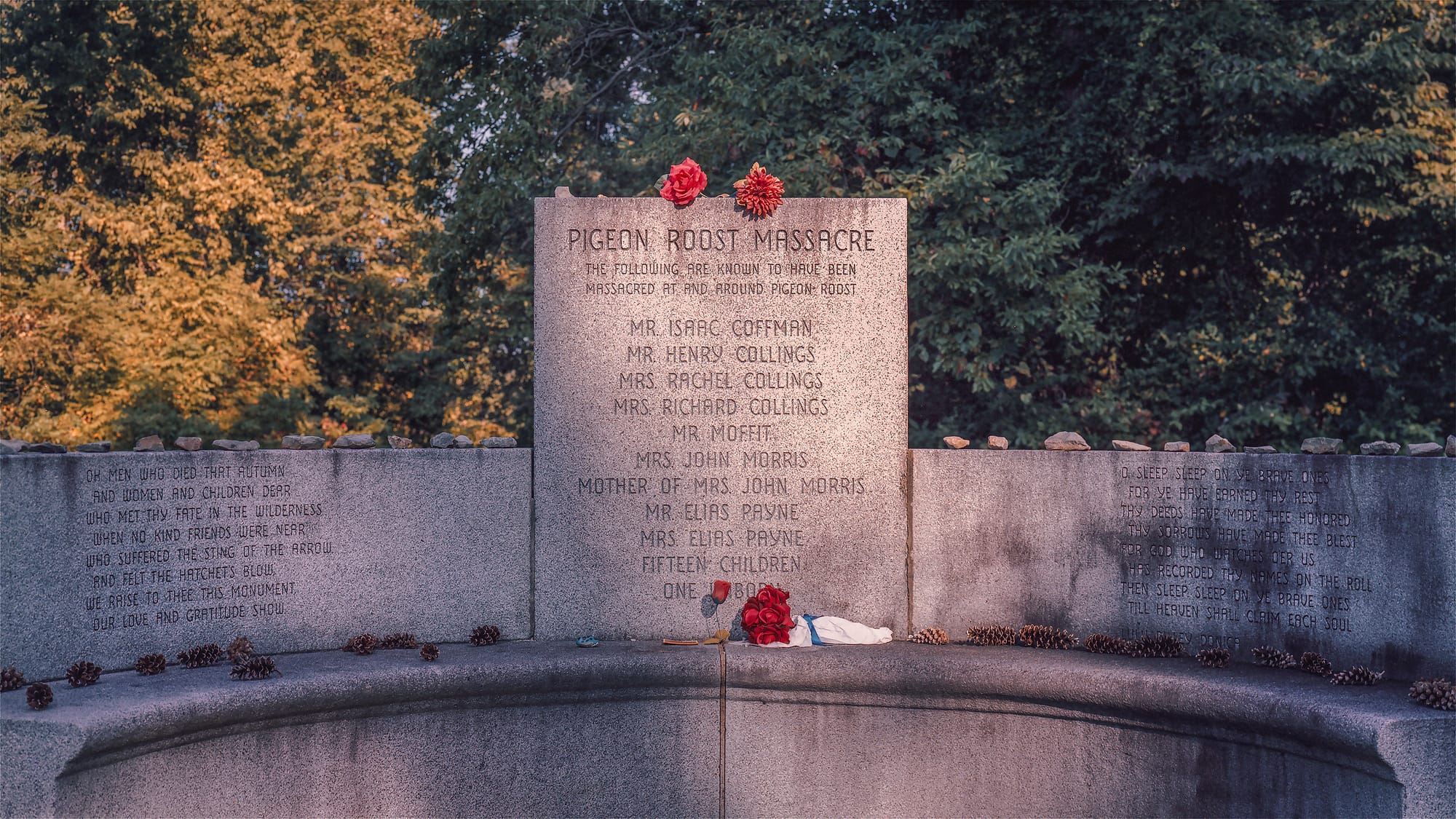
On September 3, 1812, a small party of Native Americans (mostly Shawnee, but possibly including some Delaware and Potawatomi) made a surprise attack on the village of Pigeon Roost in south-central Indiana. In all, 24 settlers, including 15 children, were killed, and two children were taken captive. Only four members of the Native American attack party were killed. The massacre was the first Native American attack on U.S. settlers in Indiana during the War of 1812, which was declared against Great Britain on June 18, 1812.
Today the memorial is a State Historic Site where visitors can see for themselves how historic understanding can change over time. The earliest memorials and markers dating to 1904, including a 40-foot-tall obelisk, lean exclusively into the “massacre” narrative, while a more recent historic marker from 2004 refers to the event as a “raid” and situates it within the broader context of the War of 1812. An annual picnic to honor the victims is held the second Sunday in September at the site.
Fall Creek Massacre
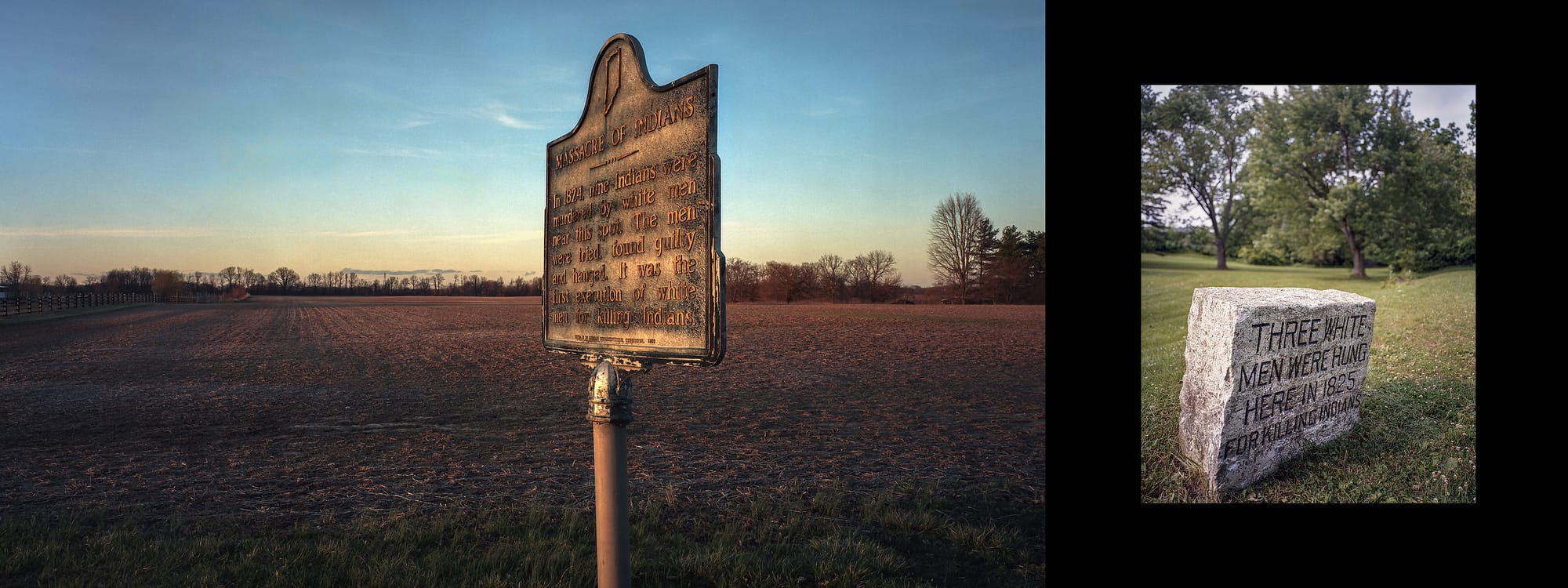
The Fall Creek Massacre is the name given to the brutal murders of nine members from a peaceful band of Seneca and Miami Indians (two men, three women, two boys, and two girls) by white settlers on March 22, 1824, in Madison County, Indiana. Three of the perpetrators were later found guilty during a trial and hanged. It was the first time that any white person was tried and executed for killing Native Americans in the U.S. It was this subsequent trial and execution of the perpetrators that set the Fall Creek tragedy apart from the countless other senseless acts of wanton violence found throughout the history of the American frontier. While justice had been served in this one instance, the case set no enduring legal precedent moving forward.
While no memorial to the victims exists, a weathered state historic marker outside of Markleville proclaims the “Massacre of Indians” near the site. And tucked away in Pendleton’s Falls Park, a squat stone marker bluntly informs visitors of the spot of the executions.
Potawatomi Trail of Death
The Potawatomi Trail of Death was the forced removal of the Potawatomi people from their home in north-central Indiana to reservation lands in Kansas. It marked the single largest act of removal in Indiana’s history and was tied to the broader Indian Removal Act of 1830. The forced march began in the early hours of September 4, 1838, when 859 members of Chief Menominee’s band were rounded up by General John Tipton and an armed volunteer militia in the Twin Lakes area near Plymouth, Indiana. The forced march lasted for 61 days, covering approximately 660 miles. More than 40 people died along the way.
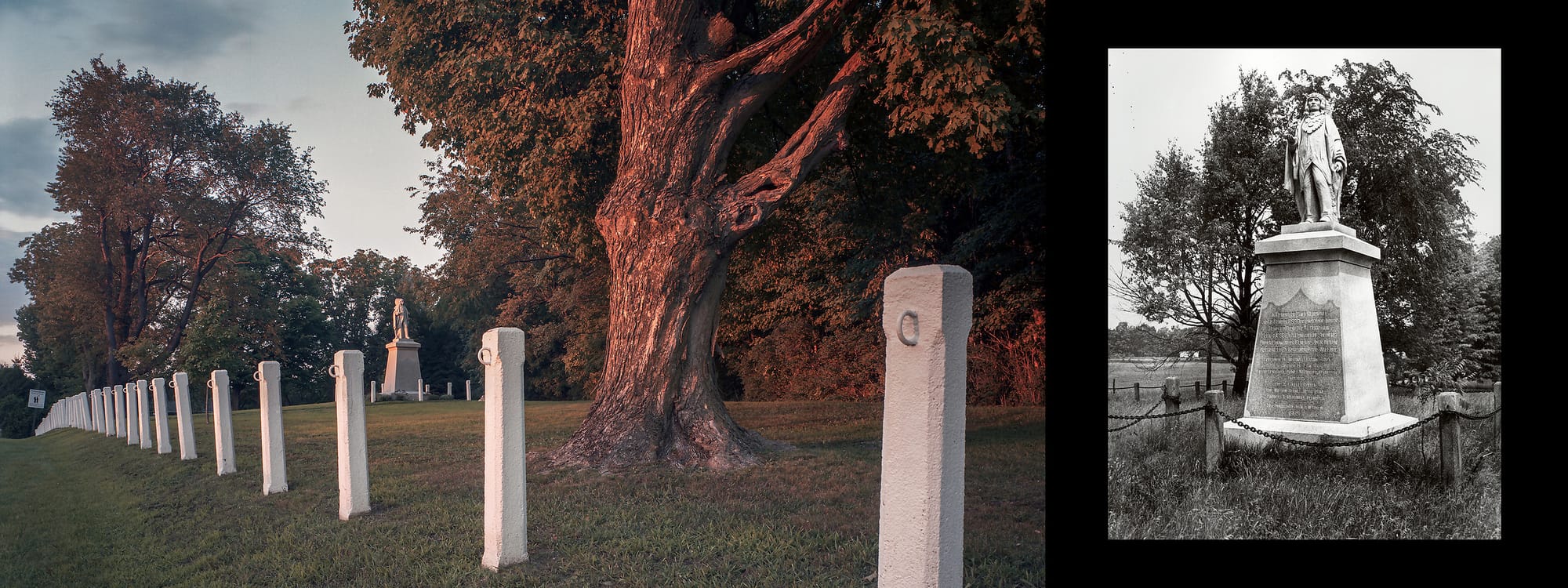
Today, the start of the Potawatomi Trail of Death is marked by the Chief Menominee Monument at the site of his Twin Lakes village. Erected in 1909, the 17-foot-tall granite statue of Chief Menominee was the first monument dedicated by the state of Indiana to a Native American figure under a state or federal legislative enactment. In addition to the memorial site itself, over 80 historical markers plot the path of the Trail of Death from Indiana to Kansas. And every five years a Trail of Death Commemorative Caravan is organized to retrace the original route of the forced march.
In the case of Indiana, all four of these sites have been remembered and memorialized in their own way. Whether or not these monuments and markers are enough to honor the events today is left to each individual to question for themselves.
Adam Reynolds
Adam Reynolds is a documentary photographer who grew up in Bloomington and is a graduate of IU with a degree in journalism and an MFA in photography. He now lives in Minnesota where he works as an architecture and design photographer.