Revisiting the Deam: Jeff Stant’s Old-Growth Vision on Frog Pond Ridge
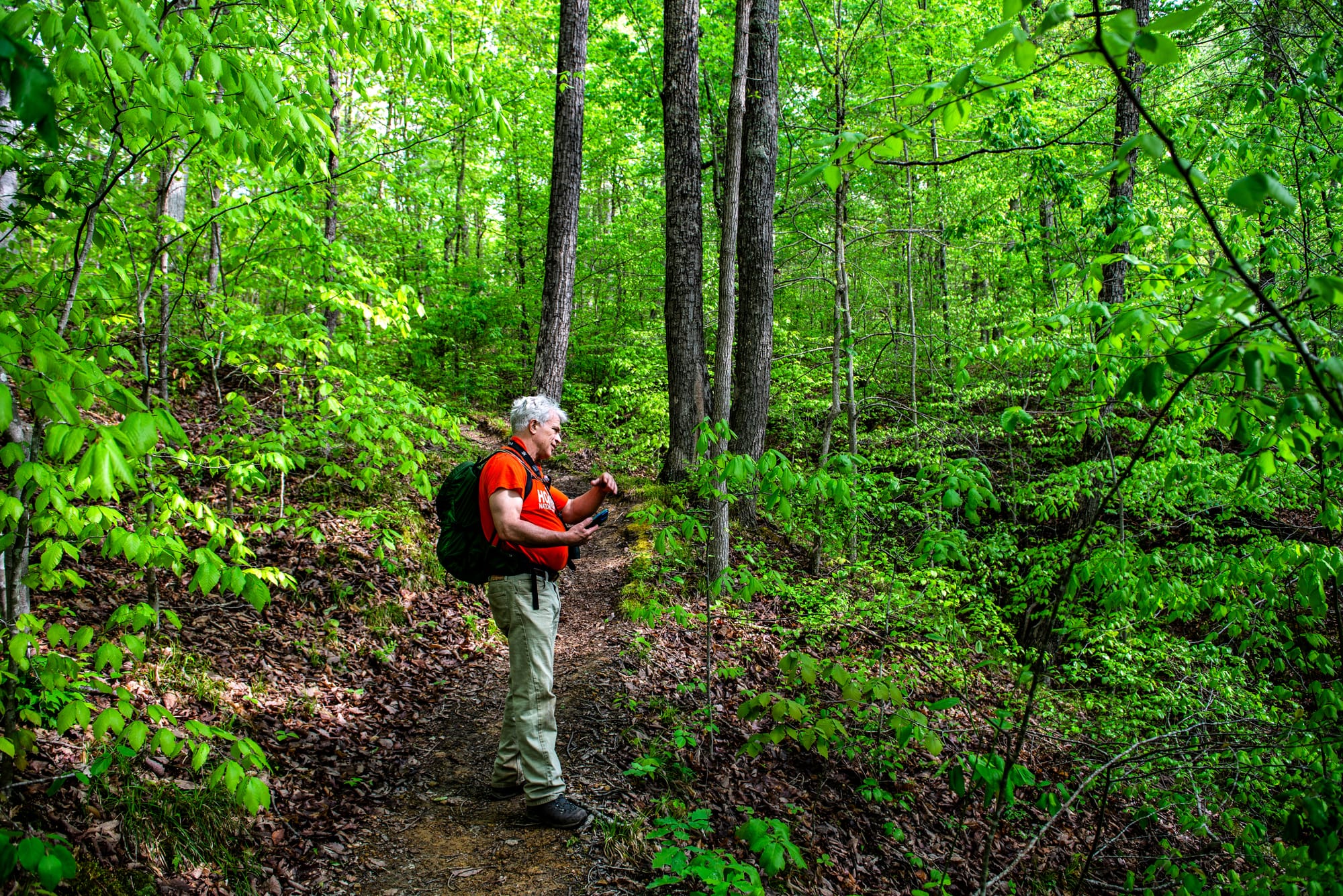
Steven Higgs discusses old growth forests with Jeff Stant.

The fourth installment in a photojournalist’s yearlong return to the wilds.
“Revisiting the Deam” is a series of stories chronicling author and photographer Steven Higgs’s exploration of the Hoosier National Forest as he revisits wilderness areas with friends, colleagues, and experts in the environmental field.
When Jeff Stant and I started planning the first of a series of hikes to old-growth hardwood trees in the Deam Wildlands Complex in January, I told him that I needed to get my 74-year-old body in backcountry hiking shape if I had any hope of following him through the woods.
Stant, the former Indiana Forest Alliance executive director and now advisor, doesn’t really hike; he bushwhacks. He traverses long distances over whatever terrain comes between him and the big trees. His initial idea was a six-mile, 400-foot Brown County ascent to some 200- and 300-year-old chestnut oaks, from Combs Creek up to Browning Mountain and down into Bad Hollow — and then back up, and back down.
Well, it turns out that nine subsequent hikes of varying lengths and degrees of difficulty through the Charles C. Deam Wilderness — one with Stant through a foot of snow — was conditioning enough to physically endure a nine-hour, five-mile trek on the Hayes Trail, with an extra mile of off-trail whacking up Frog Pond Ridge and down through the Saddle Creek Valley.
Along the way, we occupied a downed tree by a feeder creek for snacks and a 29-minute chat about Stant’s passion for wildness — and his grandiose vision for a 200-square-mile Deam Wildlands Complex, the largest block of forest in the Lower Midwest that is or has the potential to be old growth.
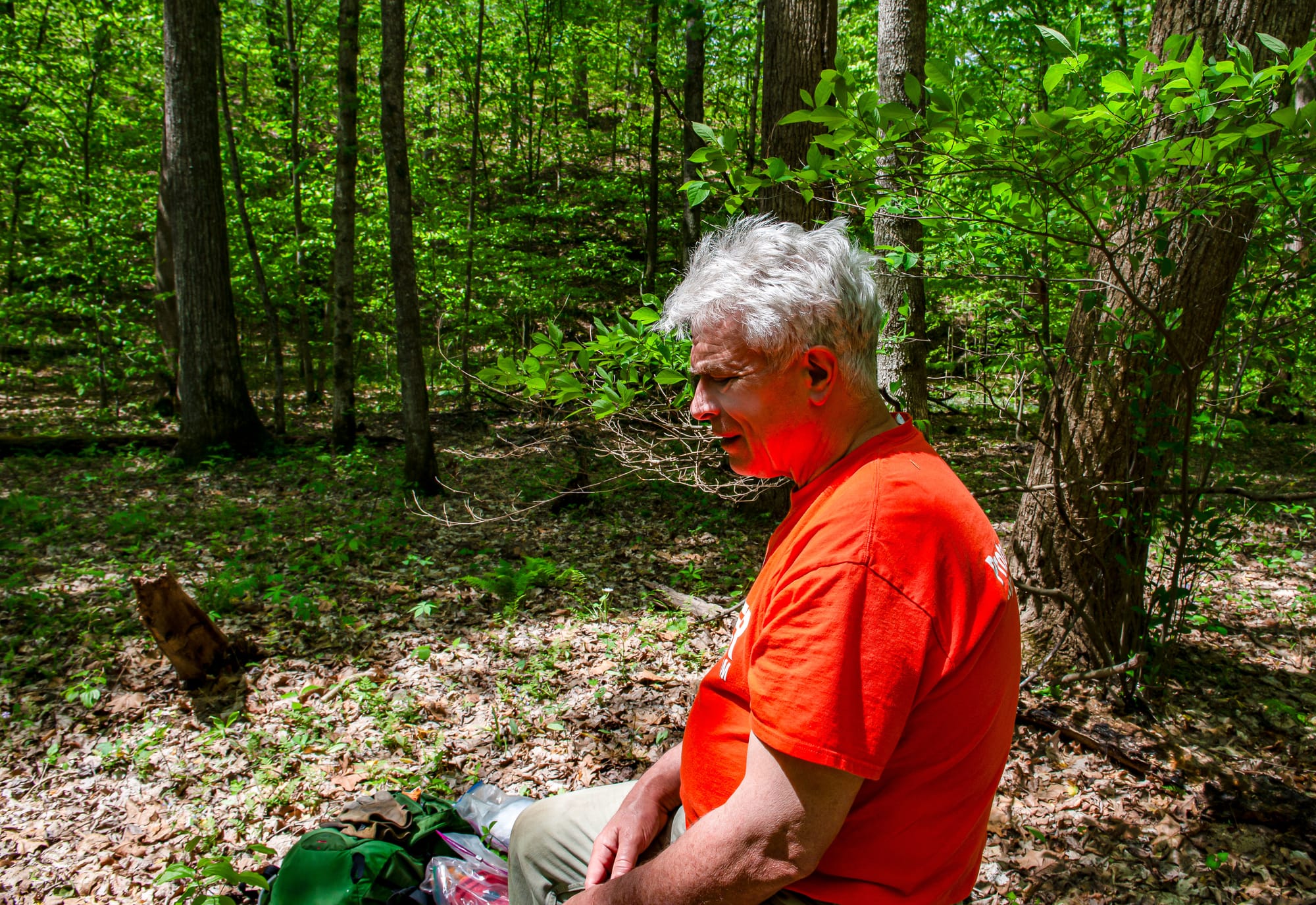
“There’s nothing else like it in Indiana,” he says, his arm arcing over the narrow, deep creek valley that enveloped us, his vision extending miles in every direction. “There’s really nothing like it in Ohio or Illinois, nothing this large in terms of wild nature.”
The phrase “old-growth forest” is a subjective term.
Indiana was 87% forest when European explorers arrived in the early 1600s, and by the early 1900s, the state’s forests had been clearcut virtually from Posey to Steuben and Switzerland to Lake counties. Fewer than 2,000 acres of the original, virgin forest remain, according to Indiana Department of Natural Resources (IDNR) statistics.
The Indiana Division of Forestry makes a distinction between old growth and virgin woods, defining old growth as trees 150 to 200 years old and older — meaning non-virgin forest can also be old growth.
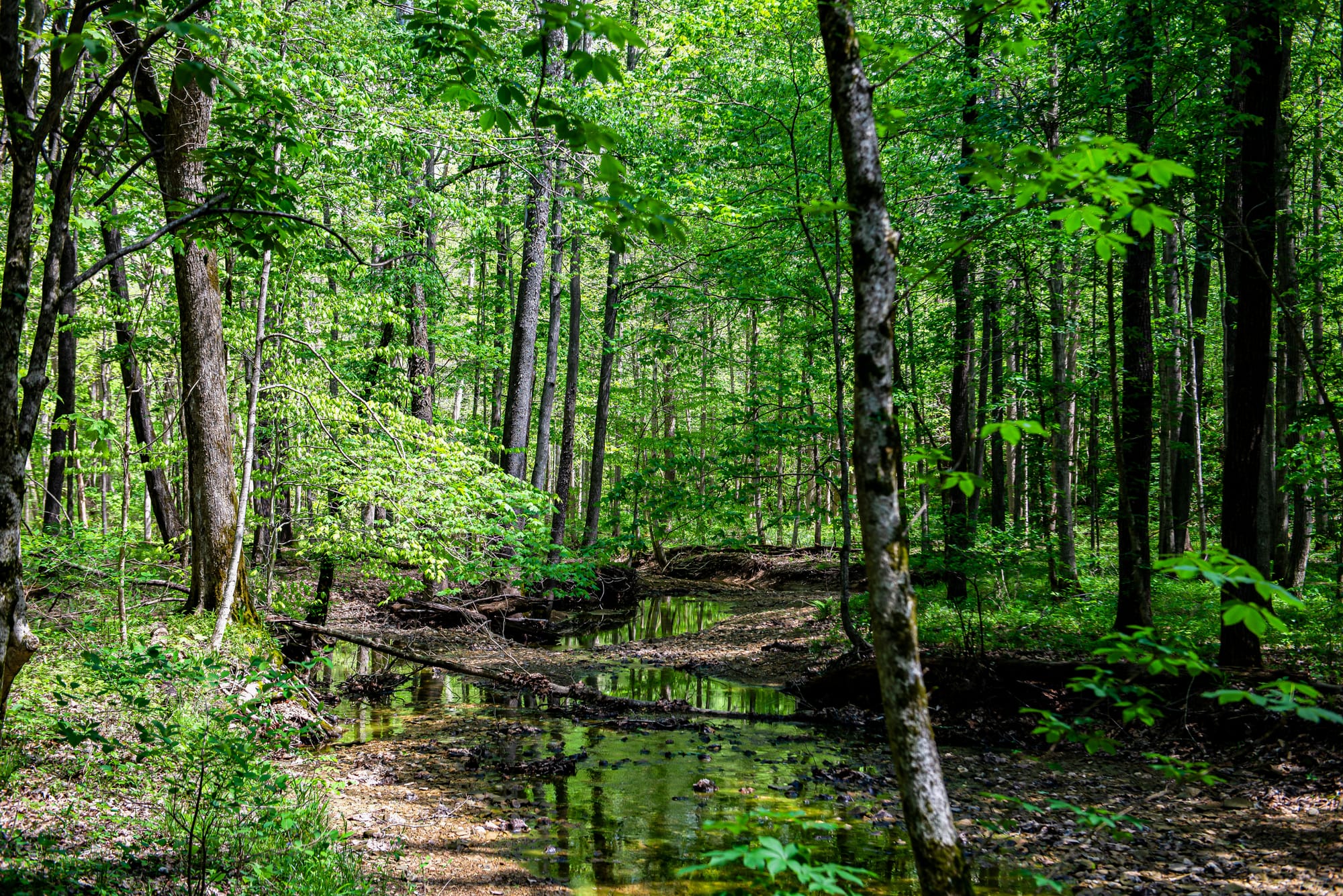
Stant offers a similar definition. An Indiana forest has reached old-growth conditions, in his opinion, when the average age of the dominant trees is 150 years or older and there’s been no human disturbance — logging, grazing, or prescribed burning, for example — for 80 or more years.
“That’s a definition that scientists who study Indiana’s forest can all agree upon,” he says.
Stant has no quarrel with the 2,000-acre estimate of Indiana’s forests that have never been disturbed.
“Between state parks like Turkey Run, Shades, Spring Mill, and the nature preserves, that’s believable, that there’s 2,000 acres of virgin forests,” he says.
But given the state’s historic and ecological realities, the key measure in Indiana is forests that are close to or have returned to the old-growth condition, which he estimates to be more like a quarter million acres, most of which are on public lands.
“Technically, biologists call it ‘secondary old growth,’ because while it was logged a long time ago and is no longer a virgin forest, it has returned to a wild ‘old-growth’ condition that is functionally equivalent to a virgin forest that was never logged,” he says.
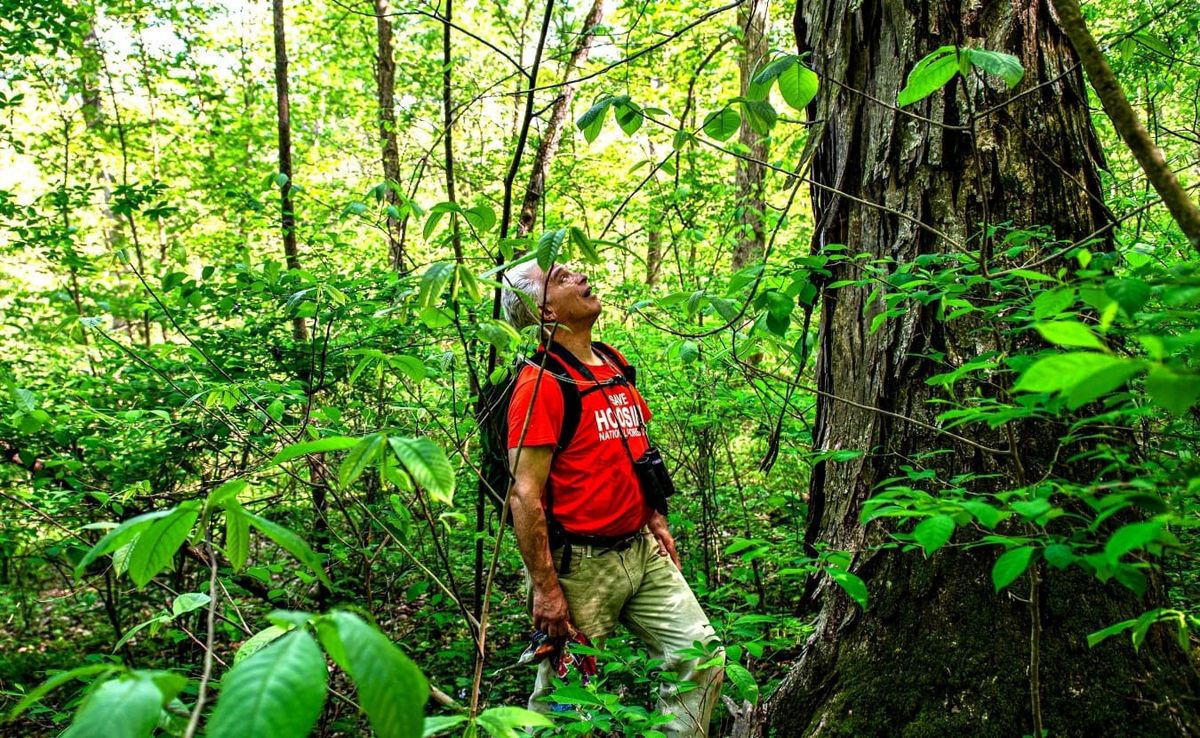
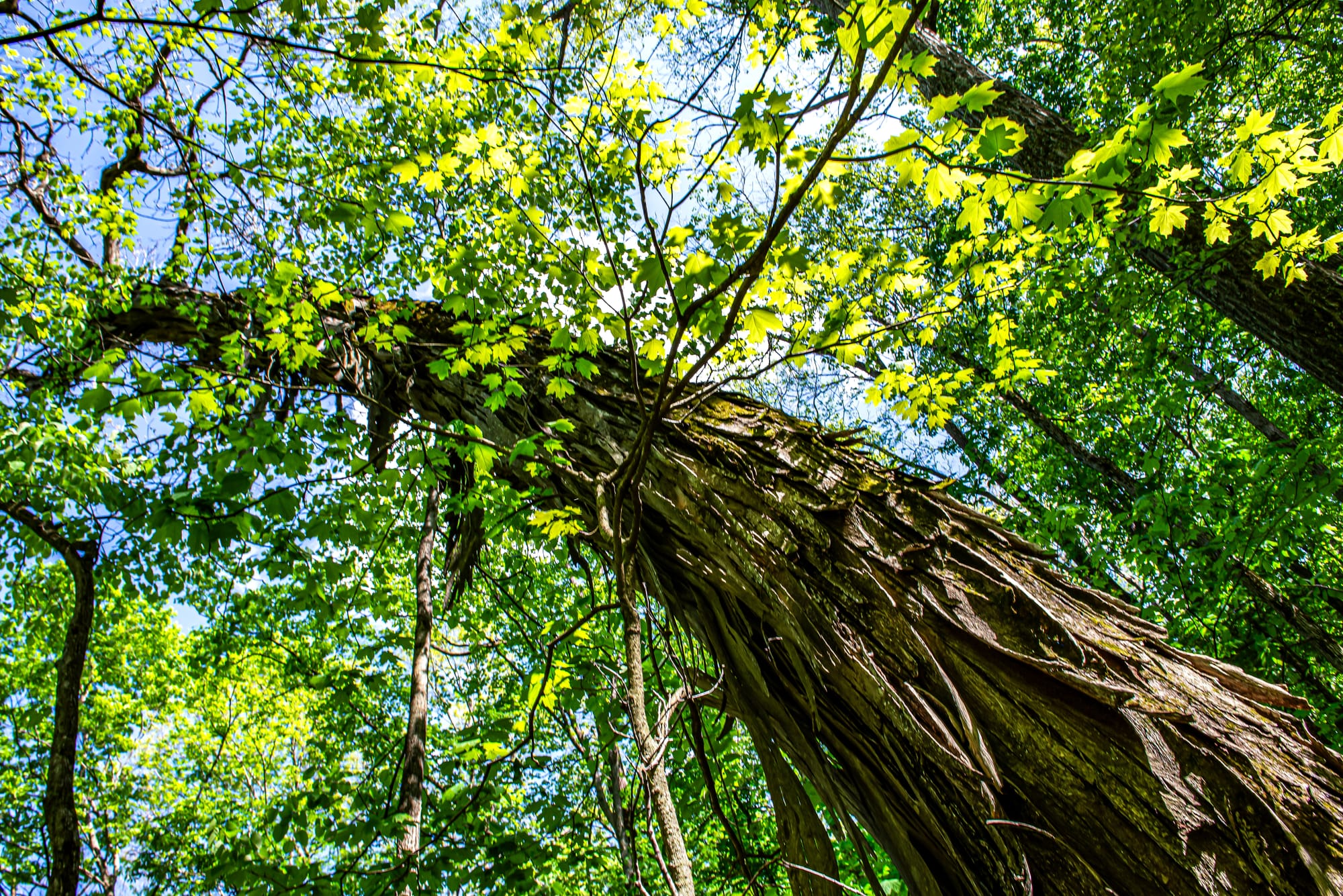
Our destination that perfect late-April day was a handful of magnificent secondary old-growth shagbark hickories on Frog Pond Ridge that had bark plates 10 feet long and, with just a hint of imagination, rose beyond the canopy and into the clouds.
As a single-file troop of teenage-boys from the nearby Ransburg Scout Reservation boisterously passed by on the Hayes Trail, Stant detailed two old-growth visions for the 12,953-acre Deam Wilderness and surrounding Wildlands.
The first, a 90-square-mile block of Hoosier National Forestland, is embodied in a bill Stant and forest preservationists are pushing in Congress that would expand the Deam to 28,253 acres and surround it with an additional 29,382-acre Harrison National Recreation Area to be managed for recreation and Lake Monroe Watershed protection. A version gained bipartisan support in the Senate but died in the 2024 lame duck session of the 118th Congress.
The second, a broader, 200-square-mile area, includes adjacent woodlands in Morgan-Monroe, Yellowwood, and Mountain Tea State Forests; Brown County State Park; the Lake Monroe Watershed; and nature preserves in Brown and Monroe Counties.
“Given all of the additional church camp land, IU land, and classified forest in private hands, you would be very safe, if not too conservative, in using the figure of 200 square miles,” Stant says.
By definition, old growth was the forest condition in the Southern Indiana Uplands from the Ohio River to Lake Monroe when the Indiana Territory was established in 1800, opening the region for settlers like Thomas and Nancy Hanks Lincoln to clear the land for homesteads.
Indeed, the towering poplars, oaks, hickories, maples, walnuts, elms, beeches, and other deciduous hardwood tree species native to the hill country had been evolving without significant human impact for many centuries.
“They were mostly these multi-aged, or what we call uneven-aged forest stands, with multiple layers of vegetation from the canopy to the floor, and a thick, abundant community of plants, mosses, and fungi on the ground,” Stant says.
But by the 1890s, Indiana led the nation in timber production, and, with a few notable examples — 240-acre Wesselman’s Woods in Vanderburgh County, 88-acre Pioneer Mothers Memorial Forest in Orange County, 64-acre Hoot Woods in Owen County, and 60-acre Donaldson’s Woods in Lawrence County — the state’s entire inventory of virgin forests of any species were gone by the Great Depression.
“In Indiana, our forests are incredibly fractured into tiny little scraps of what was once here,” Stant says.
Since the Hoosier National and the state forests and parks were established in the early- to mid-20th century, the Southern Indiana woodlands have regenerated into the largest expanse of mature hardwoods north of the Ohio, from the Mississippi River to the Pennsylvania mountains.
“The forests here in the Deam go on for thousands of acres,” he says. “It’s the heart of an area where the most dominant thing is just forest.”
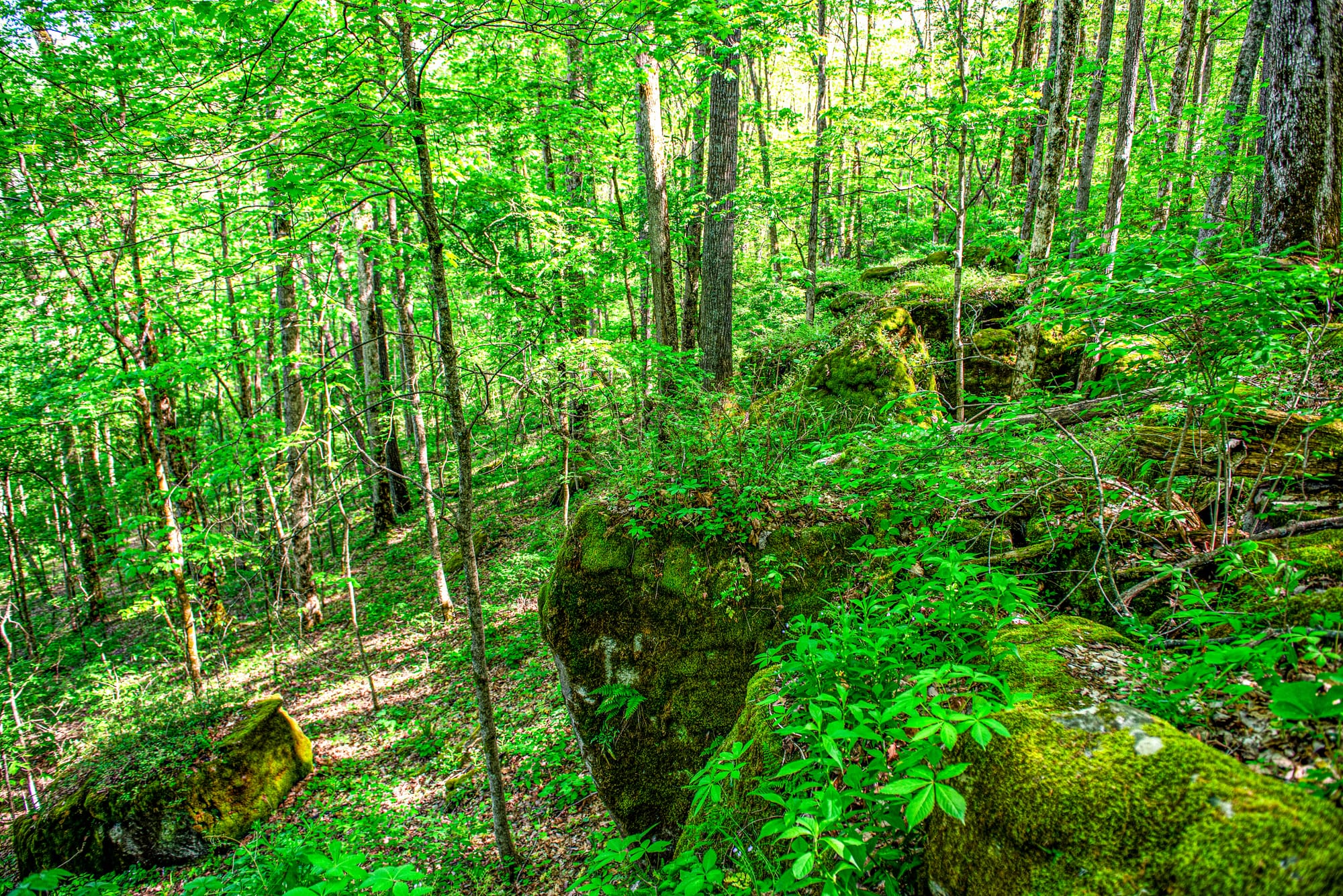
Our daylong trek followed Hayes to its junction with the Grubb Ridge Trail and took a 180-degree turn north around the southern tip of Frog Pond to the giant hickories.
And at every turn, Stant demonstrated that his passion for wilderness is inspired by an intimate, tactile knowledge of the forest. A bent, busted tree in the Saddle Creek Valley lodged against a healthy old beech provided a “roadway” to the canopy for critters of all sizes and species, he says.
At every level of that multi-aged forest environment — for every tree, plant, bush, and bird call — Stant called out their vital facts, what Thoreau described as “the phenomena or actuality the gods meant to show us — face to face.”
The Deam Wilderness and surrounding Wildlands Complex are in fact at or approaching old-growth conditions, Stant says. The forests had been regenerating since being cleared in the latter half of the 19th century. When the government took the first aerial photographs in the 1930s and 1940s, many were full-canopied; most have not been logged since.
So, when the Deam Wilderness was established in 1982, it and the surrounding Wildlands had been regenerating for between 80 and 130 years. And, for almost four-and-a-half decades since, federal law has prevented any significant humanmade disturbance on it.
“Now, 44 years later, those forests have returned to the old growth condition or are right on the cusp of returning to it,” he says.
In terms of biodiversity, Stant says the Deam Wildlands represent the native hardwood region’s “zenith state,” where natural diversity is at its highest.
“It’s really important to have more forests like that in this state when we’re in the midst of this climate crisis that is threatening whole ecosystems,” he says.
Old-growth forests are best capable of surviving climate change when they are uneven-age, he says, when they are composed of multiple age classes of every tree species — from seedlings to saplings to pole timbers to co-dominant to dominant sized trees — with multiple layers of vegetation from canopy to floor.
“It’s not just oak and hickory,” he says. “It’s oak and hickory and beech and maple and ash and elm and basswood and cherry and sassafras and gum and on and on, ironwood and hornbeam, walnut, poplar, aspen.”
Trees in uneven-age stands are more resilient because they have varying levels of resistance to diseases and blights, Stant says. When there’s a large disease outbreak, for example, most species go to seed and produce young trees to replace the dying adults. The DNA differs slightly from one individual to another of that same species, and those differences allow some to survive disruptions that others cannot.
“If you have the broadest possible representation of that genetic diversity for each species, you’re increasing the chances for each of those species to survive a massive blight or disease outbreak,” he says.
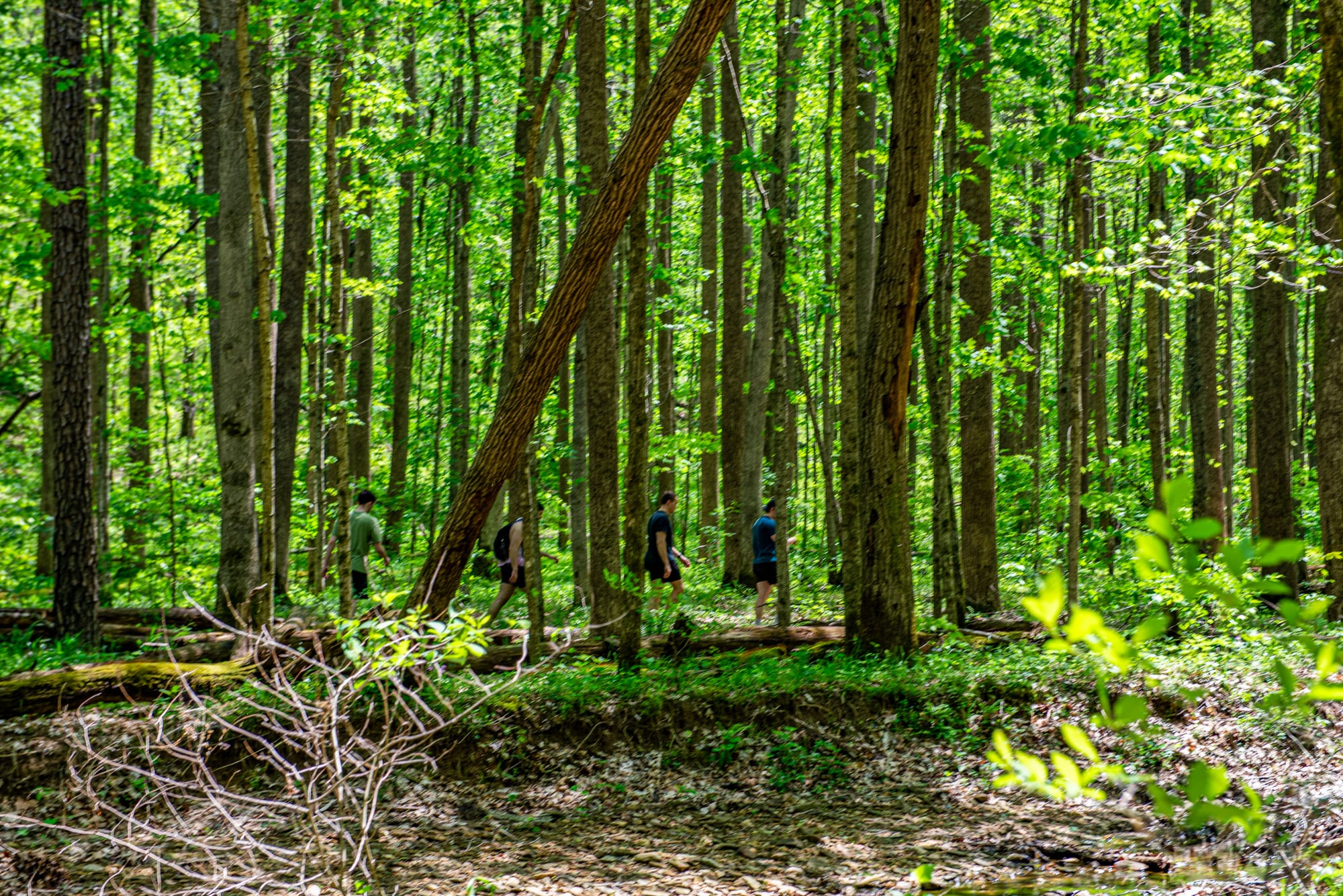
By the time we reached the Hayes Trailhead for our tri-athletic adventure to Frog Pond Ridge — hike, climb, bushwhack — my ankles, knees, and other body parts had but five days left to be 74. The nine conditioning hikes notwithstanding, I was apprehensive about my capacity to endure a day in the deep woods with Jeff Stant.
Well, I’ve never hiked to Bad Hollow. But I have hiked to Browning Mountain from three directions. And after our nine-hour old-growth hickory hike, I’m confident I can and will follow Stant to old-growth trees that were already a century old when the first settlers reached the Deam Wilderness in 1826.
Some of those arboreal relics are still standing some two centuries later in the Brown County hills. And there’s nothing else like them in Indiana or in the Lower Midwest.
Steven Higgs
Steven Higgs is a Bloomington journalist, photographer, and author. He's written three books for IU Press on environmental heroism and natural areas of Indiana and taught journalism at IU for 27 years. Read more on his website: StevenHiggs.com.