Revisiting the Deam: Waldrip Ridge — The Place No One Knew
Steve recalls visits to a vanishing homestead.


The third installment in a photojournalist’s yearlong return to the wilds.
“Revisiting the Deam” is a series of stories chronicling author and photographer Steven Higgs’s exploration of the Hoosier National Forest as he revisits wilderness areas with friends, colleagues, and experts in the environmental field.
Waldrip Ridge may indeed be the most beautiful and historic place in Southern Indiana that no one ever heard of.
And after two hikes there exactly one year to the day apart — the latest with my friend and fellow author Elaine Guinn — I can say definitively that Waldrip Ridge will in fact remain anonymous to anyone outside the fields of archaeology and Indiana history.
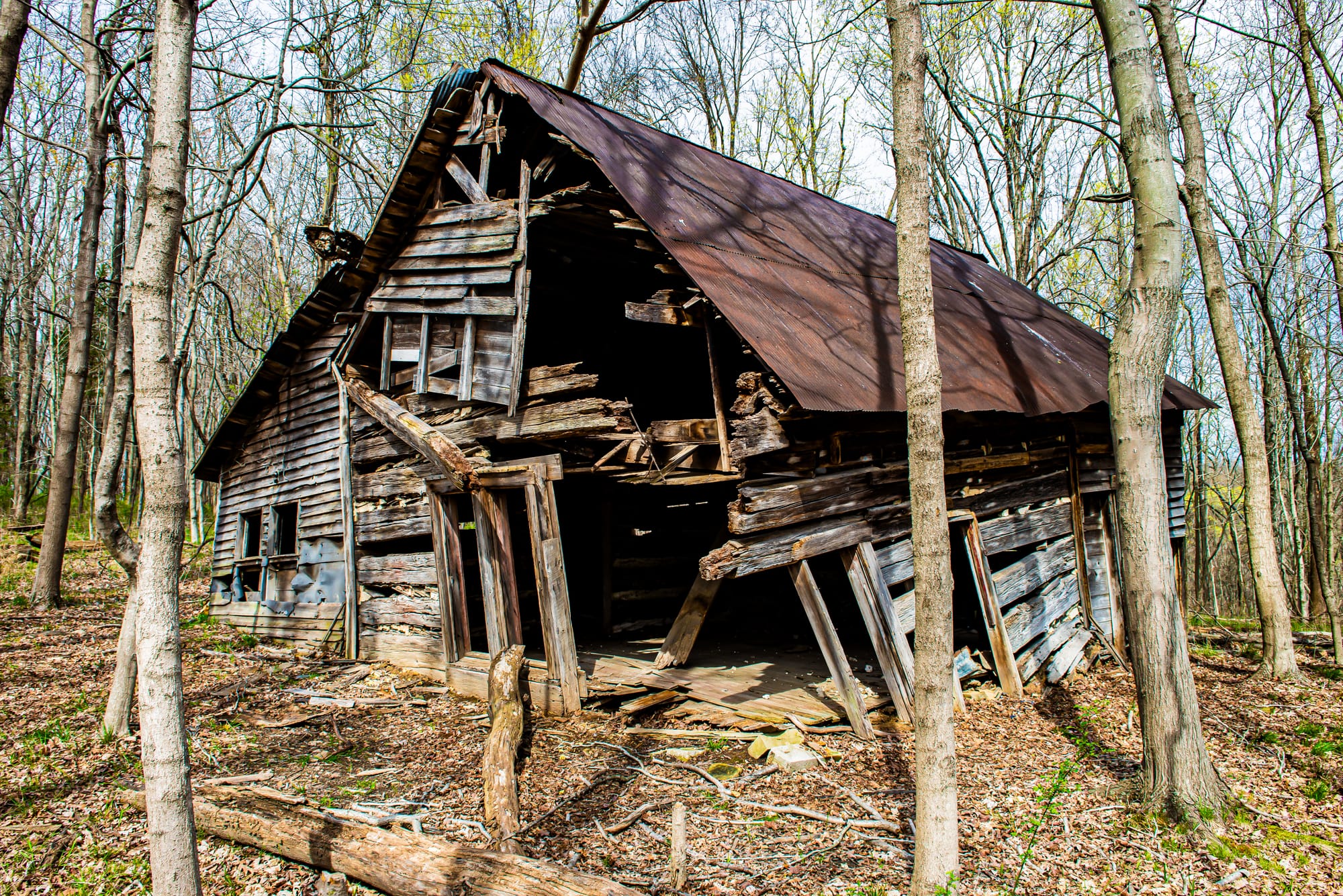
The Waldrip Homestead and Cabin, places I’ve known so well for the past three decades, have been consumed by wildness. For all practical purposes, they no longer exist.
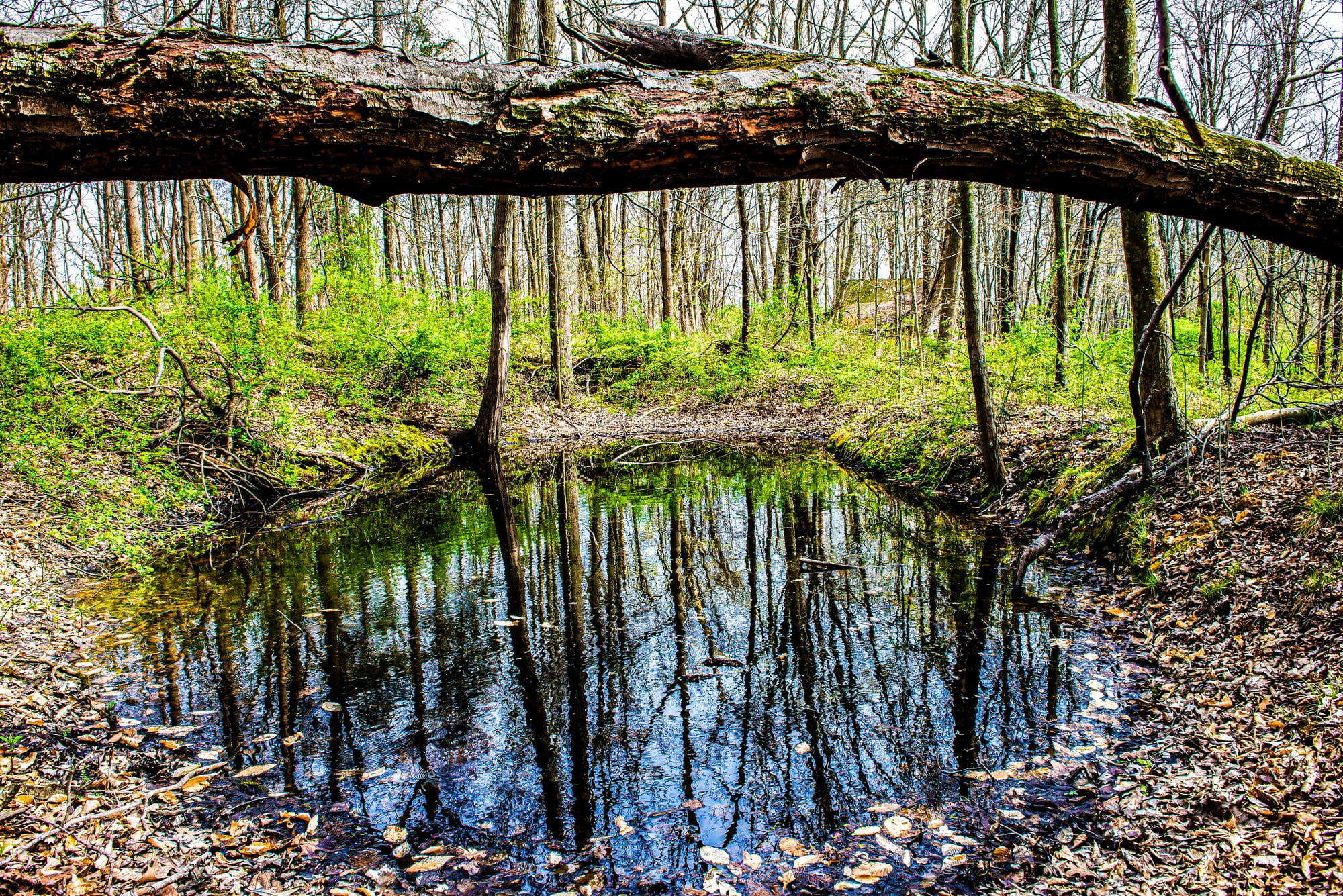
I’ve been there six times since I led Elaine, her friend Amy, and their sons Jack and Gage on a Natural Bloomington Ecotour to the cabin in August 2013. Thirteen years later, we couldn’t even find the pond that signaled the farmstead’s presence and that would have sported a magnificent patch of Virginia bluebells this time of year.
The closest we came this time was a mirage — the second, apparently — an extrasensory occurrence Elaine can confirm.
Waldrip Ridge looms some 200 feet above Lake Monroe’s southern shoreline to the west of the Indiana 446 Causeway and has been one of my top photo stops since my now-passed buddy “Uncle” Dave Strohm took me there shortly after the U.S Forest Service purchased it in 1990.
In those days, the five-room, late-19th century cabin was still native-hardwood strong. We climbed the stairs and smoked a bowl in the second-floor bedroom. We perused the newspapers that the Waldrip family had embedded into the upstairs walls for insulation. Dave collected Antique Automobile Cards and was particularly taken by the 1927 Model T ad.
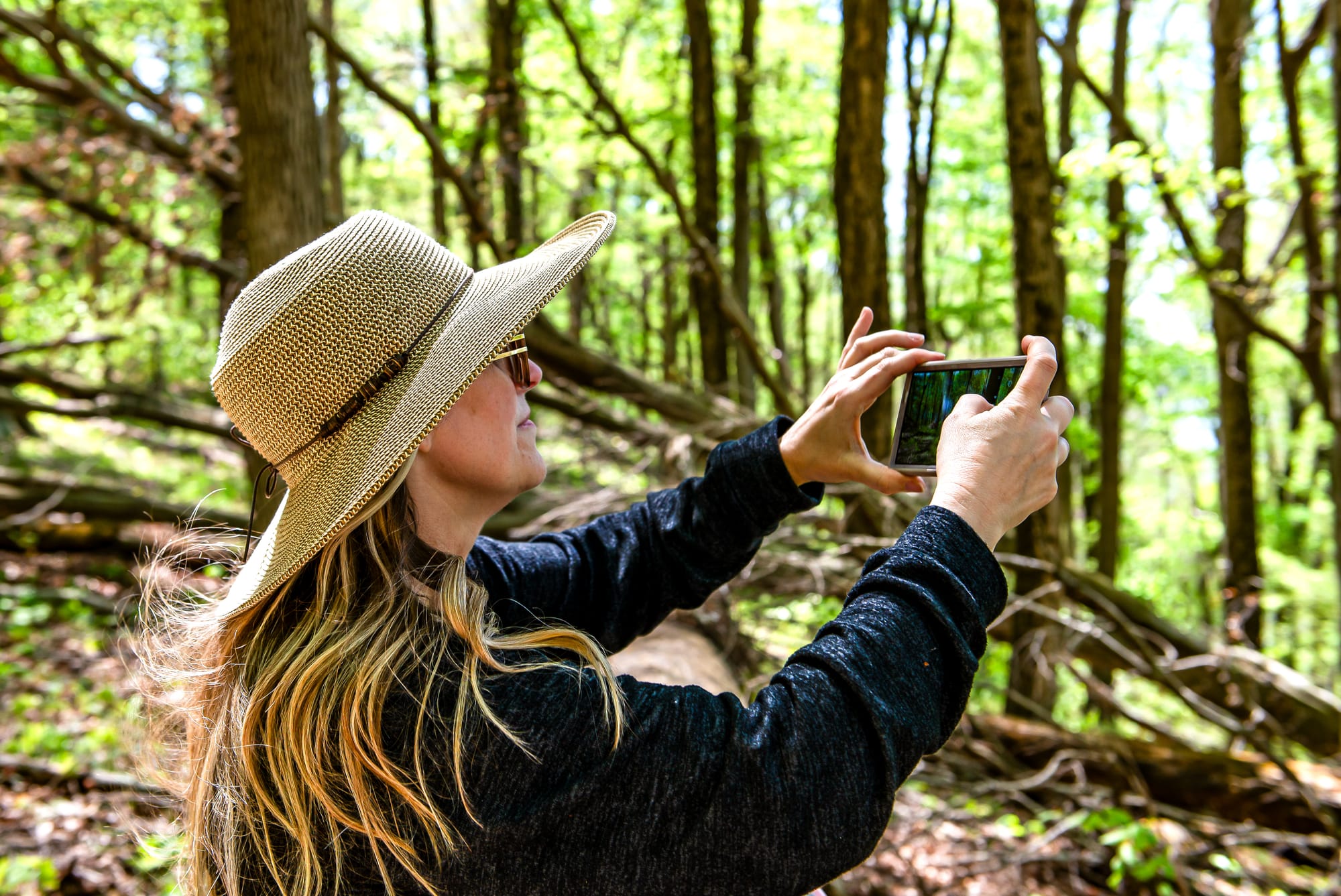
The unofficial Waldrip Cabin Trailhead could easily be mistaken for a deer trail off an old roadbed that Alltrails calls the Monroe Trail. Only the curious and the enlightened ever followed the fork to the lake overlooks, let alone to the never-publicized cabin.
The Cabin Trail was an early-spring escape, a level, mile or so stroll to and along a ridgetop with sensational seasonal views of Lake Monroe, surrounded by a barrage of bluebell, dogwood, and other hill-country petals in bloom.
The ridge lies across the highway from the Charles C. Deam Wilderness and would be part of an expanded wildlands complex, managed for backcountry recreation and watershed protection under the Benjamin Harrison Recreation Area and Wilderness Establishment Act that Indiana preservationists are pushing in Congress.
Elaine is an old friend from The Bloomington Alternative days when she was the first executive director of New Hope for Families, a Bloomington-based shelter for homeless families — an issue she is intimately familiar with. She’s the author of Scared Dog Energy: What My Homeless Father Taught Me About Love, Fear, And Survival.
By the time Elaine and her crew joined me for the late-summer 2013 ecotour, the Waldrip pond was full, but the cabin’s condition had deteriorated to the point that our exploration was limited to sticking our heads inside windows and doors, touching nothing, withdrawing immediately.
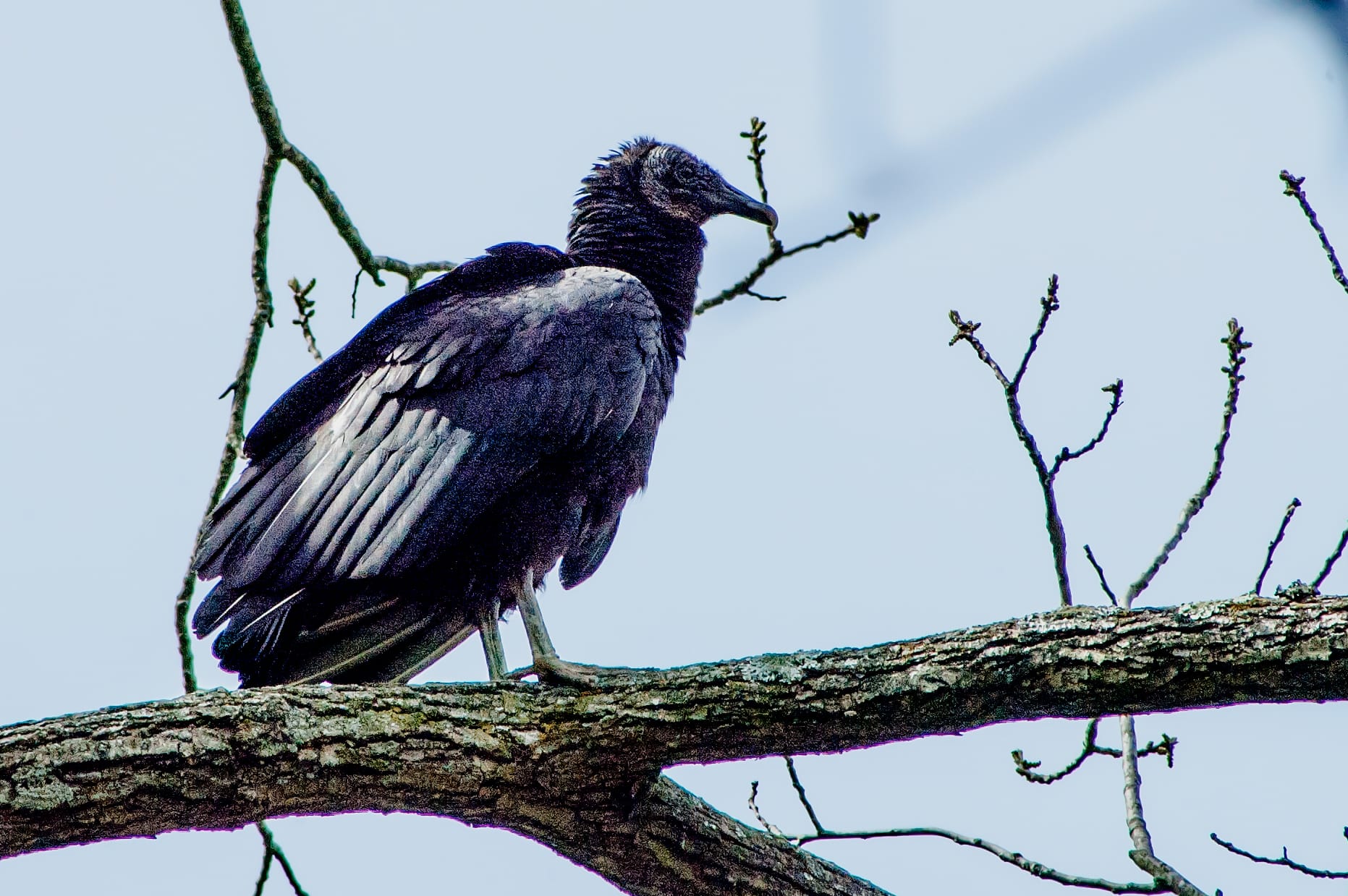
When I led a Natural Bloomington Ecotour to Waldrip with IU Archaeologists Cheryl Munson and Ellen Sieber in May 2014, the cabin attic was home to a family of black vultures, whose alpha would fly to a nearby perch and hiss at us intruders.
Former Forest Service official Teena Ligman told me wildflower hikes she used to lead there were met with the same greetings and unrelenting vulture-eye surveillance.
The Waldrip Cabin was 136 years old when Elaine and I last hiked there.
“The original house was built around 1877, a few years after Joshua Waldrip bought 30 acres of land, married Srepta Bond, and their first child was born,” Sieber and Munson say in Looking At History: Indiana's Hoosier National Forest Region, 1600 to 1950.
And, the archaeologists added in that definitive 1992 U.S. Forest Service publication, the house seems to have been an architectural anomaly. With one downstairs room consisting of hand-hewn log walls, and a second downstairs room and the upstairs featuring frame construction, it appears that those sections were built in phases. But there was “ample evidence” they were built at the same time.
“Other than the German American log house form found in Dubois County, we know of no other example in which log and frame construction were combined from the outset in a house,” Sieber and Munson say.
The Waldrip farm was economically successful, descendants and archaeological evidence suggest.
Situated on a broad ridgetop above the Salt Creek, the spread included a barn, corncrib, combined henhouse and woodshed, privy, stone-lined cistern, hayfield, apple and peach orchards, and a root cellar, in addition to the pond. The family sold the apples and peaches in Bloomington and harvested timber as a “cash crop.”
All Looking at History says about the Waldrips’ departure is that a dinner bell used by the women to call the men in from the fields and orchards was donated to the Burgoon Baptist Church, “when the homestead property passed out of family possession in 1941.”
In addition to veterans of the Ransburg Scout Reservation just down Waldrip Creek Road, Teena’s wildflower and history hikes, and my ecotours, the Cabin Trail-enlightened included paintball warriors, who waged war there during a period that I wrote about but haven’t found any photographs of yet.
“In the early 2000s, the old homestead on a ridgetop overlooking Lake Monroe — the Salt Creek Valley in 1927 — served as a paintball battleground,” I wrote in a Natural Bloomington Ecotours & More blog post about the ecotour with Elaine, Amy, and the boys. “Bright, primary color paint splotches defaced the cabin’s walls outside and in. Similarly bespattered plywood defense shields ringed the yard.”
The paint scars were gone by the 2013 ecotour with Elaine. But Teena told me for that blog that the structural issues we encountered were in part due to logs being pulled from the walls for firewood.
By my Waldrip Cabin photo stop in April 2017, the home had nearly collapsed and was torn down and hauled away shortly thereafter by the Forest Service.
I decided to photograph the cabinless homesite and hiked Waldrip Ridge on April 20, 2025, assuming the bluebells and redbuds would once again be on dramatic display.
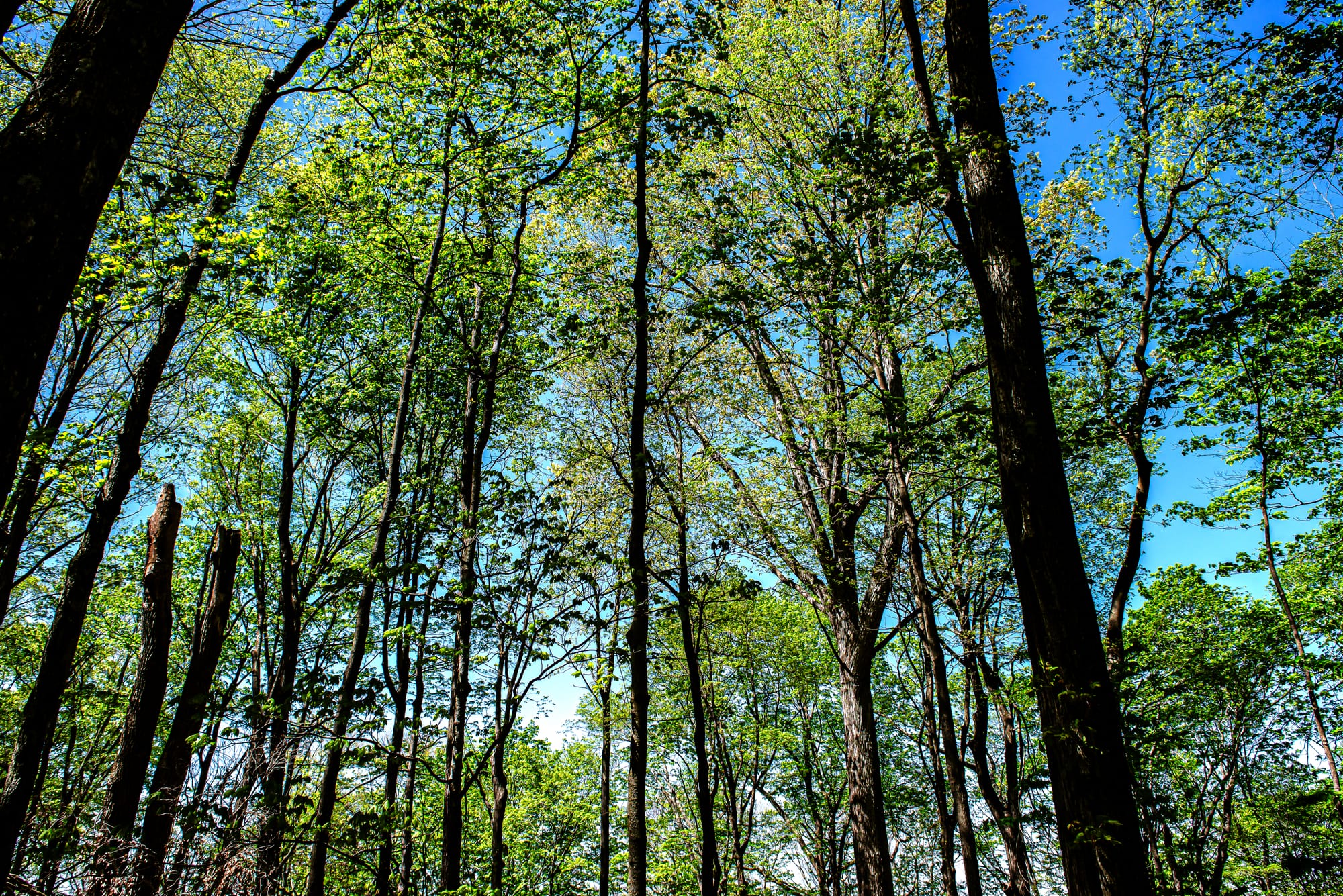
The Cabin Trail at the fork had grown over but was still recognizable to a guy who’d been veering left for decades; parallel the pine stand to the ridgetop vista and turn left. But due to storm damage, I hiked past the homesite to a bend in the ridge that meant I had gone too far.
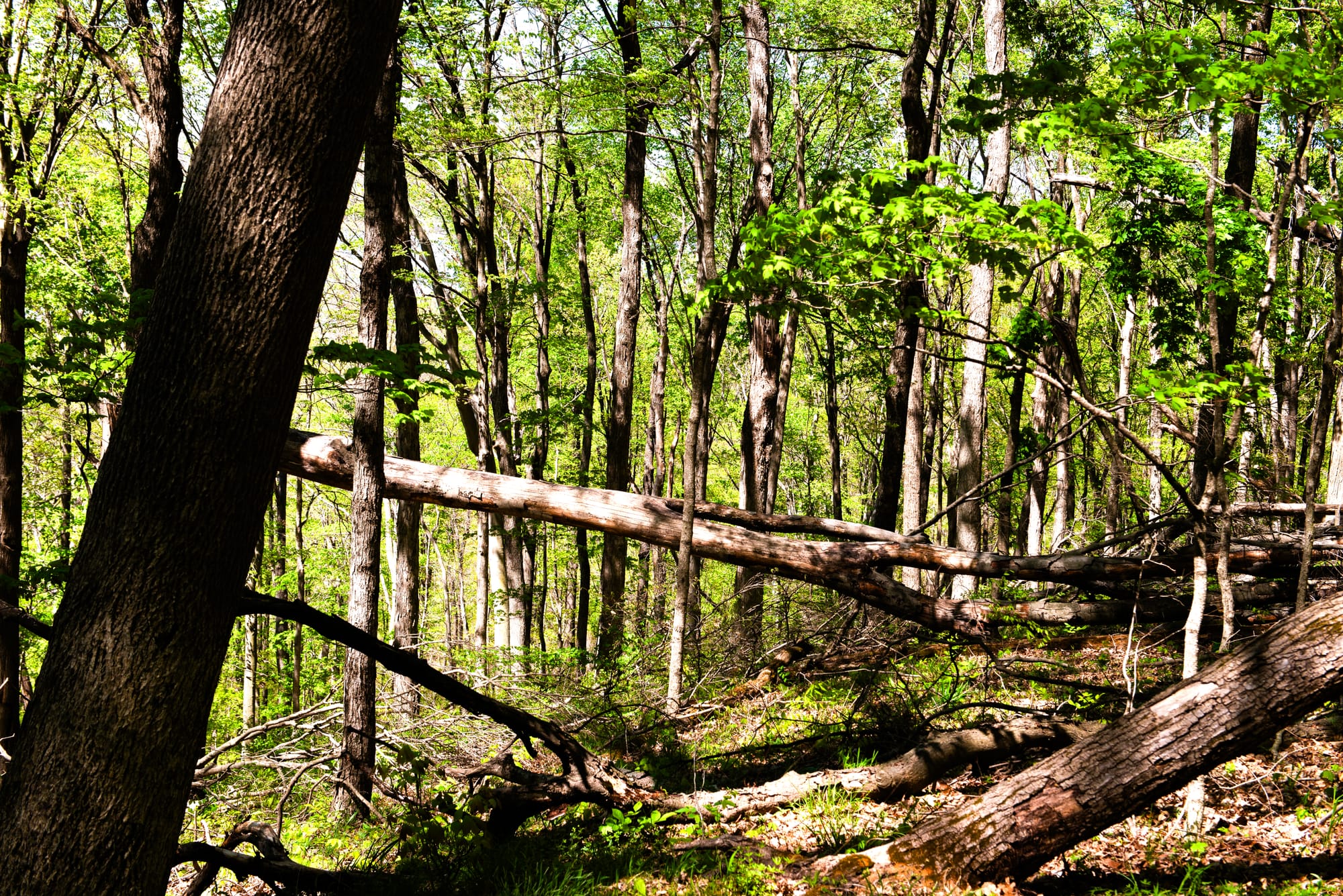
Approaching the trail uphill at a spot where I had detoured downhill to clear a massive, downed hardwood, I spotted the pond on the way back. I was running out of energy and light that day and figured I had my landmark for the next time.
That’s when the first mirage apparently appeared.
When Elaine told me she was coming to Bloomington from her home in south-central Kentucky, I suggested we revisit Waldrip. I knew it would be mostly bushwhacking, but we couldn’t miss the downed tree and pond just above it, and the bluebell-laden homesite just above them.

The Cabin Trail took even more effort to identify than it had 365 days prior. And when we reached the downed tree and pond sighting from my last hike, no water hole loomed above, so we carried on, until we reached the same bend in the ridge that ended last year’s quest.
On our return, I saw the glimmering pond and led Elaine a little higher up the slope to find: no water, no bluebells, no hint of the homesite.
That mirage was not apparent. It was real. Ask Elaine.
Three decades after Uncle Dave and I read the newspapered walls of the room where the Waldrip family slept for more than a half century, their homesite has evolved up the evolutionary scale and back to wilderness.
Since the Cabin Trail is no longer obvious to the enlightened, even the most curious and daring won’t discover the expansive lake vistas. And with nothing left on the homesite but the cistern, some flowers whose seeds Srepta Waldrip sewed 150 years ago, and a foundation, I may be the only explorer in its future.
The Waldrip Cabin Trail is not impassible, but the storm damage and rapidly regenerating ground cover are erasing humankind’s presence and welcome along it.
For a place few ever really knew anyway, that’s as it should be.

Steven Higgs
Steven Higgs is a Bloomington journalist, photographer, and author. He's written three books for IU Press on environmental heroism and natural areas of Indiana and taught journalism at IU for 27 years. Read more on his website: StevenHiggs.com.