Curiosity Through a Thousand Tiny Eyes
Students at IU Drosophila lab commit to genetic research.

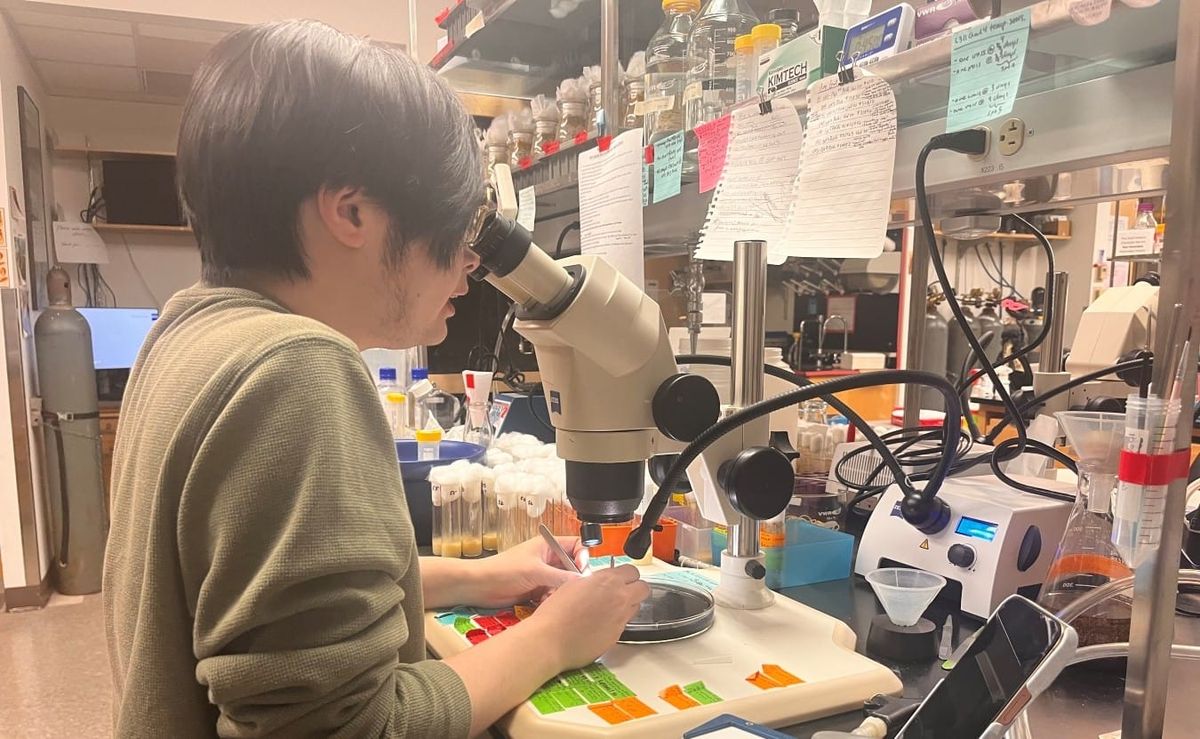
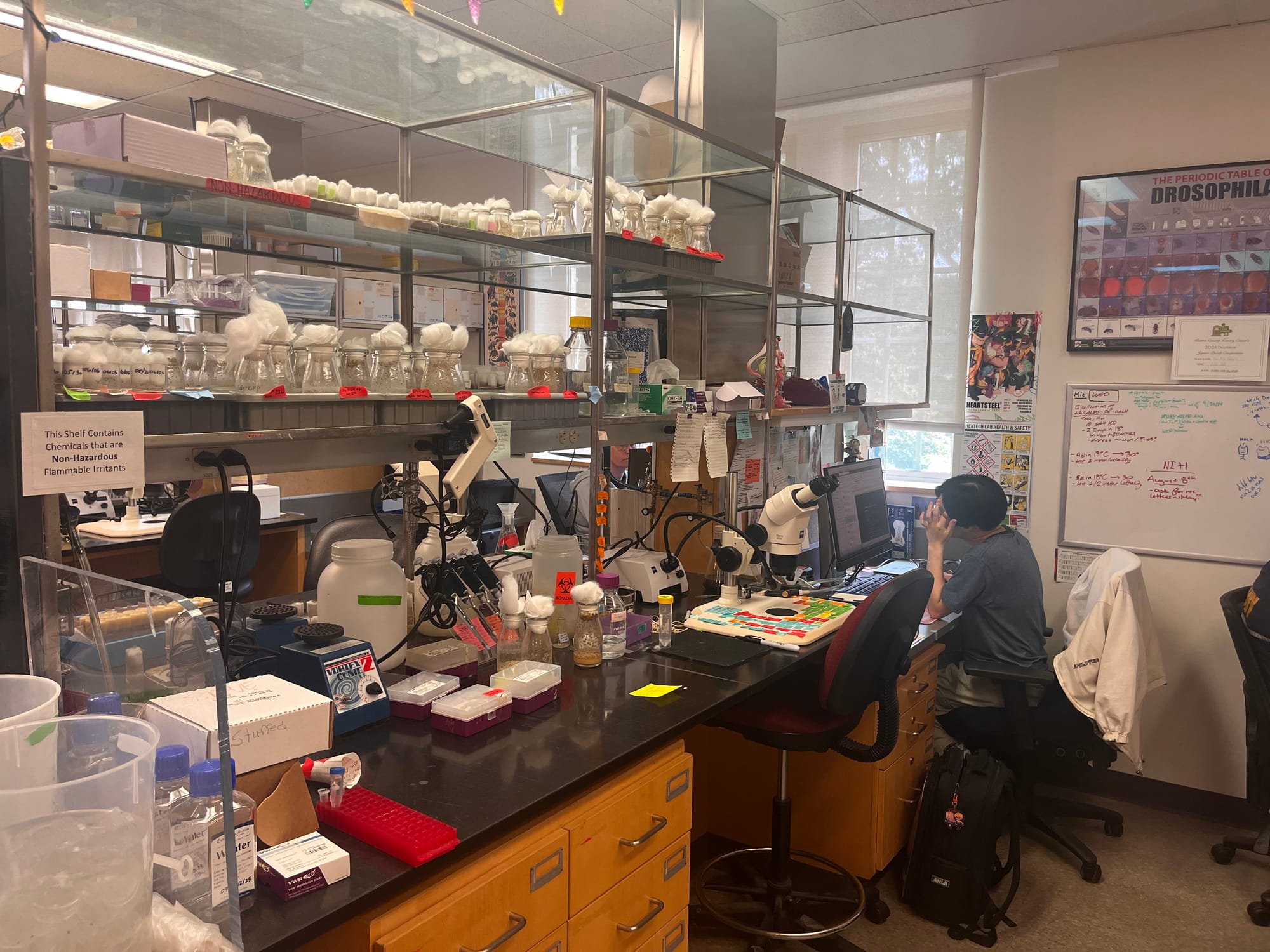
The fruit fly incubators sit on the far side of the lab, their steady hum a constant backdrop. The flow of cold air from the air conditioner, always on for ventilation, causes the tacked papers above the workstations to sway like leaves on a branch. Sunlight from a nearby window slants across the room, casting shadows across the lab benches.
Nearby, the clink of test tubes echoes as a researcher rearranges vials, sending flies and larvae crawling up the tube walls beneath a white cotton corks.
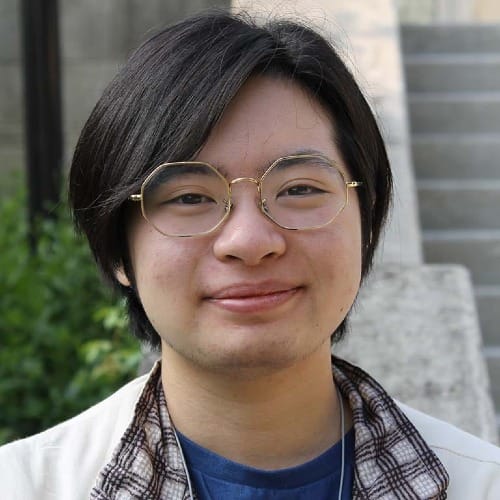
At his bench in a Drosophila lab at Indiana University, Thanaporn “Mie” Kusupholnand bends over a microscope, its ring light illuminating a plate of anesthetized flies he needs to sort. He’s been spending more time here than normal in preparation for his preliminary exam on his PhD thesis, the one that will decide whether he can stay in his graduate program. He hopes his thesis on fruit fly eye development can one day be used to cure ocular disease.
The flies he sorts will give him more data, more preparation, for his research and exam.
Three years of working with fruit flies have made the task routine. A vial can be sorted in minutes — males from females, virgins from nonvirgins, the ones destined for breeding from those that will be discarded.
The 24-year-old is terrified of bugs, but, as he puts it, the flies are asleep. They’re not scary when they’re unconscious.
“I still, I do get afraid when they start flying around,” he says, smiling uncomfortably.
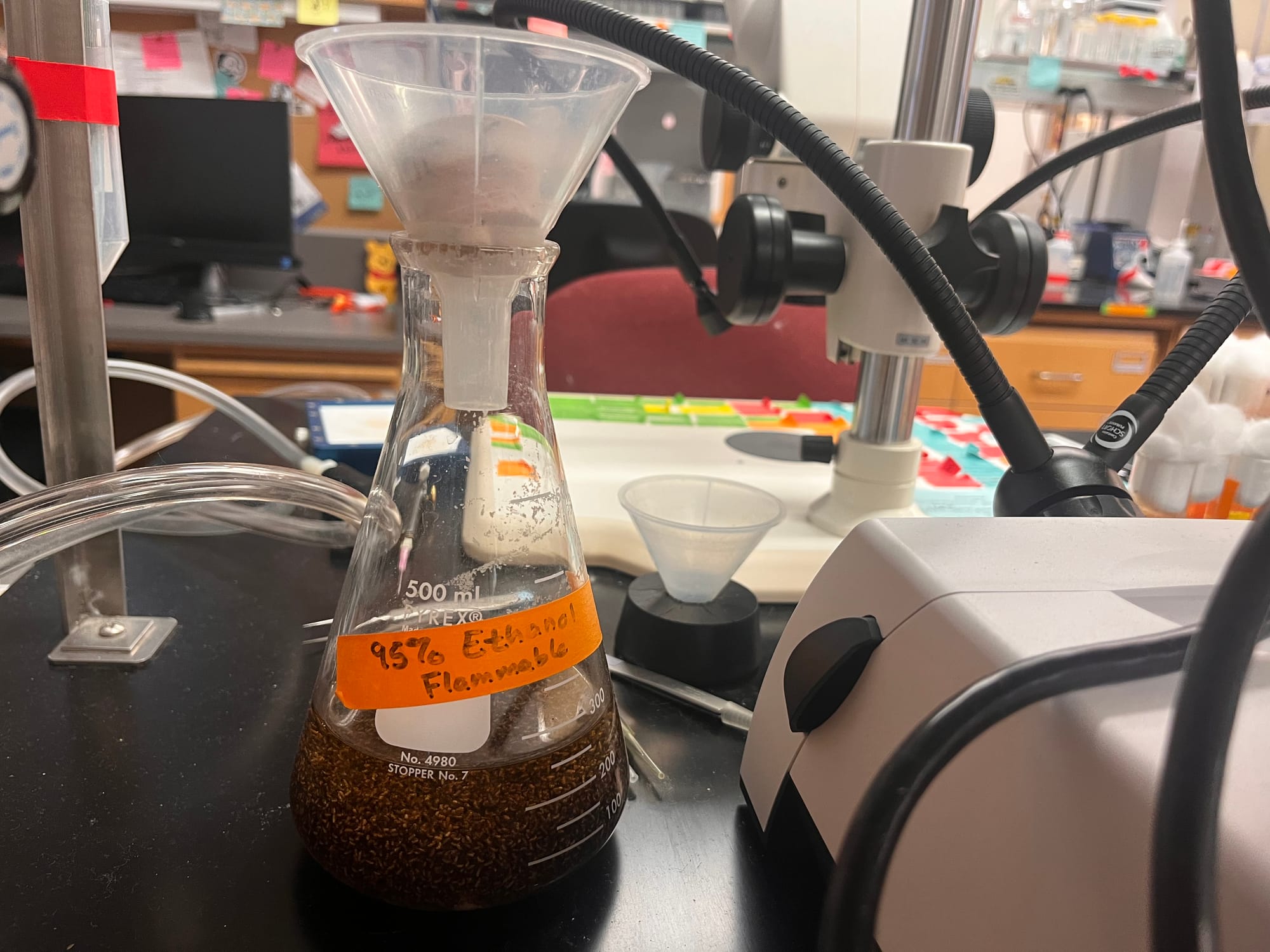
The faint smell of ethanol hangs in the air, emitted from an Erlenmeyer flask where unwanted flies are dumped to their death.
For Kusupholnand, or “Mie” as everyone calls him, the work is not emotional, it is procedural. The name Mie was a nickname from his mother, who would call him “mine” when he was little. Her Thai accent made it into ‘Mie.’ It stuck. His mother lives in California, where he was born as a first-generation American.
Focusing on the flies, Mie continues to sort the ones that will live from those that will die.
“I think over time, you know, working with it, you kind of get a little desensitized to it,” he says.
The virgin females he separates today will lay the next generation of larvae carrying the desired phenotype, part of the lab’s ongoing genetics.
Mie finishes sorting the sleeping flies and puts the virgin females in a new tube with food at the bottom, stopping it up with a cotton wad before they can awaken.
For the rest, he scrapes them into the flask, adding a new layer of dead flies to the inch-high mound of carcasses littering the bottom.
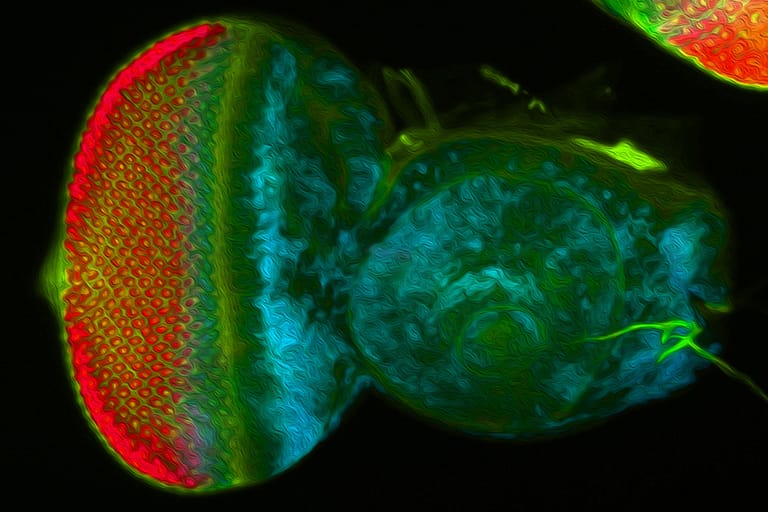
Kusupholnand is a third-year PhD biology student in the research group of Professor of Biology Justin Kumar. The group studies developing compound eyes in Drosophila melanogaster — the Latin name for fruit flies — to understand the molecular developments that go into creating a three-dimensional organ. When these developmental processes go wrong, that can lead to congenital disorders, which in humans include such conditions as anencephaly and spina bifida, Kumar explains on his IU web page.
Mie’s work focuses on a genetic phenomenon called Pol II pausing, a regulatory step in genetic development.
Mie said to think of it like an assembly line. When a factory machine starts making a product, it often pauses right after the first step to make sure everything is set up correctly. RNA polymerase II (Pol II) does the same thing with genes.
He started studying fruit flies in his junior year of undergrad at Duke University. Upon graduation, Mie knew he wanted to keep studying Drosophila, so he came to IU — home to some of the country’s top researchers in the field, and to the largest fruit fly stock center in the world.
Mie’s project is one of many in a lab of 10 researchers, including two long-term research associates, one postdoctoral researcher, four graduate students, and two undergraduates.
Mie sits across from undergraduate researcher and IU senior Lindsay Fleitman, who studies imaginal disc development in larvae. Part of her job is sorting flies as well.
At the end of her lab bench sits a plastic skeleton in a black lace dress, watching over the lab.
“I kill more males,” Fleitman said with a laugh as she scraped flies off her microscope tray into a beaker.
Fleitman joined the lab three years ago, researching eye and antenna development in fly larvae.
By her third day, she was already sorting and dissecting flies.
“It wasn’t very long to get used to beheading,” she joked, referring to the dissection process.
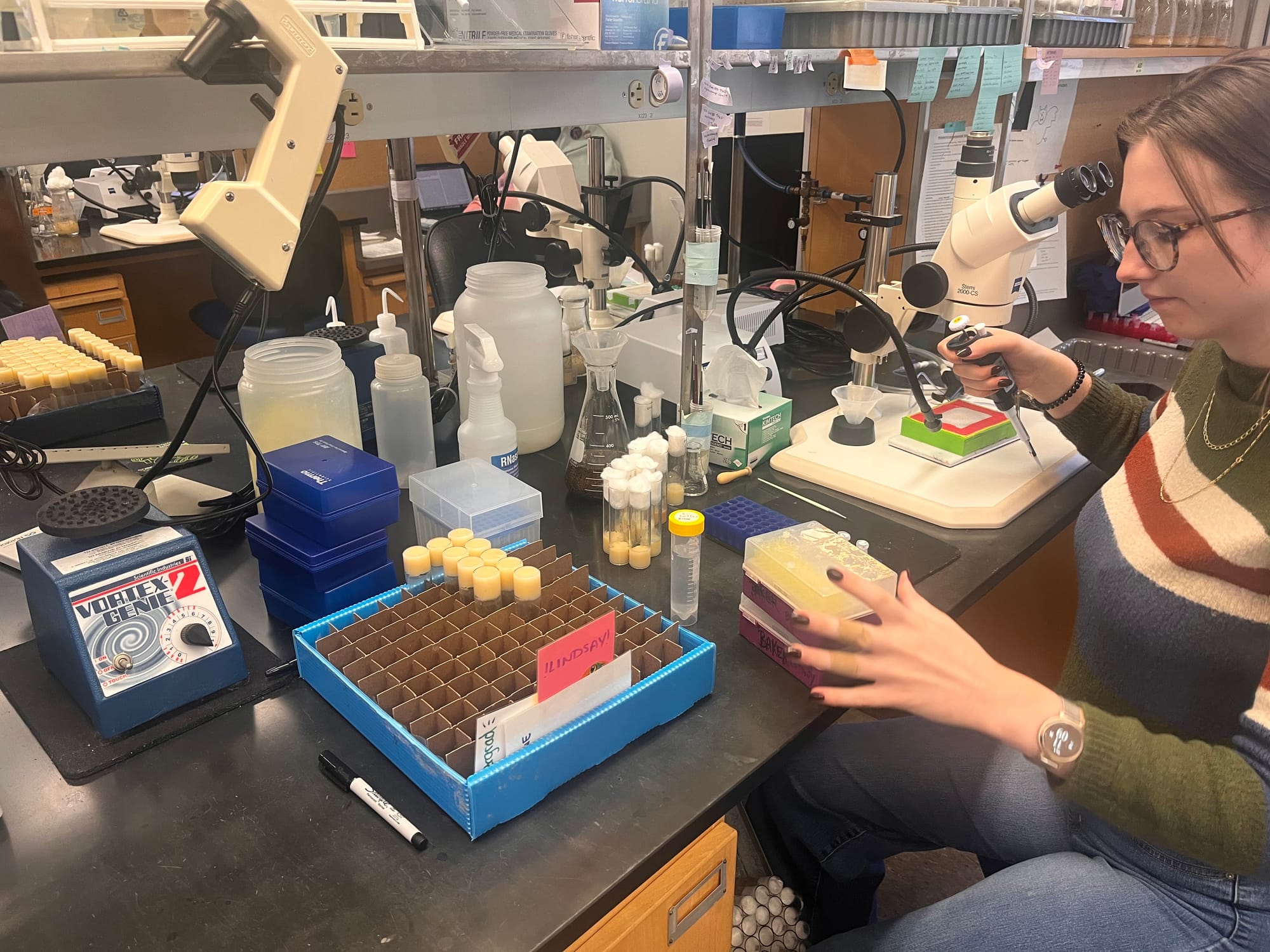
Like Mie, she finds the tasks are second nature. When Fleitman graduated in May, she had accomplished something few undergraduates do by becoming a first author on a research paper.
IU Bloomington’s Drosophila stock center, founded in 1986, houses more than 91,000 genetically distinct stocks as of 2026 and serves as a resource for geneticists around the world. Its international reputation is due to Distinguished Professor Emeritus Thomas Kaufman, whose idea it was to move the center from the California Institute of Technology at Pasadena, and to Kathleen Matthews, who cofounded the center and directed it for more than 30 years, until her death in 2018.
Fruit flies are commonly used to study complex biological processes, such as Pol II pausing and others directly related to human health and disease. According to Kumar, the eye development lab where Mie works has over a thousand mutant strains of flies.
“If you were working on a vertebrate model system like zebrafish or mice or a primate, there’s no way you could house that many in any reasonable space,” Kumar said, explaining why the lab uses flies. “They’re cheap, they’re inexpensive, they’re easy to house.”
Additionally, they regenerate within two weeks. Labs using mice wait around 18 months for the animal to be able to reproduce a new line.
“The other thing about fruit flies is that all the genes that control your development and my development, most of them have genes in flies that are very similar, or exactly the same,” Kumar said.
According to research at Cambridge, fruit flies share around 75 percent of the genes responsible for diseases found in humans.
Kumar has been studying fruit flies since 1987, when he was an undergraduate at the University of California Riverside. After graduation, he moved to Purdue, where he continued studying Drosophila as a PhD candidate and also led a basketball team made of researchers. When he graduated, all the grad students and faculty he played with signed a basketball and gave it to him. He joined the IU faculty in 2002, after postdoctoral studies at the University of Southern California and Emory University.
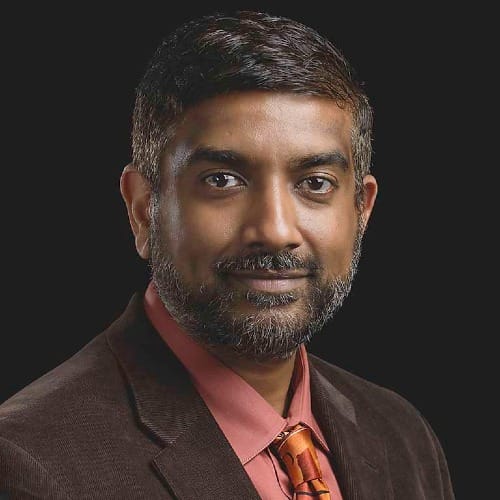
Kumar has the basketball in his office in the lab, tucked on a shelf under a line of microscopes and above his ever-present lemon-scented candle. It reminds him of how he wants to run the lab.
“We’re actually friends,” Kumar said. “We try to make sure that everyone feels like it’s not a business, it’s not a place of work, but it’s more we’re family and friends.”
As the weak November sun sets outside the lab around 6 p.m. on a Monday, Mie starts dissections on the new larvae. He has to get through 11 vials of larvae tonight, almost double the usual amount. But with his preliminary exam on Friday, he wants the extra data.
Kumar walks through the lab with a Cherry Coke in his hand, ready to end his day. On his way out, he asks the lab assistants how their work is going, smiling as he catches up with his colleagues.
Stopping near Mie’s work station, Kumar lets Mie know he is locking up the lab, and that he shouldn’t leave without a key. Mie nods in acknowledgement and turns back to his work.
He starts the larvae dissections by putting four pools of solution on his dissection tray. One for the larvae, one for the dissection, one for the removed heads and one for the discarded bodies.
Straightening his back and placing his elbows at a 90 degree angle, he gently holds two forceps and grabs a larva from its solution, placing it in the pool under the fully zoomed-in microscope. Holding the body in one forceps, he uses the other to grasp the larva’s two mouth hooks. With a gentle tug, the head separates from the body.
Mie says he thinks the larvae don’t have rational thought like humans do, but they have genetically inherited behaviors and they do feel pain.
“I’ve seen it myself here,” Mie admits “It is a little sad, but it is the tradeoff for learning more about people, ’cause obviously we can’t do anything like this ethically on humans.”
Mie continues to dissect the larvae, finishing the 15 from one vial and putting the finished heads in a different dish. Getting a new pipette head, he moves on to the next group of larvae.
When dissections get monotonous, Mie listens to music or watches people play video games on YouTube. The game doesn’t matter as long as it doesn’t have a storyline. Storylines are distracting, and distraction means possibilities for skipping steps. Today, The Marias Radio on Spotify is enough.
The new vial is genetically modified with a gene called tubby, allowing Mie to tell which larvae mutated before he dissects them. The larvae he doesn’t want are small, while the mutated larvae are large, or tubby, giving the gene its name.
When Mie was an undergrad at Duke, he took a class in biological art. For the class, he cross bred multiple physical genotypes of fruit flies and presented them under a microscope for his project.
“I presented that to people partly as like, this is one of the things that a geneticist or something would be doing daily,” he says.
Growing up, Mie thought a scientist was a really abstract concept. He says the only representation of a scientist is in movies and TV shows as the person in the lab coat.
“I was trying to display, like, this is what I do,” Mie says. “It was another sort of commentary type thing because a lot of people have qualms about using animals for science.”
Mie was surprised at the responses to his exhibit. He says people told him they didn’t agree with using living organisms for science.
While Mie understands why people struggle with using mice, their cares about flies were unexpected.
“We find fruit flies in our kitchen and we hardly want them there,” he said. “These are like genetic tools, there’s no reason to feel bad about it.”
While he dissects the tubby gene flies, his phone dings with a message from his boyfriend.
“What time should I pick you up?” it reads.
Mie’s boyfriend picks him up from the lab when research runs late, not wanting Mie to walk home in the dark.
With at least an hour left before he can leave the lab, he texts his boyfriend back, sighs and returns to his last two vials of flies.
After he finishes dissections, he has to wait 45 minutes for them to set before refrigerating them. He sets a timer and starts studying for his preliminary exam.
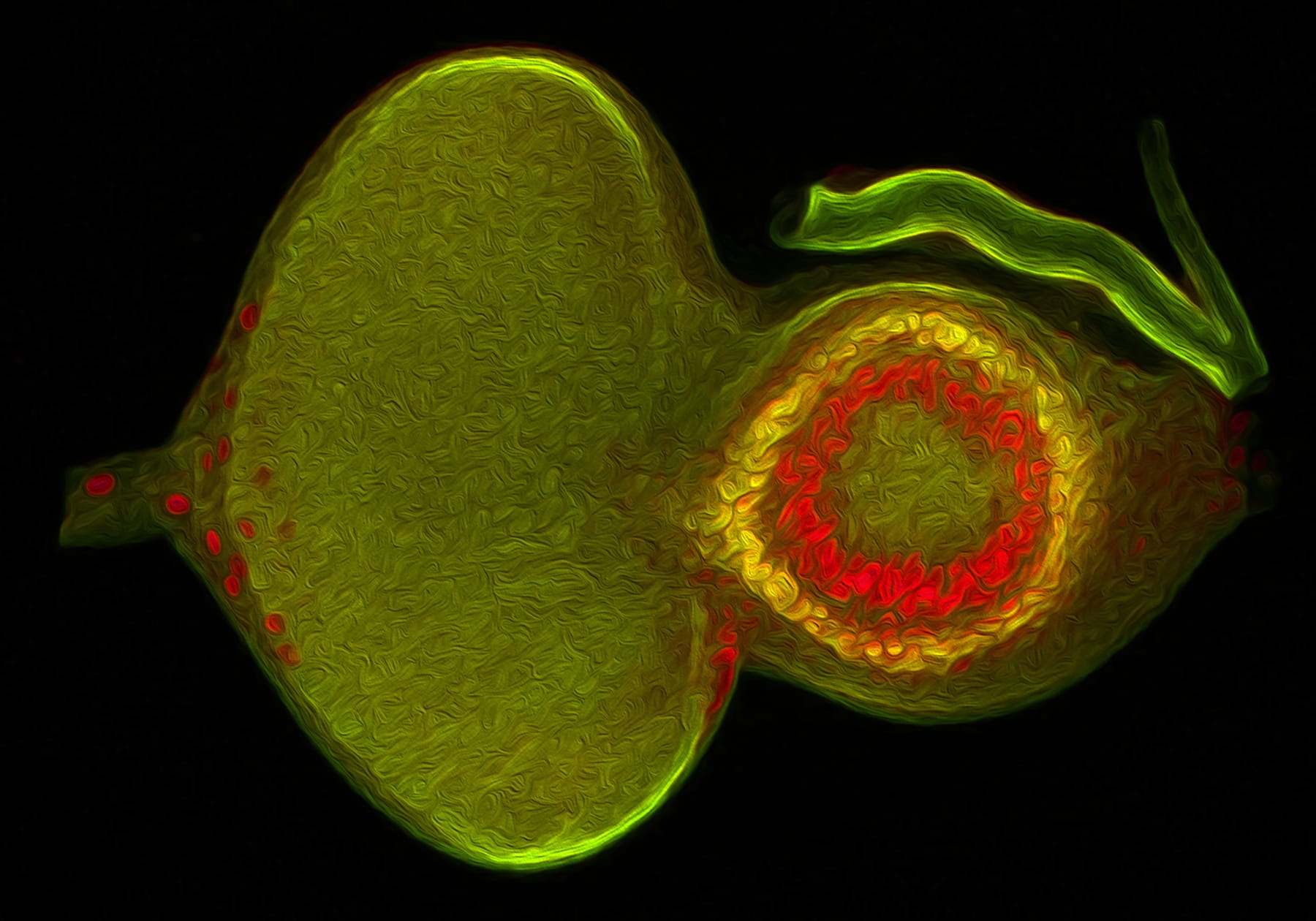
To most of the world, fly larvae are maggots and fruit flies are pests. To Mie, they are the way forward into research for human eye disease. Mie said despite the obvious differences, fly eyes and human eyes develop in nearly identical steps. They possess the same signals and genes.
Mie hopes that one day his research will be used to help cure eye diseases, but for now it is pure research.
“There are a lot of ocular diseases that we know of in people that have, like, mutations that we can study also in flies,” Mie said. “I think that brings a lot of value.”
Mie’s research isn’t meant to cure a disease. He hopes that one day his research might help inform research into eye disorders. Maybe the mechanisms he uncovers in fly eyes will show how certain diseases begin, or point toward ways of preventing them, but right now, the work isn’t aimed at a specific cure or a particular outcome.
For Mie, the research is driven by curiosity rather than an end point. It’s about asking why and experimenting to figure out.
“That’s the whole point of doing this is to contribute to the field in a beautiful way,” Mie said. “I think I enjoy knowing the fact that I could, you know, bring some new discovery.”
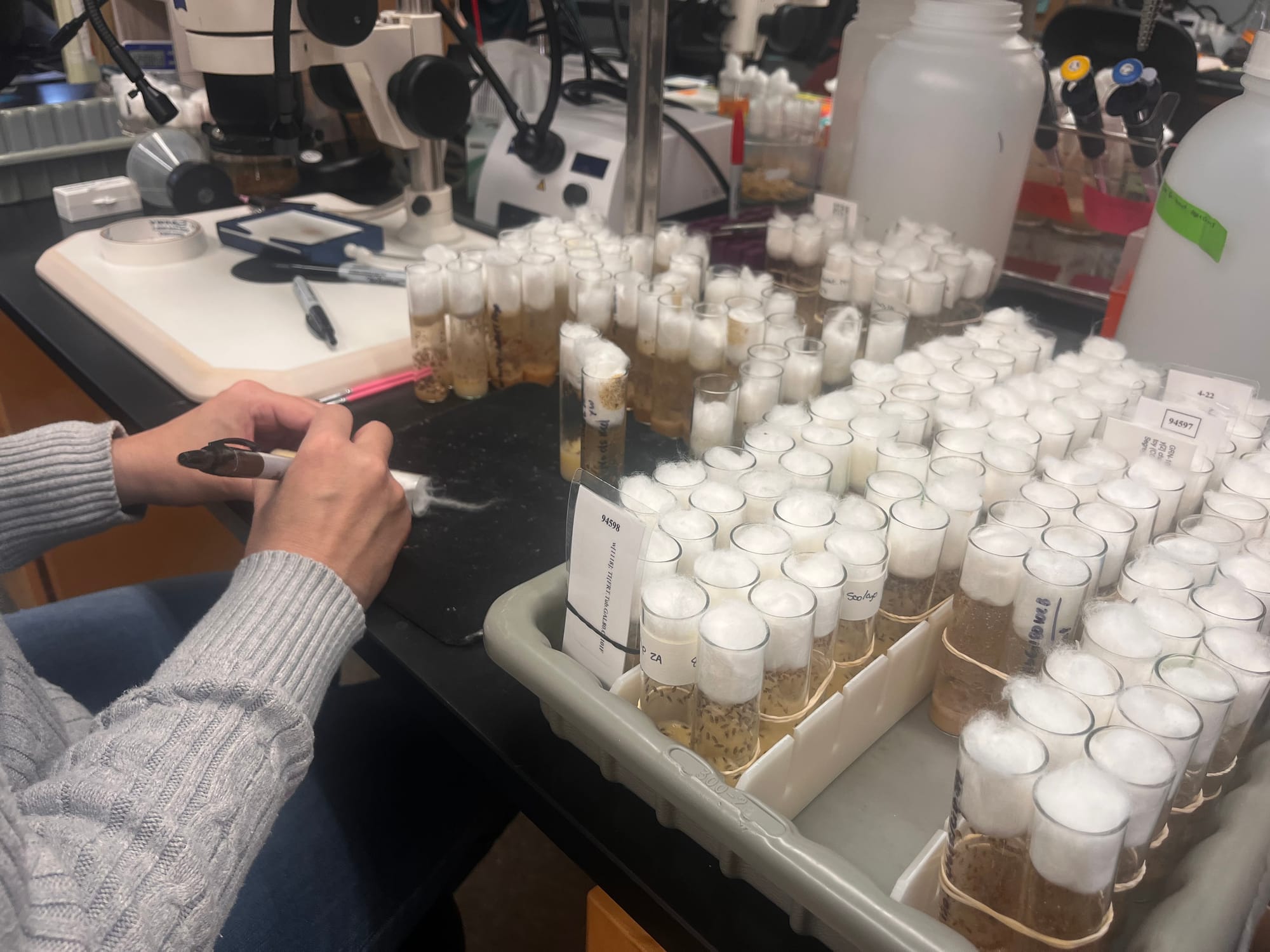
The Drosophila lab focuses on basic research, which is driven by curiosity rather than a goal of creating a specific product or solving a problem.
According to Bonnie Weasner, a long-term research associate in the lab and mentor to Mie, basic scientific research on fruit flies might sound silly, but most genetic research starts there.
“Our goal is to provide a foundation for clinical research,” she explained.
Weasner started working in the lab 22 years ago. She worked as a banker beforehand, and got involved in the lab through her husband, who works in molecular biology, building the DNA put into the flies.
Since she started, she has mentored 15 graduate students, including Mie, and gotten her own degree in biology. Now, she spends her days researching different genes in fruit flies.
“Our research is taken later and adapted to treat different diseases,” Weasner explained, writing a new label for a vial of flies with bioluminescent eyes.
Kumar explained that the work done in the lab is meant to be a base for vertebrate experiments.
“It’s really fun to work with students, to try to get them to kind of fall in love with the fly eye like I have, to really make contributions to molecular biology,” Kumar said. “But we don’t take it beyond the fly. My lab doesn’t do that.”
Instead, the scientists use the inexpensive flies to research mutations that can be moved into vertebrate experiments. While the ten researchers in the lab won’t be the names attached to medical breakthroughs, they might be the ones who discover the key mutations.
Friday arrives, and Mie is not ready for the preliminary exam. His presentation is not finished, and he doesn’t understand the difference between two signaling pathways.
“I hope they don’t ask me why this works,” he says to Weasner, who is sitting across from him.
“Whatever.”
Sitting at his lab station, Mie flips through notes and drinks his 44-ounce mango ginger smoothie from Smoothie King. His fingers tap and his eyes race across his computer screen, scrolling his email for a link to Flybase.org.
In four hours, he will sit in front of a tribunal of professors and present the basis of his thesis project. The exam will determine whether he can continue his PhD program and research into eye development.
As Mie’s finger slaps the mouse scroll bar, Kumar comes to stand near his work station.
“Hey, good luck,” Kumar says to him
Looking up from his work, Mie laughs.
“Thank you,” Mie responds before turning back to his presentation. Taking a deep breath, he continues working, pasting photos of eye mutations into the slide deck. The afternoon will decide if he can follow his curiosity.
As the clock approaches 3 p.m., he finishes his presentation.
“I hope this goes well,” he laughs as he closes his computer and heads to the exam.
A few hours later, he steps back into the lab relieved he gets to continue his research. He passed.
Elyse Perry
Elyse Perry is a local journalist working with WFHB and WFIU/WTIU News. She grew up in a small town near West Lafayette, and she remains a Boilermaker at heart despite being a recent graduate from the IU Media School.