Historic Marker, Ceremony Honor World War II Hero Gerry Kisters
A dedication at the Monroe County Airport honors “one of America’s most decorated heroes.”


Gerry Kisters was one of America’s most decorated heroes in World War II, a young man from Bloomington whose extraordinary acts of courage won national admiration and merited both the Medal of Honor and the Distinguished Service Cross.
But to Justin Robertson, he was simply “my favorite uncle,” a slightly eccentric family man who never played the role of hero. “He was kind, gentle, generous, and fascinated by the natural world,” Robertson said. “He seemed to have a remarkable gift for understanding the language of animals and children.”
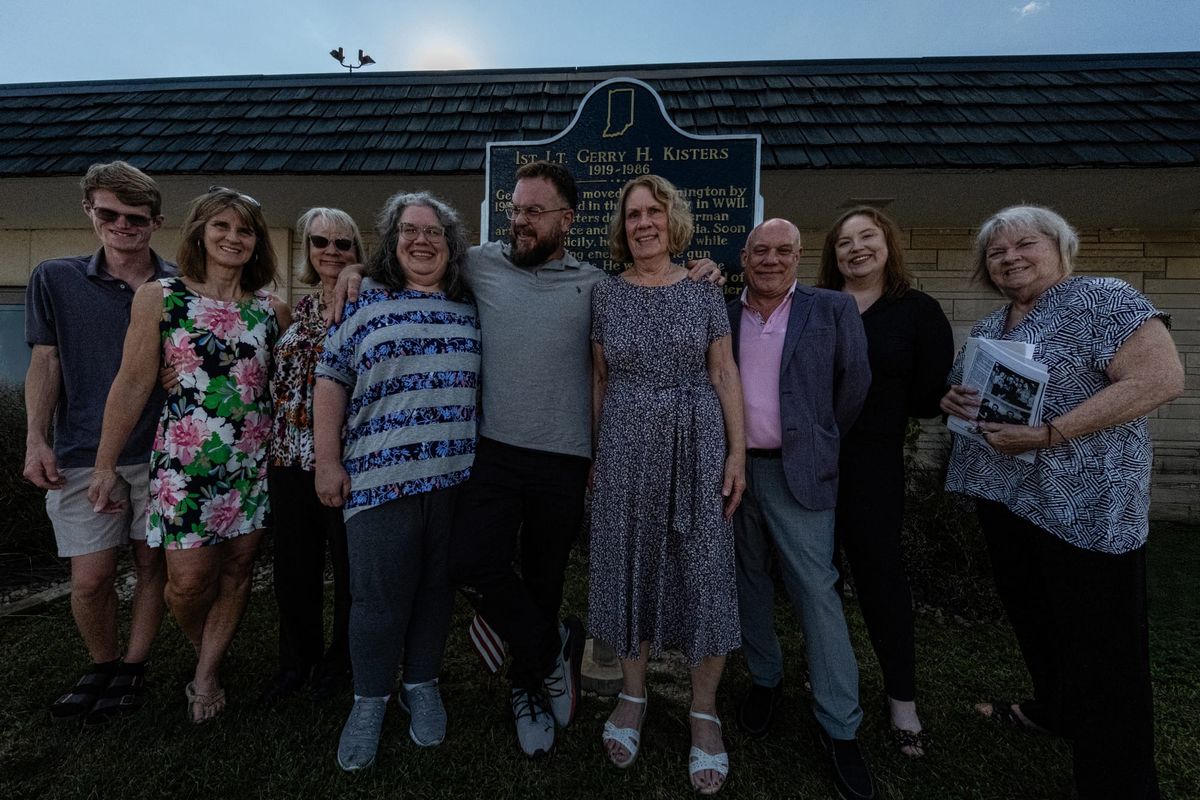
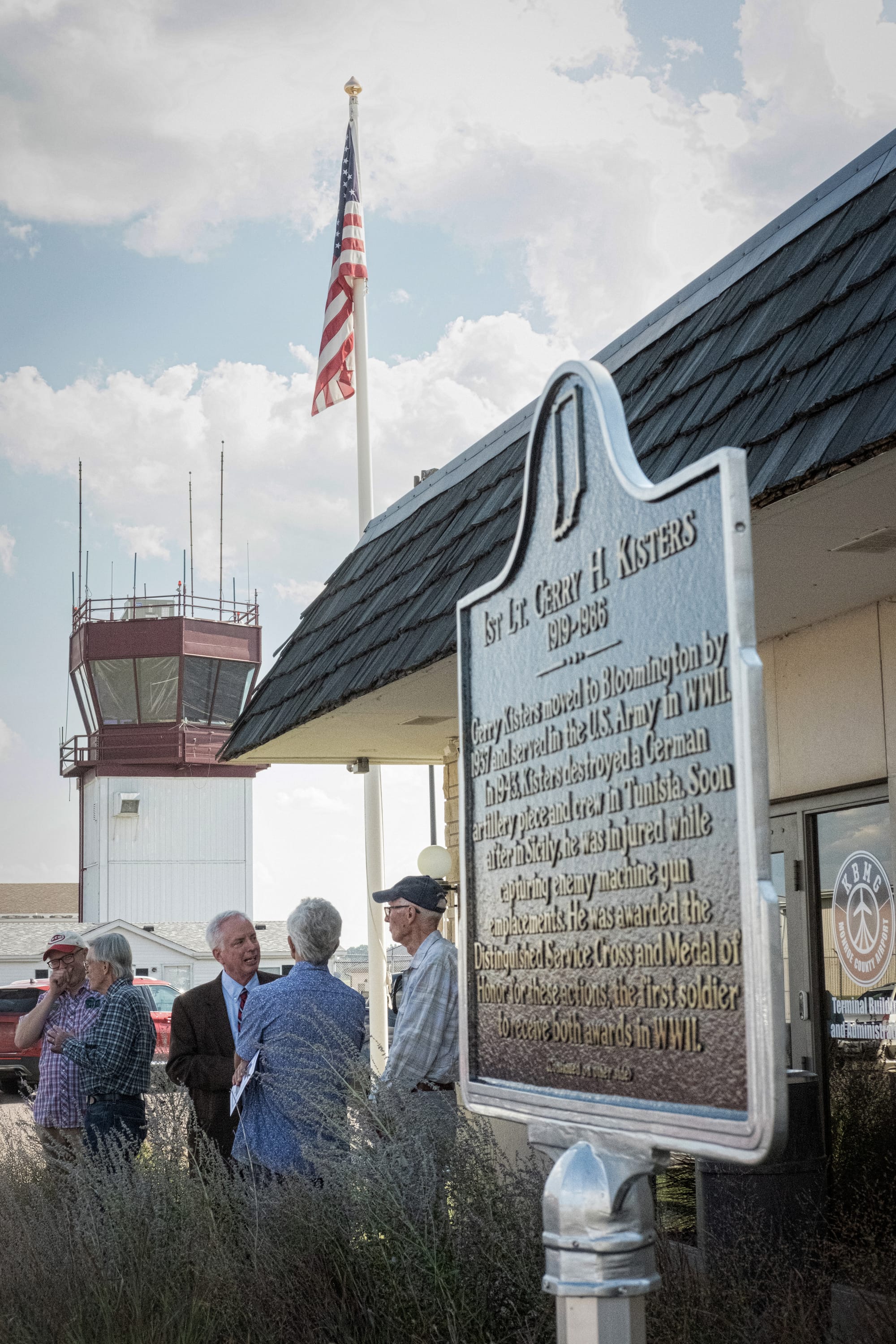
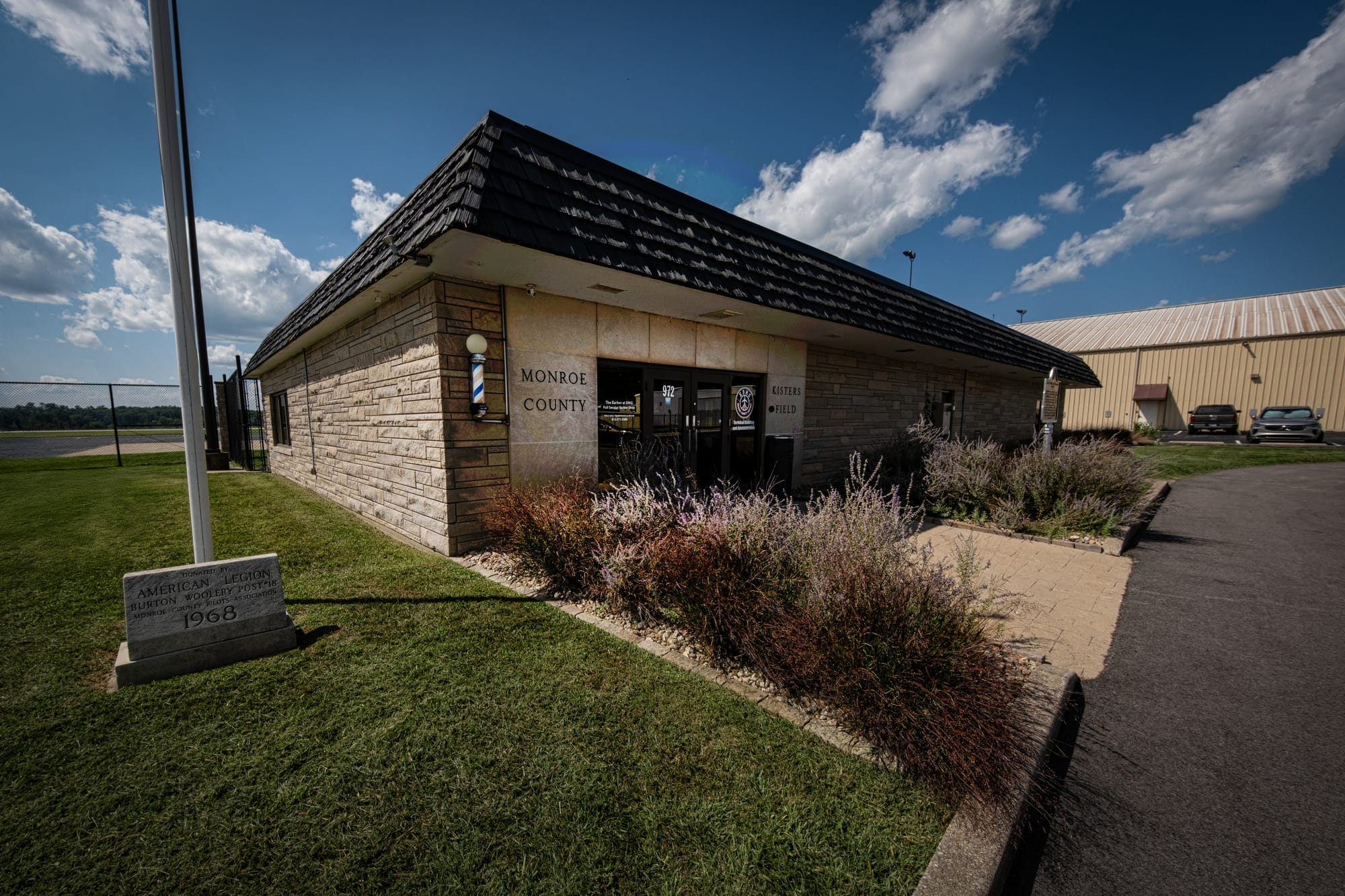
Robertson spoke Friday at the dedication of a state historical marker honoring Kisters. The marker, placed by the Monroe County History Center and the Indiana Historical Bureau, is at the Monroe County Airport, which is officially named Kisters Field.
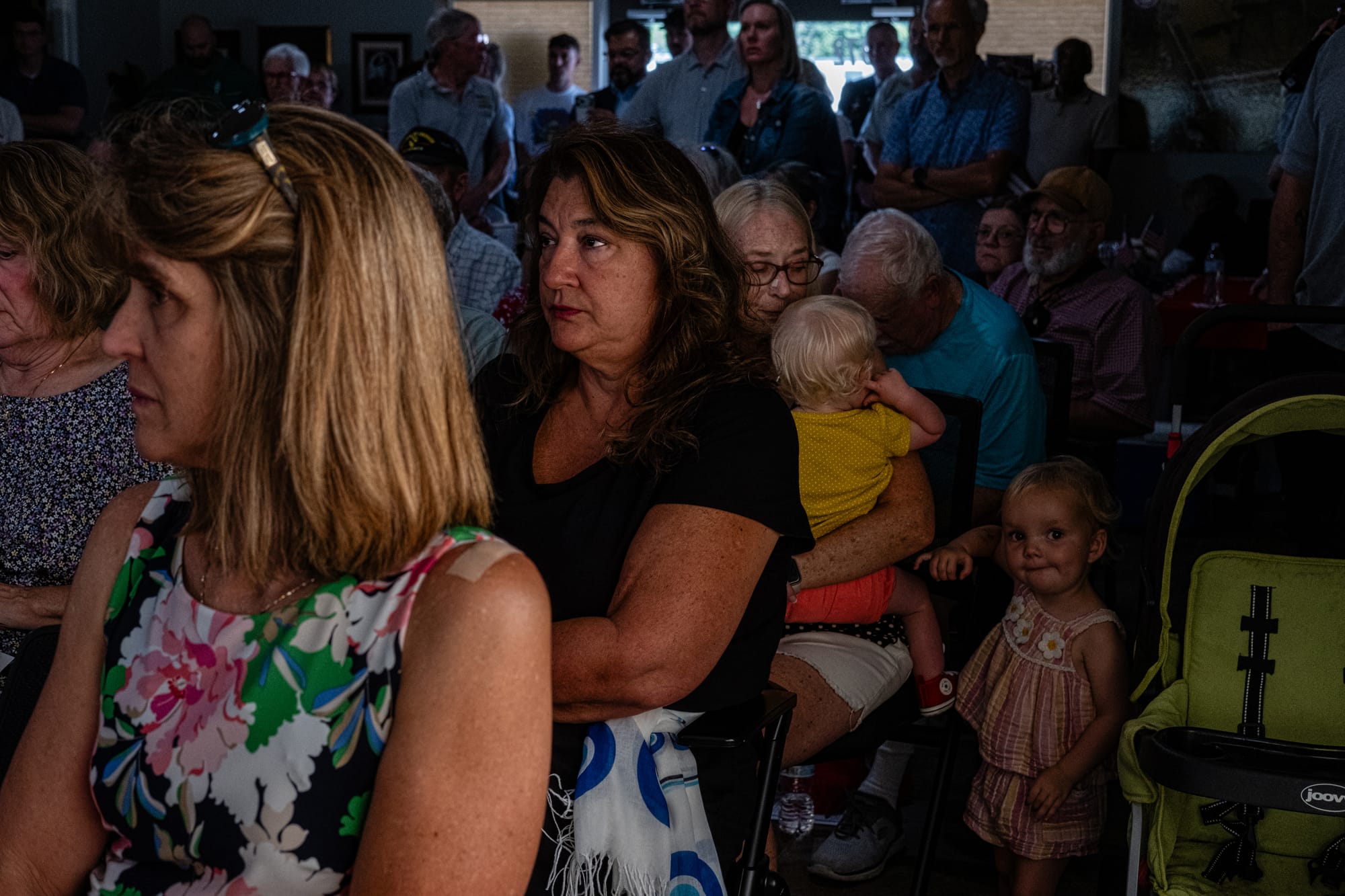
A standing-room-only crowd of about 75 people packed the administration building room for the ceremony. Also speaking were David Nord, the Monroe County historian and a retired Indiana University journalism professor; Nick Cullather, an IU professor who specializes in diplomatic history; and John Summerlot, a local military historian and veterans’ advocate.
Gerry Kisters — pronounced with a hard G, like Gary — was born in Salt Lake City and moved with his family to Indiana, where his father, a German immigrant, would own Kisters’ Furs, selling fur coats, jackets, stoles, and other apparel. He married a local girl, Nola Eads, and seemed destined to take over the family business when World War II called.
Trained in Army reconnaissance, Kisters was sent to the Mediterranean theater, part of Winston Churchill’s strategy to attack the “soft underbelly” of the Axis powers, Cullather said. In May 1943, in Tunisia, he crept forward into a German position under heavy fire. Using his rifle and hand grenades, he took out a German artillery unit, killing its crew members.
Two months later, in Sicily, Kisters and an officer captured an enemy machine gun unit, again under heavy fire. He then crawled forward alone to capture a second machine gun and kill three crew members. He was struck five times by bullets, wounded in both legs and one arm.
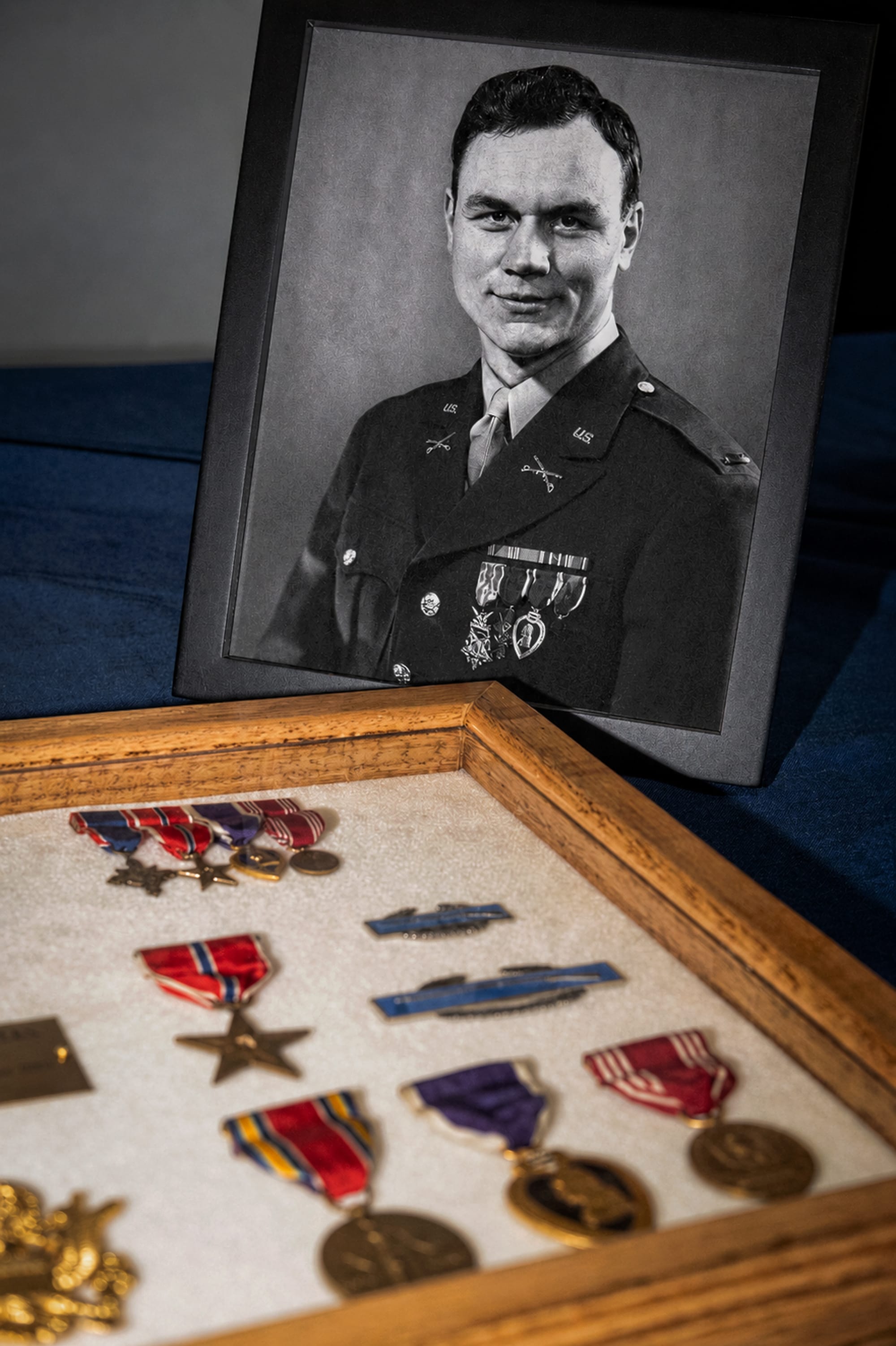
He received the Distinguished Service Cross for his action in Tunisia and the Medal of Honor for what he did in Sicily, becoming the first soldier in the war to win both highest medals. “The courage of this soldier and his unhesitating willingness to sacrifice his life, if necessary, served as an inspiration to the command,” his Medal of Honor citation read.
Both awards were presented February 8, 1944, after the 24-year-old Kisters had returned to the United States. President Franklin Delano Roosevelt presented the Medal of Honor at the White House, and General George Marshall presented the Service Cross at the Pentagon.
“This was big news all over the country. All the papers had this story,” Nord said. They included the New York Times and also the fashion industry publication Women’s Wear Daily; its headline read, “Ex-Fur Man First Soldier to Win 2 High Decorations.”
It was certainly big news in Bloomington, where the local World Telephone carried two front-page stories on the medal presentations. The next weekend, the city hosted a parade and reception on the courthouse square, where a huge crowd gathered despite extreme cold and the worst winter storm of the season. The mayor announced that the airport, under construction, would be named Kisters Field. IU President Herman B Wells made Kisters an honorary I-Man, giving him admission to sports events. The governor and a congressman were there.
“Lt. Kisters smiled and waved his hand,” the newspaper reported. “He appeared to be equally astonished and pleased.”
After the war, Kisters shrugged off his fame. As Summerlot said, he was the quintessential American citizen soldier, following in the footsteps of Revolutionary War patriots who settled in Monroe County as Indiana became a state and the Civil War veterans who made the Grand Army of the Republic a fixture in post-war civic life.
Robertson, the operations manager at the Monroe County History Center, said his uncle didn’t talk about the war: “It was almost as though he kept that part of his life separate from the people who hadn’t been there during those desperate times.”
In civilian life, he said, Kisters was an inveterate collector whose home was filled with rocks, minerals, old newspaper clippings, tools and household items, anything that grabbed his attention. At Christmas and on birthdays, he gave his nephew boxes of rocks and minerals.
He may have treasured his military medals, Robertson said, but “I really think his most prized possession was his coveted piece of fossilized dinosaur excrement that he had scored in a roadside shop somewhere in the Southwest while on one of his rock-hunting trips. To me, at eight years old, this was the most important material possession anyone could own.”
Kisters paid close attention to the natural world, his nephew said, watching birds and insects, gardening, and planting trees. He allegedly even built a rocking chair for the backyard squirrel.
He owned and operated Kisters’ Furs on East 10th Street and lived the life of a quiet businessman. He assisted his wife with a children’s day care center at their home at 10th and Dunn streets. For years, he helped support a mission in Peru that fed and clothed impoverished children. The couple raised three daughters and one son. He died in 1986 at age 67.
Robertson said his uncle probably would have been flattered but uncomfortable to be the subject of a historic marker and a community celebration.
“1st Lieutenant Kisters showed extraordinary courage when the world demanded it of him,” Robertson said. “But the man I knew showed me another kind of courage: the courage to remain kind, generous, and engaged with the world. After seeing so much of what was terrible in the world, he spent the rest of his life paying attention to what was wonderful about it.”
Steve Hinnefeld
Steve Hinnefeld is a journalist and former Herald-Times reporter, IU media relations specialist, and IU Media School instructor. He writes about education at inschoolmatters.wordpress.com and lives in Bloomington with his wife.

Kathryn Coers Rossman
Kathryn Coers Rossman is a proud lifelong Hoosier. Her photographic focus is on authentic, unscripted moments of connection, with particular interest in how sports foster shared identity and community.