Revisiting the Deam: National Recreation Area Key to Protecting Lake Monroe Drinking Water
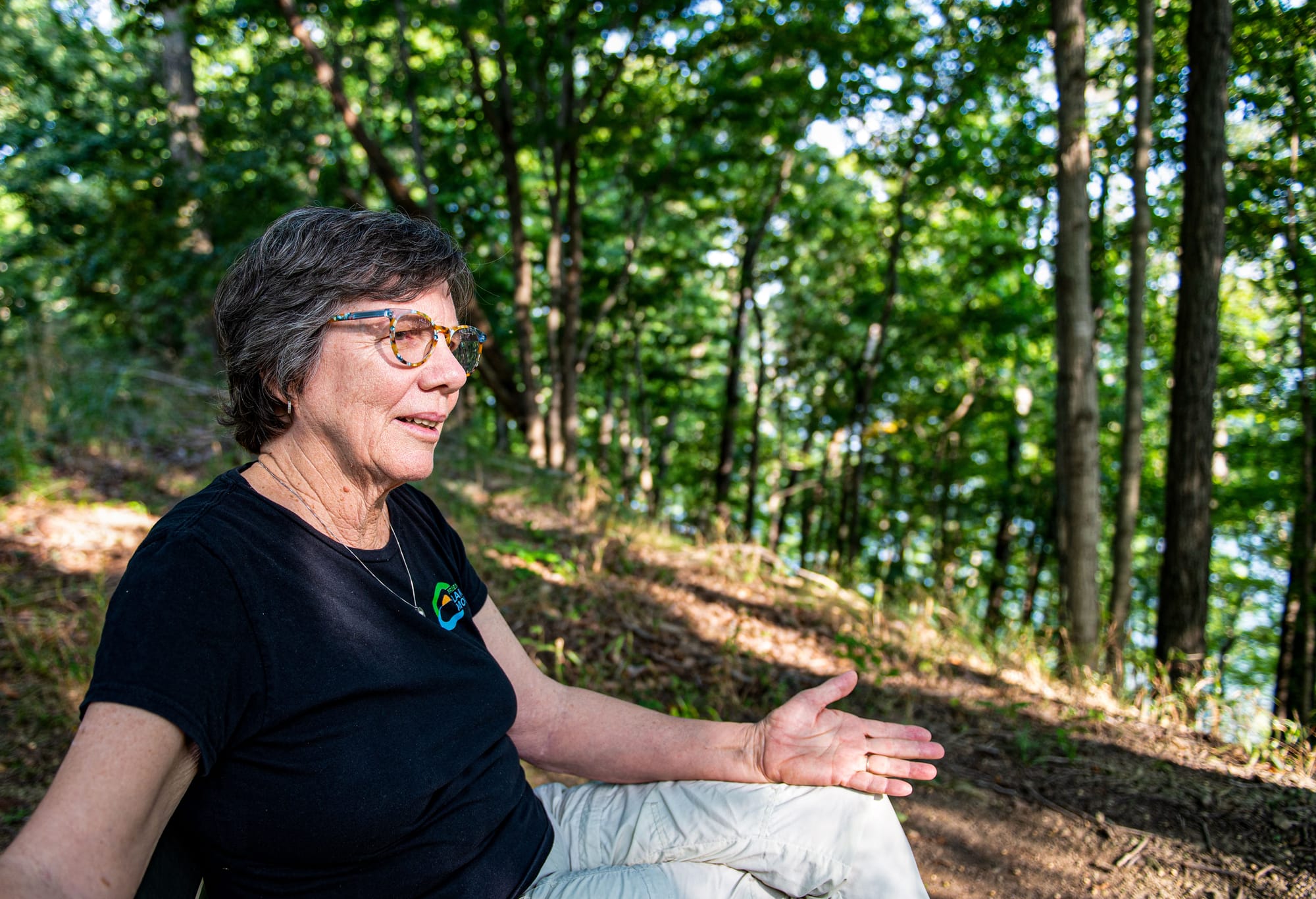
Higgs hikes with Friends of Lake Monroe president, talks importance of protecting watershed.


The seventh installment in a photojournalist’s yearlong return to the wilds.
“Revisiting the Deam” is a series of stories chronicling author and photographer Steven Higgs’s exploration of the Hoosier National Forest as he revisits wilderness areas with friends, colleagues, and experts in the environmental field.
The Deam Wildlands are crucial to Lake Monroe water quality.
So says Sherry Mitchell-Bruker, a PhD hydrologist and president of Friends of Lake Monroe, a nonprofit she started a decade ago that is dedicated to protecting water quality and sustainable recreation on Indiana’s largest lake.
Mature forestland protects waterbodies like Monroe from sedimentation, pollution, and other threats to water quality, which in Monroe’s case means safeguarding the sole source of drinking water for more than 120,000 citizens. The 10,750-acre lake’s watershed is more than 25 times the lake’s size.
“We’re really lucky here with Lake Monroe,” she says on a shaded bench on the Amy Weingartner Branigin Peninsula Trail, “because 82% of the watershed is forestland.”

The 441-square miles of the Lake Monroe watershed where Mitchell-Bruker and I chatted extends in a radius east from the dam in southern Monroe County into Lawrence, Jackson, and Brown. It arcs just across the Bartholomew County line in a couple places and nearly reaches Johnson.
A watershed, or drainage basin, includes all the land that drains into a lake, river, or other waterbody.
The Monroe basin encompasses the entire 90-square-mile Deam Wilderness expansion that Friends of Lake Monroe, the Indiana Forest Alliance, and other environmental groups are urging Congress to establish through the Benjamin Harrison National Recreation Area and Wilderness Establishment Act.
The act would more than double the 12,953-acre Charles C. Deam Wilderness and surround it with a 29,382-acre national recreation area. It is designed in part to protect Lake Monroe water quality.
The expansion act passed the U.S. Senate but died in the U.S. House after it was introduced in the 2023-24 session by Republican Senator Mike Braun. With the now-Indiana governor’s support, wilderness proponents are pushing Southern Indiana’s congressional delegation to reintroduce and pass the bill.
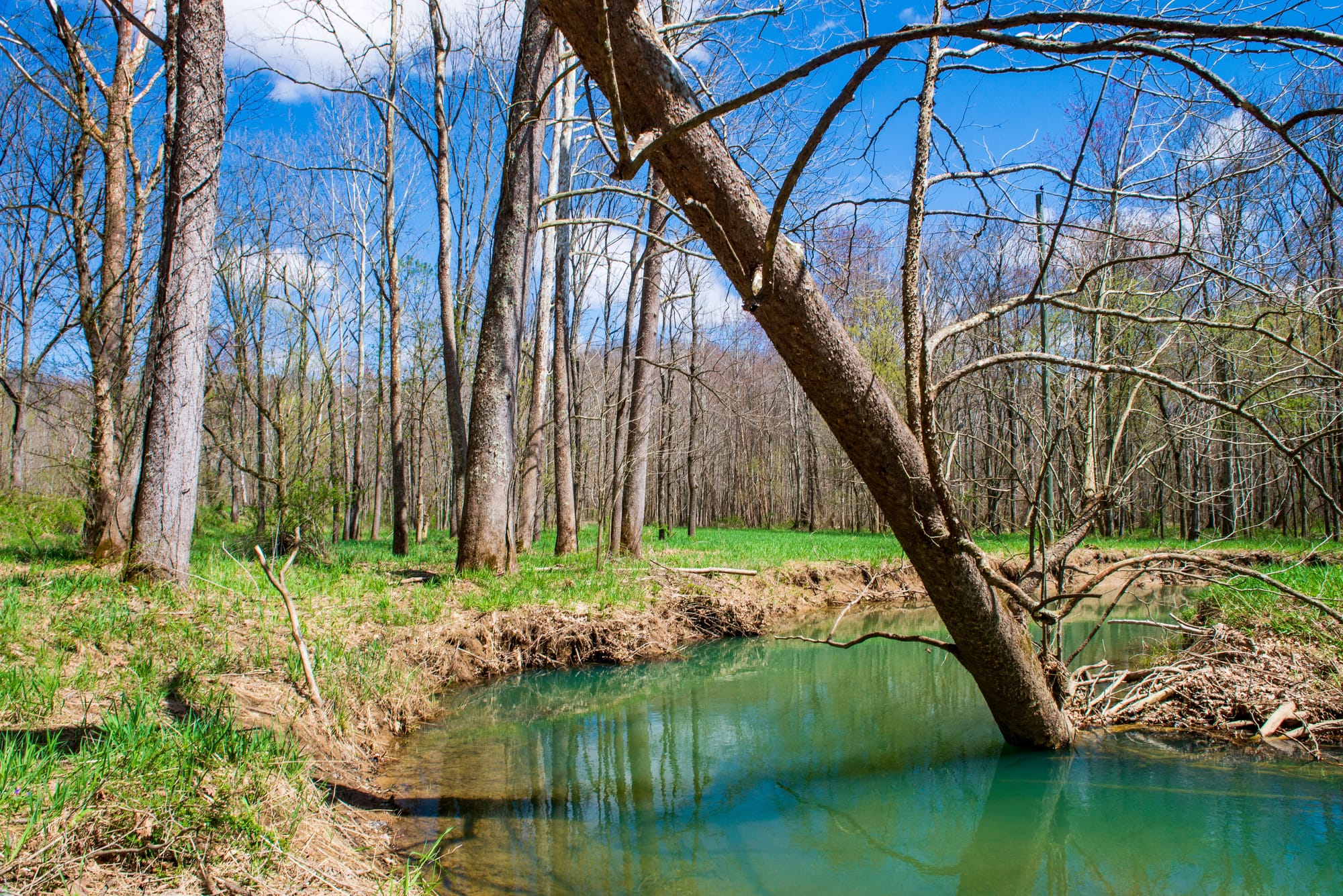
The Monroe Watershed and Deam Wildlands Complex are also contiguous to some 110 square miles of protected upland forest that includes state and federal lands, such as Brown County State Park, Morgan-Monroe and Yellowwood State Forests, and various scout, church, and otherwise privately protected forest reserves.
Friends of Lake Monroe focuses on “the entire watershed,” its president says, all 265,000 acres of it.
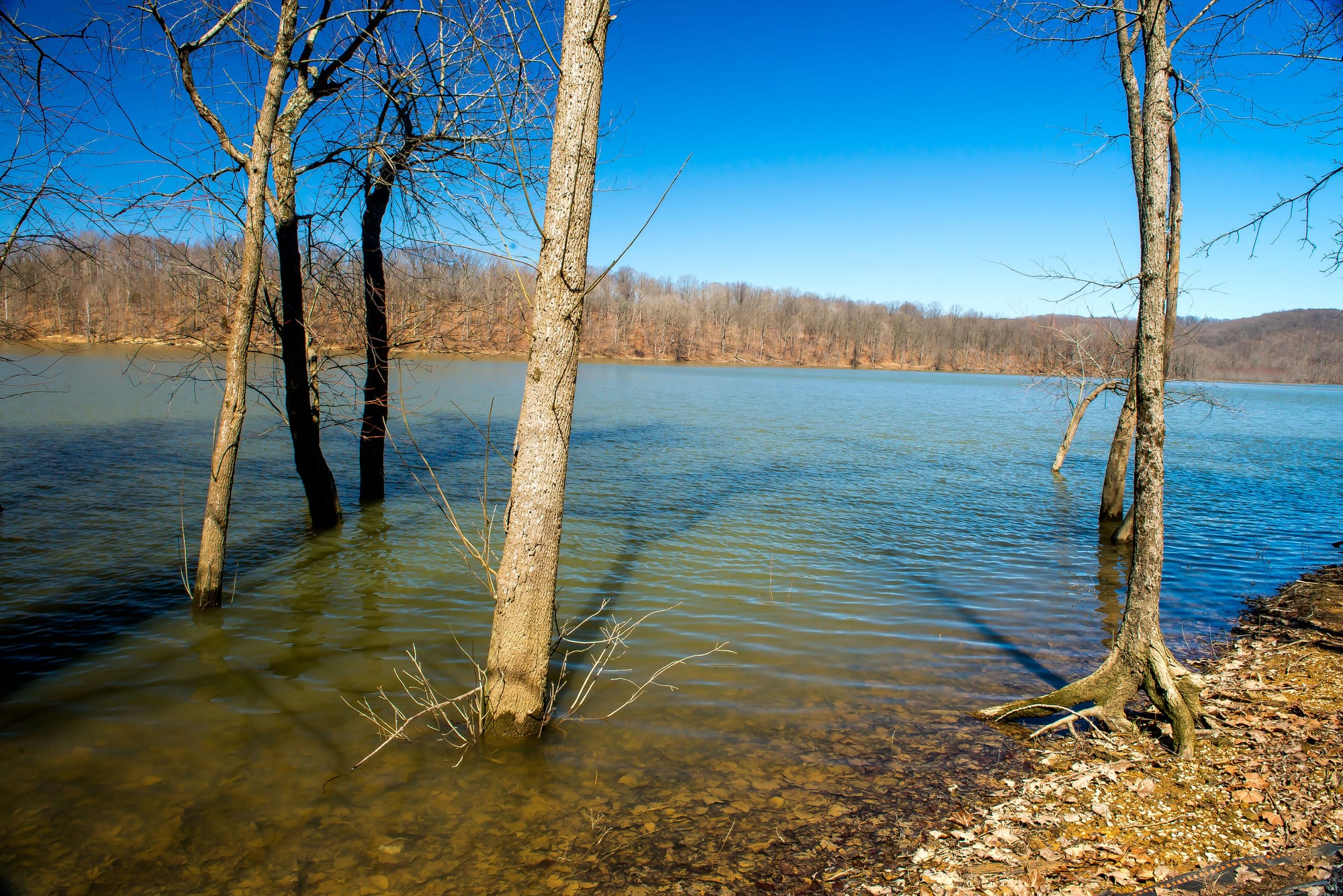
A Louisville native with a doctorate from IU’s School of Public and Environmental Affairs, Mitchell-Bruker says septic systems and agricultural runoff pose the greatest threats to most lakes in Indiana and beyond. But Monroe’s densely forested shorelines mitigate the potential harm.
“On many, many lakes, the land is ringed by homes,” she says, citing Lake Lemon as but one example. “But that is not the case in Lake Monroe, because there’s federal and state land along the edges of the lake.”
And years ago, Monroe County enacted strong ordinances limiting development around the lake – establishing what she calls eco zones – to protect against soil erosion and lake sedimentation.
Standing on the edge of a narrow, wooded ridgetop some 150 feet above the lakeshore, Mitchell-Bruker says the slopes are “extremely steep,” and when homes are built on such landforms, soil runs off into the water.
“Attached to the soil are nutrients that then sink to the bottom of the lake,” she says. “When those are released, they cause algal blooms.”
Algal or algae blooms develop when nutrients like nitrogen and phosphorus in water cause microorganisms to increase rapidly, discolor the water, and under some conditions – blue-green algae especially – can harm aquatic life and humans.
Septic systems and agriculture are significant contributors to nutrient runoff in any watershed, including Monroe’s. But they constitute a smaller role here.
Only 2.2% of the Monroe basin is developed, according to a Lake Monroe Watershed Management Plan Mitchell-Bruker and the Friends of Lake Monroe created and are implementing. And just 7.7% is cropland: 3.5% cultivated crops like corn and soybeans and 4.2% hay and pasture.
“The dominance of forestland means no septics, no agricultural runoff,” she says.
Indeed, all land use in the Monroe watershed affects the lake. Small actions over a large area are funneled into a lake that is 25 times smaller than the watershed itself.
“This has a cumulative impact on the lake, so everyone in the watershed needs to use the land responsibly to improve water quality,” she says. “The biggest landowners are the U.S. Forest Service and Indiana DNR, so they have the capacity to make big improvements or cause big problems.”
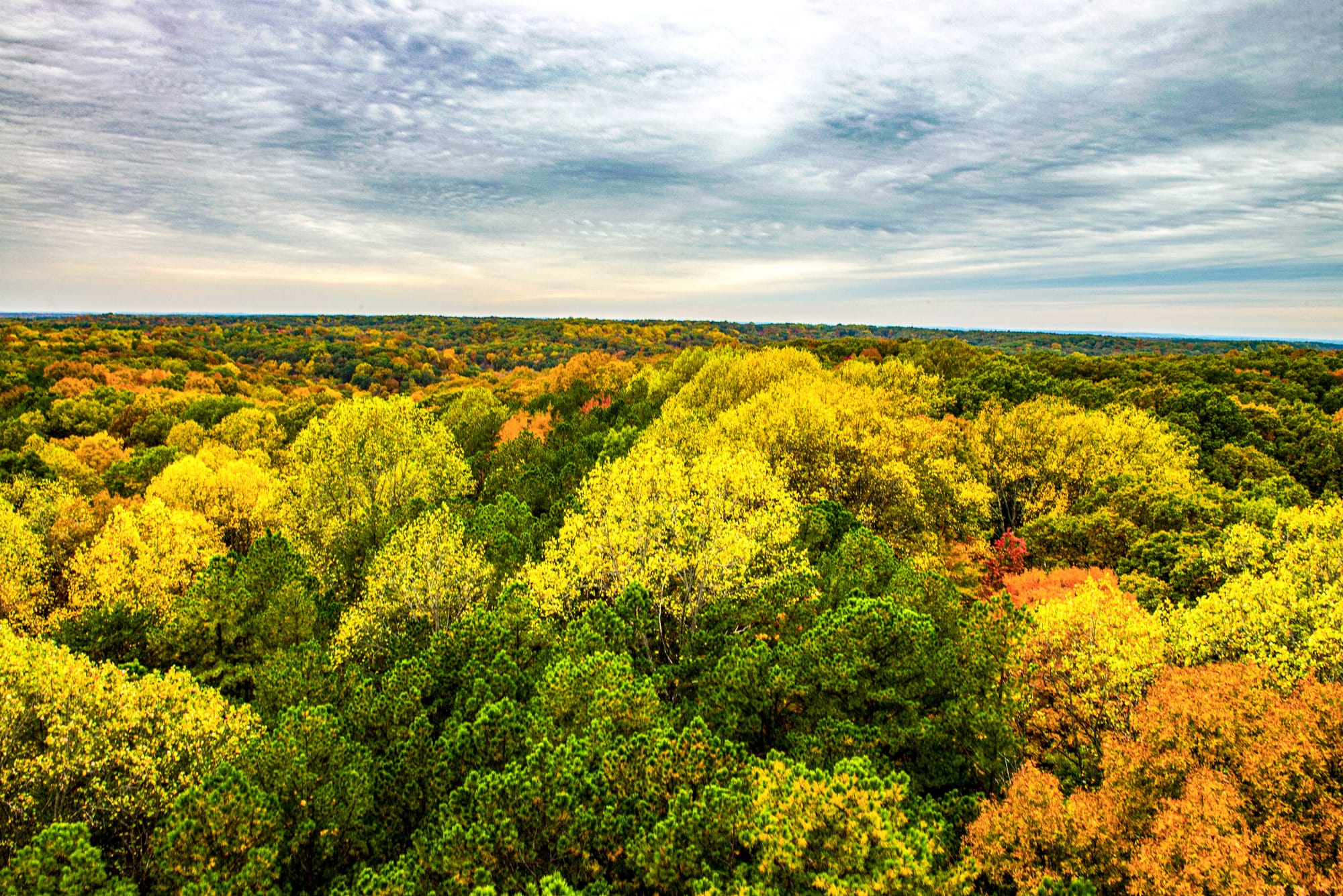
The leaves of the hardwood trees that in early August blocked what in three months will be a spectacular Lake Monroe vista inhibit sedimentation, which can also cause algae blooms and other problems, Mitchell-Bruker says.
Sedimentation is an endemic issue with waterbodies created behind dams, according to the Oak Ridge National Laboratory’s Water Power Program. Soil, along with silt, muck, and organic matter like leaves and twigs, can wash into the water, settle, and accumulate on the bottom.
“Over time, trapped sediment diminishes reservoir capacity, impairs water management, disrupts recreation, and negatively affects downstream ecosystems,” the Oak Ridge site says.
Without its forest cover, the Monroe Watershed’s steep slopes underlain with mostly impermeable siltstone are particularly prone to soil erosion and thus lake sedimentation, Mitchell-Bruker says.
“What happens when rain hits the ground on siltstone?” she asks and answers. “It just runs off.”
But tree roots stabilize the thin soils on the lake’s surrounding ridgetops and hillsides, as well as on the banks of upstream feeders like the three Salt Creek forks that meet on the Deam Wilderness’s lakeshore boundary to form Lake Monroe.
“When trees overhang a feeder stream and shade it,” she says, “that makes it less susceptible to algae and more receptive to fish and other aquatic organisms.”
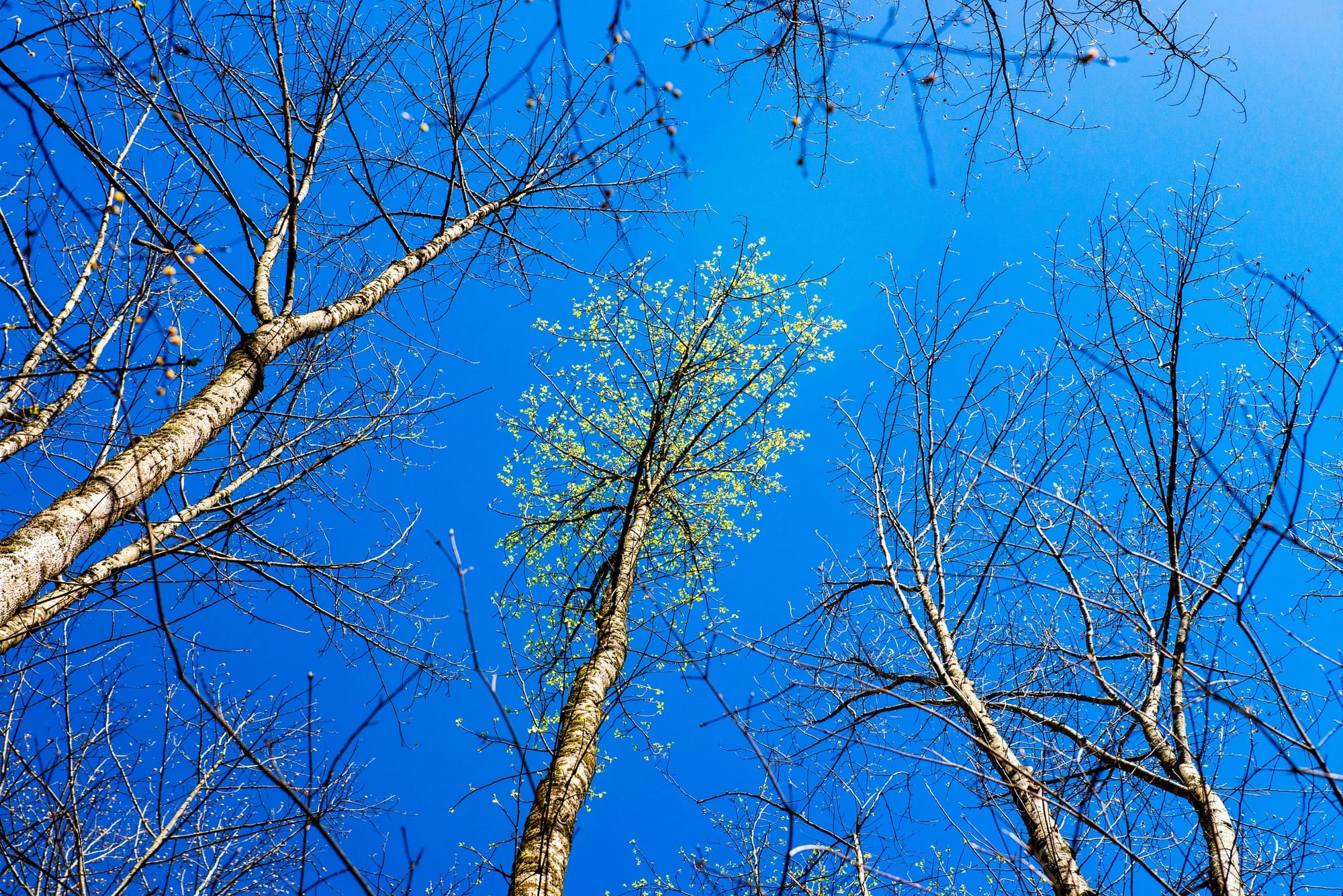
The Deam Wildlands’ unbroken forest cover also helps reduce erosion by catching precipitation before it even reaches the soil, Mitchell-Bruker adds.
“The presence of the tree canopy causes the precipitation to be interrupted so that it doesn’t hit the ground,” she says. “They call that interception.”
The bare limbs of late fall through early spring perform a similarly protective function.
Even if the leaves aren’t on the trees, the branches and bark still intercept precipitation, leading to less impact from rain. “And that means less soil erosion,” she says.
On the trail to the bench, we passed a forest opening created by a downed tree where forest life was re-emerging.
“There was a windstorm and a lot of downed trees,” she explains, “and those downed trees are also helping to prevent erosion and support new growth.”
Mitchell-Bruker comes by her drive to protect water honestly. She grew up in a family of seven kids and developed a passion for nature while living next to a big park and a Kentucky horse farm when she was young.
“I was a lifeguard,” she says. “You know, I just always enjoyed being in the water.”
After earning bachelor’s and master’s degrees in biology and environmental science, she received a doctorate in environmental science at IU, specializing in hydrology. She later spent a decade of public service with the federal government. For the first seven years, Mitchell-Bruker worked on restoration projects on Florida’s Everglades National Park. For the final three, she served as watershed manager and lead hydrologist for Northern California’s Lassen National Forest.
The politics at both were “very tense, very difficult.” Presidential politics are omnipresent in Florida. The national forest sat in the middle of California’s endangered spotted owl territory and the contentious national debate surrounding it.
“They had gotten to the point where all of the logging had basically ground to a halt over this controversy,” she says of the spotted owl.
Since returning to Bloomington more than a decade ago, Mitchell-Bruker has dedicated her passions, experience, and skills to identifying and addressing threats to lake water quality through Friends of Lake Monroe.
One of their focuses is to help upstream landowners cover the cost for restoring riparian areas throughout the watershed.
“When you have agriculture going all the way up to the stream bank,” she says, “whatever happens with erosion from those farm fields, it goes straight into the stream and then carries with it the chemicals and the fertilizers and the nutrients.”
But again, development and agriculture are small pieces of the Lake Monroe Watershed puzzle. It’s what everyone does throughout the watershed that matters.
“That’s one of the reasons why the wilderness, especially the Deam Wilderness expansion and the recreation area, are so important,” she says. “It’s because that’s a huge amount of land.”
If the forest is managed as wilderness, then there won’t be the scale of logging and burning practiced and proposed in the lake watershed by the Forest Service on the Hoosier National Forest lands and by the Indiana Division of Forestry on state forest lands.
Neither will there be any pesticides applied, Mitchell-Bruker says. Spraying, road building, logging, burning, the whole panoply of toxic and extractive activities, are simply not allowed.
“In wilderness, nature decides what happens,” she concludes. “And in my opinion, nature is a lot wiser than we are.”
Steven Higgs
Steven Higgs is a Bloomington journalist, photographer, and author. He's written three books for IU Press on environmental heroism and natural areas of Indiana and taught journalism at IU for 27 years. Read more on his website: StevenHiggs.com.