The Bicentennial, the Semiquincentennial, and the 1916 Pageant of Bloomington
David Nord examines Bloomington’s historical pageant and discusses race and gender in politics.

Historians view civic commemorations such as this year’s Semiquincentennial, the 250th anniversary of the Declaration of Independence, as useful windows on historical eras — not the era commemorated, but the era of the commemoration.
For example, in The Memory of ’76: The Revolution in American History (2024), Michael Hatten describes the American Bicentennial in 1976 as a vivid display of a politically divided America. While in office, President Nixon hoped to use the Bicentennial as a political tool for himself and his party. After his Bicentennial Commission collapsed along with his presidency, national-level planning turned largely commercial. It became what critics called the “buy-centennial,” a ubiquitous “sellabration.”
Meanwhile, a left-leaning People’s Bicentennial Commission (PBC) emerged to organize into Bicentennial activities an alternative vision of how the principles of the Declaration of Independence supported 1970s politics of race and gender. A key aim of the PBC in 1976 was to build into American public history and civic life an appreciation for what we today call diversity, equity, and inclusion (DEI). And they succeeded. The Bicentennial of 1976 was a kind of popularization of DEI values, politics, and policies.
This year’s Semiquincentennial of 1776 also highlights DEI — but in reverse. At the federal level, it is about deleting DEI from public history and civic life. In the leadup to July 4, 2026, President Trump has ordered that “divisive” subjects such as race and gender be removed from national parks’ materials, including an exhibit on 18th-century American slavery at Independence Hall in Philadelphia. He describes the deletion of disturbing subjects such as slavery and racism as “restoring truth and sanity to American history.” Meanwhile, Secretary of Education Linda McMahon is currently leading a “History Rocks!” tour of American schools designed by a coalition of conservative groups to promote a feel-good American history of faith, heritage, and patriotism. No negativity, no DEI.
The long history of historical commemorations tells a similar tale. Some people have always worked to organize certain issues into politics and history; other people have worked to organize them out. As Michael Hatten puts it: “Americans have routinely produced multiple and often contradictory memories of the Revolution. … Consequently, our conflicts over the meaning and legacy of the Revolution have reflected and served as a proxy for many of the most long-running political debates and cultural tensions in American history.”
Even for professional historians, historical memory is always presentist in a sense. We try to perceive the past on its own terms, in its own context. But the past is another country, as historians like to say. And we can’t go there. We can only view it from afar.
In the realm of local history, one of my favorite examples of presentism in historical commemoration is how the Indiana Statehood Centennial in 1916 played out in Bloomington. When I say “play” I mean play as in theater. The Statehood Centennial celebration in Bloomington was an elaborate outdoor pageant, with dialogue, music, dance, and multiple scenes with dozens of local people as actors.
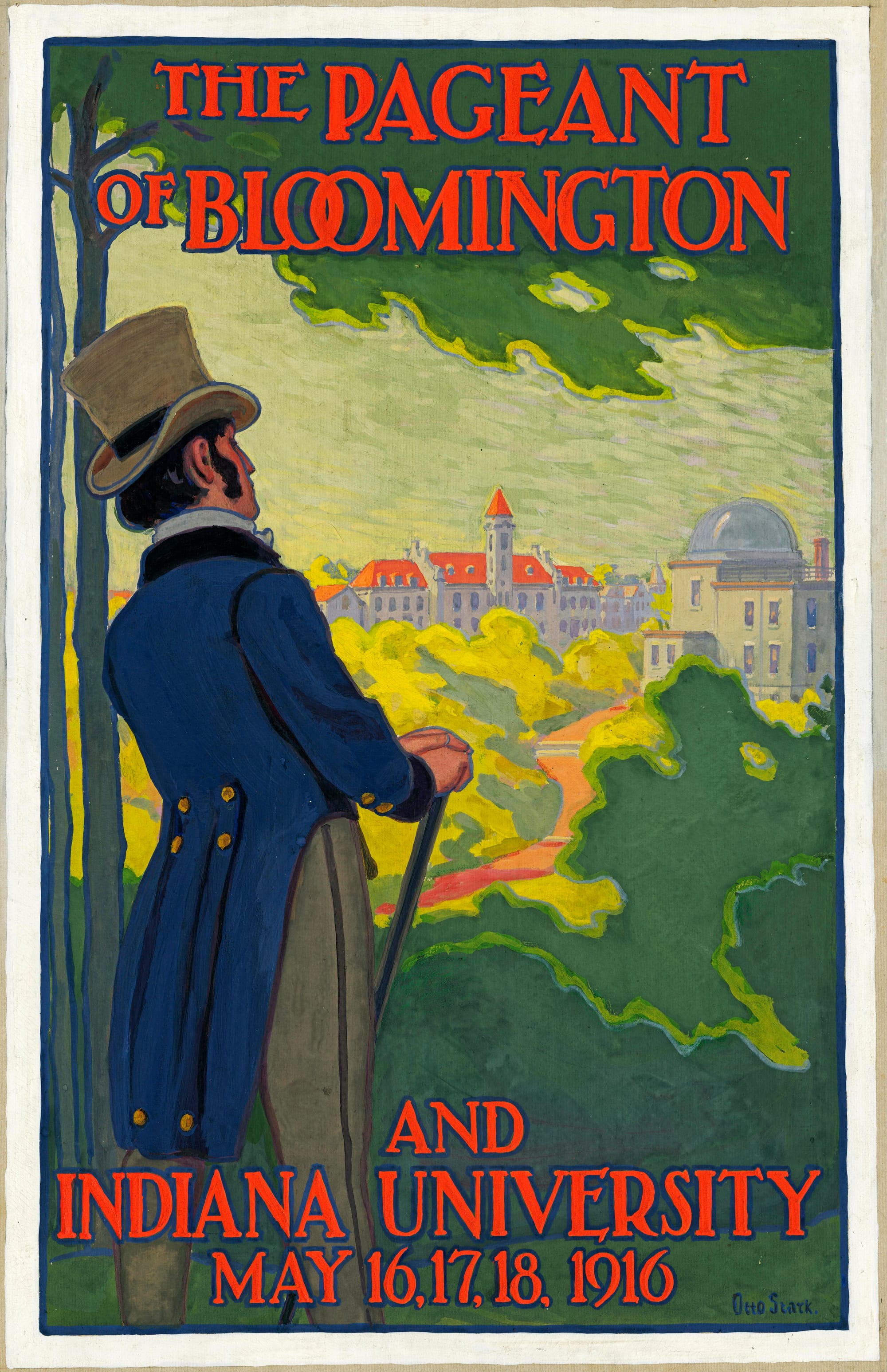
The mere fact that it was a pageant is perhaps the most telling aspect of the celebration. Between about 1905 and 1920, a pageant craze swept through America. Every town, it seemed, wanted a pageant, and pageant associations and “pageant masters” sprang up to help them mount one. The nation’s leading pageant impresario was a philanthropy educator and writer named William Chauncy Langdon. Langdon described his pageants in theatrical terms: “The pageant is a drama in which the place is the hero and the development of the community is the plot.”
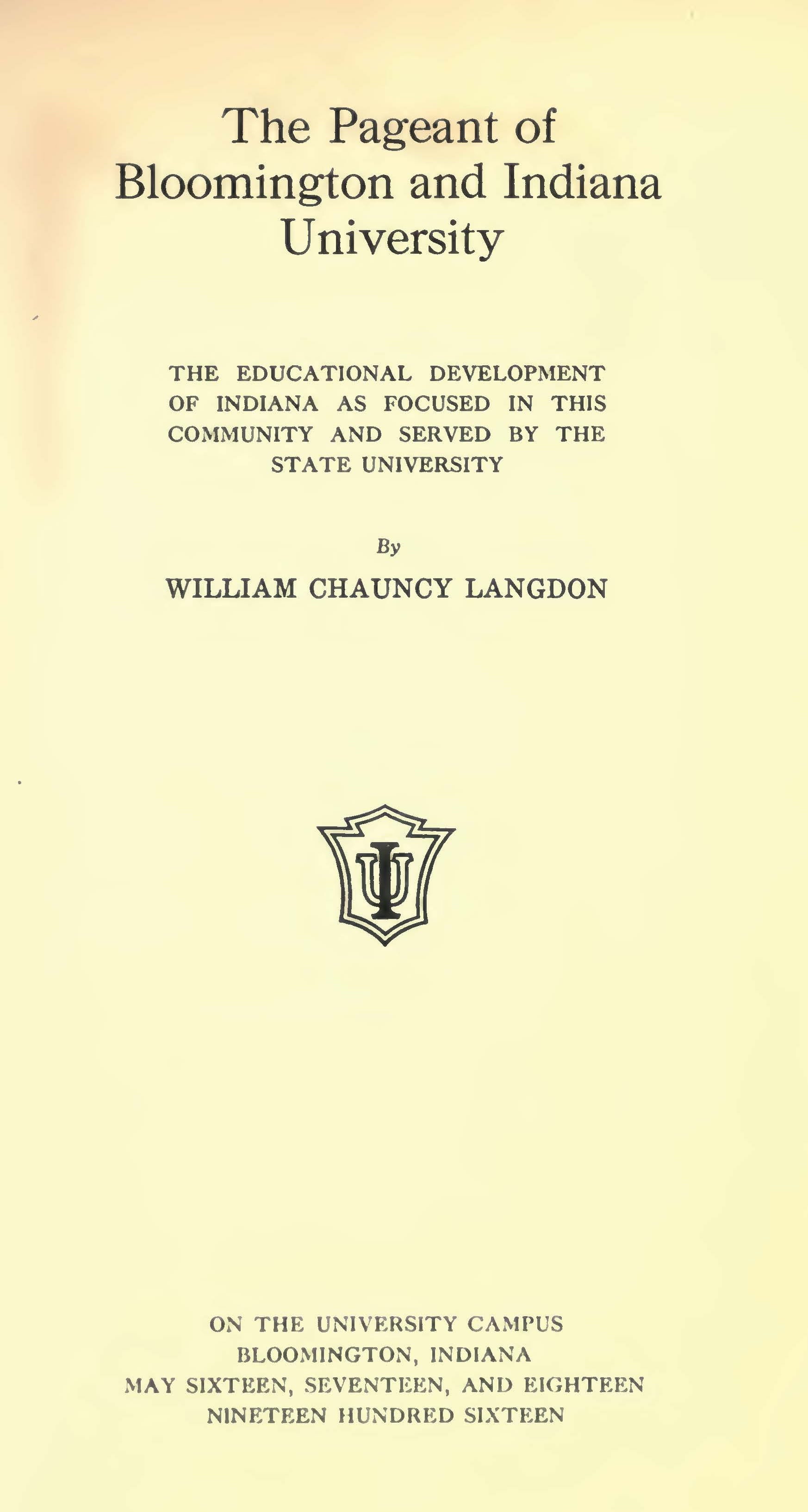
The early 20th century was the so-called Progressive Era, and Langdon was an exemplar of the central values of progressivism: public community, civic progress, and active government wedded to professional expertise. Langdon brought those values to Indiana and Bloomington, which hired him as its pageant master in 1916. Langdon wrote the script, inspired the costumes, music, and choreography, and directed the production.
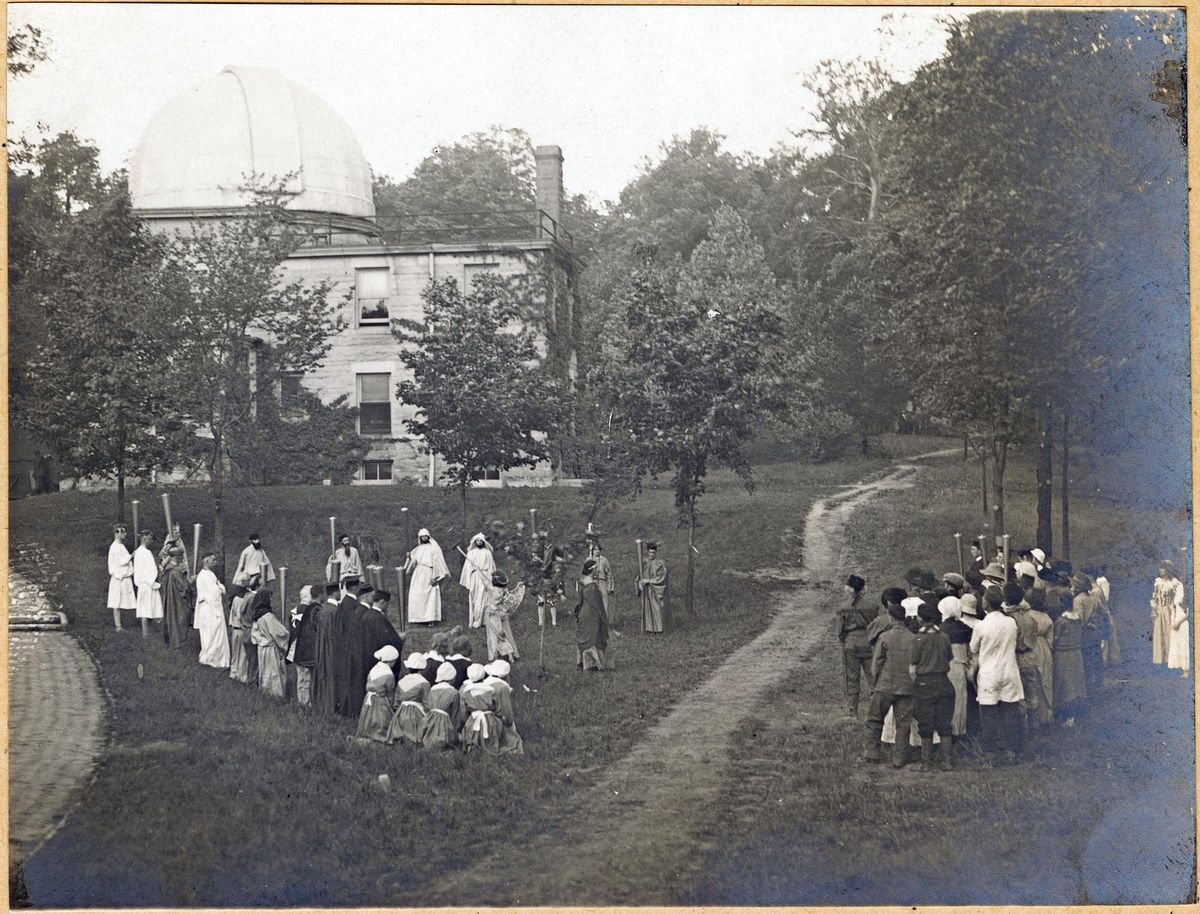
The pageant was staged at Indiana University’s Dunn Meadow and near the Kirkwood Observatory. It unfolded in four Parts with nine Episodes, which ranged across the century after Bloomington’s founding in 1818. Throughout, Langdon built on Progressive-Era themes of public community, civic virtue, and professional expertise.
In Langdon’s published script, titled the Pageant of Bloomington and Indiana University (1916), Episode One is about the original auction of town lots. Although an auction is ostensibly a free market, Bloomington’s community-minded citizens make sure that ordinary people are protected. The widow Brown, for example, is allowed to buy her lot at a fair price, while a greedy “Speculator,” an outsider who was willing to pay more, is driven out of town by a virtuous, democratic mob.
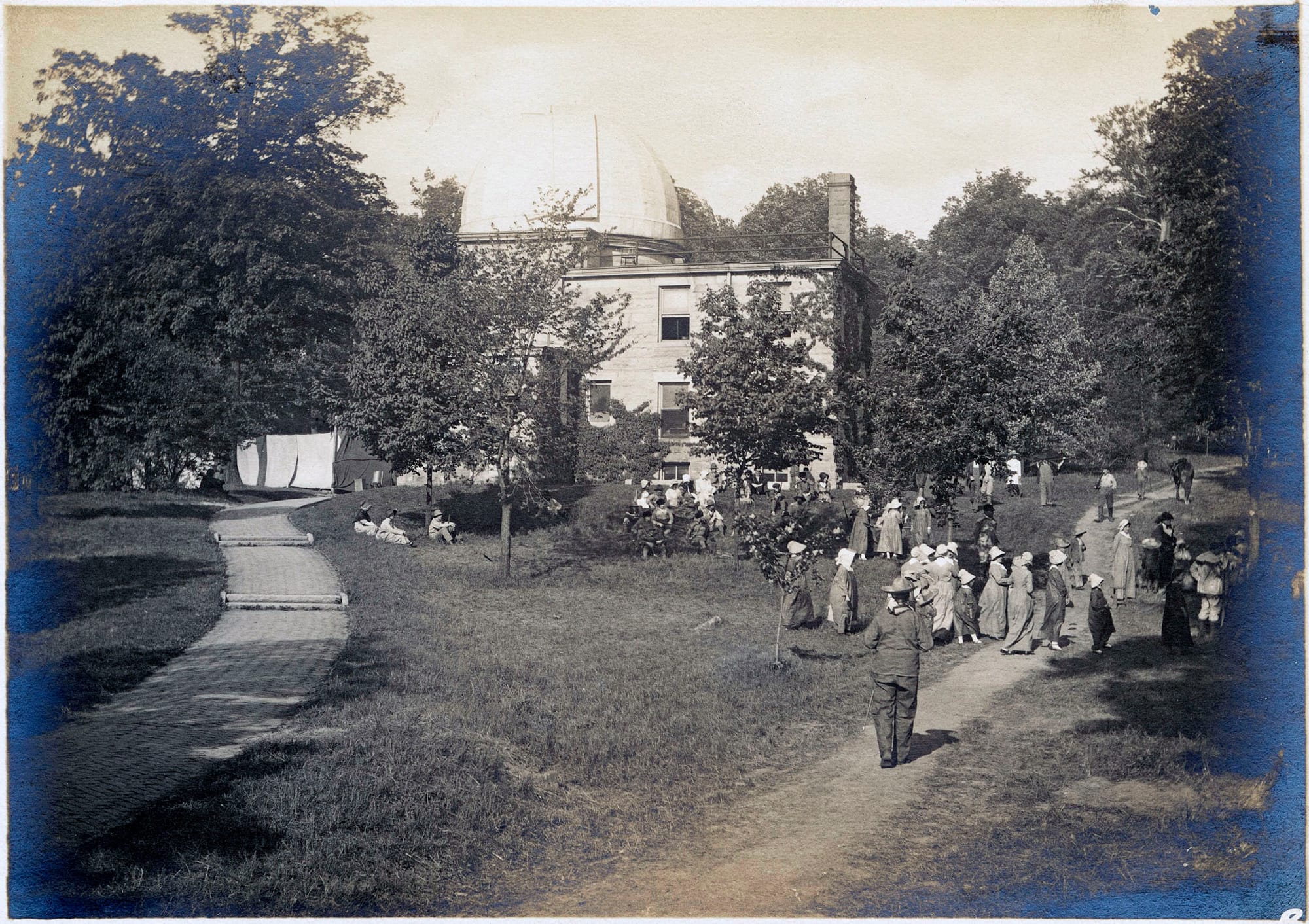
Episode Four is about the State Constitutional Convention of 1850, and Langdon makes this act entirely about tax support for public schools as essential for the “public good.” One of the main speakers is an actor portraying Caleb Mills of Crawfordsville, the father of free public schooling in Indiana.
Episode Seven is also about public schools, with the focus on teachers and teaching. A local backwoodsman is campaigning to be County Superintendent of Schools. He knows nothing about education except “lickin’ an’ larnin’.” Anyone can be a teacher, he says, so hiring teachers is simply about political favoritism. But in the middle of the episode, he hears that his wife has just delivered twins — and he changes tune completely. Suddenly, he wants only well-trained professional teachers for his own children. “This education business is expert work and I won’t stand for anyone monkeying with my children,” he declares.
Episode Eight brings local history up to the present with the founding of the Bloomington Chamber of Commerce in 1915. The new Chamber is portrayed as a kind of voluntary government, a mixture of elite business democracy and professional expertise in service to the public good. This episode includes a chat between two local farmers. One farmer is a grumpy loner, an ignoramus and proud of it. The other farmer is a community joiner, who is seeking and getting modern scientific advice from a Purdue farm agent. Not surprisingly, he is the one who is an enthusiastic member of the new Chamber of Commerce.
Hovering over all of this is the spirit of Indiana University, sometimes literally embodied in the “figure of the University.” The University is the apotheosis of progressivism: a bastion of “lux et veritas” (light and truth), with roots in the truths of antiquity and the light of modern science, and supported by the state government for the public good.
Although the pageant format — with its staged scenes, costumes, music, dance, and embodied spirits — disappeared in the decades after 1916, organizers of local historical commemorations have preserved many of the Progressive-Era themes of active government, civic community and progress, modern science, and professional expertise.
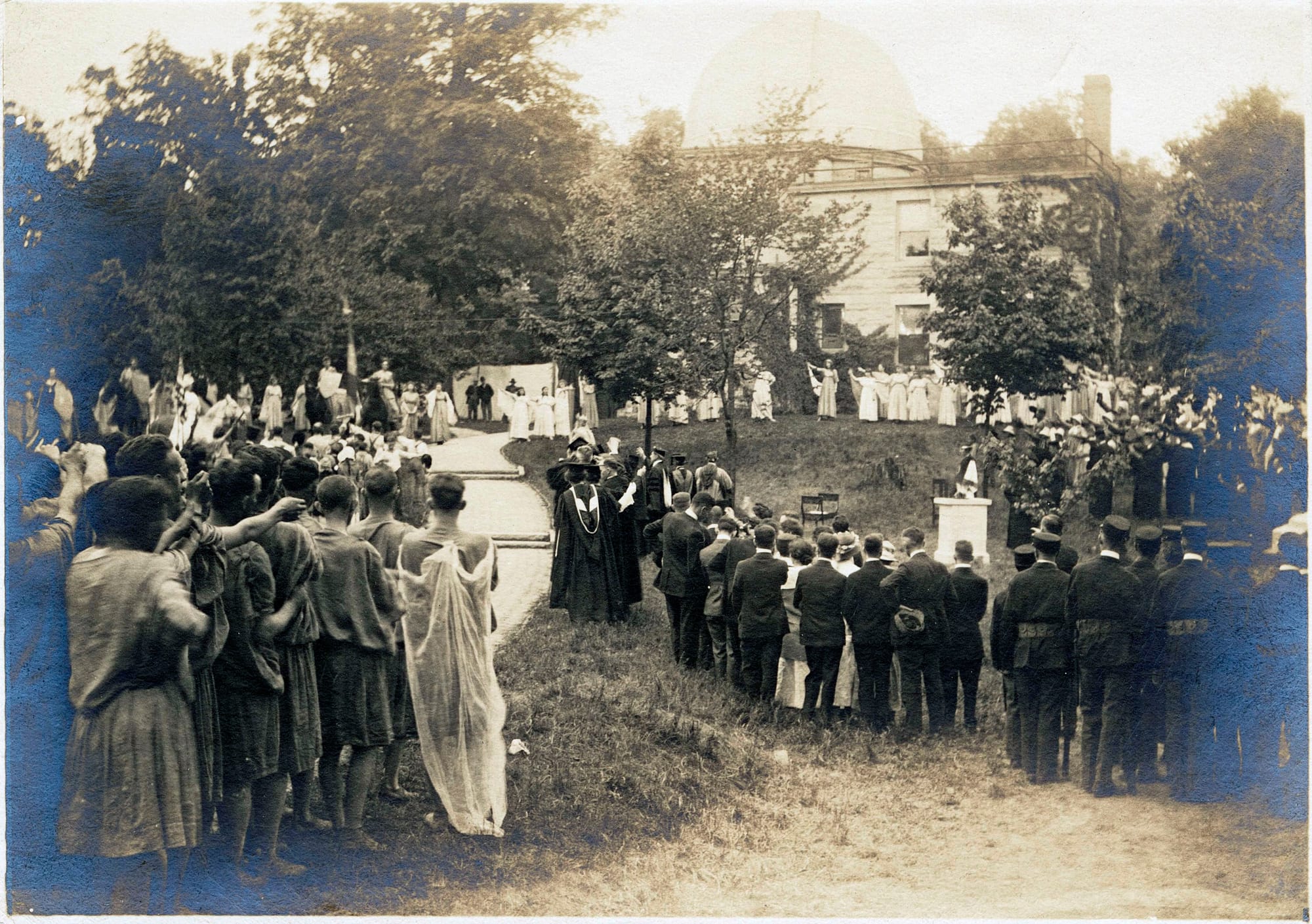
But the past is past, and in some ways the Progressive Era was very different from our own time. For example, in historic commemorations of that era, including the Pageant of Bloomington, DEI was not an issue because most white people did not imagine minorities as bona fide members of the civic community. African Americans were absent from the Bloomington pageant, except for several runaway slaves in Episode Five, who were being spirited through town by white abolitionists with slave-catchers in pursuit. They were silent; they had no dialogue or agency; they were on their way to somewhere else. Although Indians were native to the land, they were portrayed in the pageant’s introductory scene as marauding, murderous, tomahawk-wielding savages attacking the virtuous Bloomington Pioneers. In an exciting crescendo, the “Spirits of Hope and Determination” rush to protect the sturdy pioneer families, who drive off the Indians. The Indians quickly disappear forever, as “the orchestra swings full and strong into the Hymn to Indiana.”
In 1916 no one tried to organize DEI out of the celebration, because no one had organized DEI into it.
David Nord is a professor emeritus at IU. He is a former Associate Editor and Interim Editor of the Journal of American History. His academic field of research was the history of American journalism and publishing. In retirement, he holds the volunteer position of Monroe County Historian, an appointment by the Indiana Historical Society and the Monroe County History Center.
David Nord
David Nord is a professor emeritus at IU. He is a former Associate Editor and Interim Editor of the Journal of American History. In retirement, he holds the volunteer position of Monroe County Historian.